Dysrhythmia Worksheet for UTA N4581: ECG Interpretation Gu
Dysrhythmia Worksheet
(Disclaimer – use these rules for UTA N4581 only. Exceptions abound in real world
--Answers can be found within the power point)
SA node rate: AV node rate: Purkinjie fibers rate:
Define the terms:
Depolarization
Repolarization
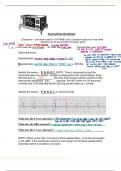
Identify the waves -- P, Q, R, S, T. NOTE: Time is measured across the
horizontal plane (not tested –voltage is measured on the vertical plane). Each
little bitty box is seconds. Each big box (which contains 5 little
bitty boxes) represents seconds. We don’t think in 0.04 seconds –
consider that 1500 little bitty boxes (300 big boxes) make up 1 minute!
Identify the waves -- P, Q, R, S, T, on the ECG strip.
What does the P wave represent? =
What does the QRS represent?=
What does the T wave represent? =
NOTE: Where is the “blip” or bump for atrial repolarization → buried somewhere
in the QRS → the ventricular muscle is much larger so the atrial repolarization
wave/blip (which is smaller) is not seen.
Dysrhythmia Worksheet for UTA N4581: ECG Interpretation Guide
, Dysrhythmia Worksheet for UTA N4581: ECG Interpretation Gu
…then measure the PRI and QRS and calculate the heart rate.
PRI measures . The purpose of the PRI:
1.
2.
QRS measures =
Rate =
Rhythm =
In summary --- ECG Interpretation- A Recipe for Success.
a. Are P waves upright? Yes – the impulse most likely originated in the SA
node – first name of your rhythm = sinus.
b. Is there a P wave before each QRS and a QRS for every P wave? No,
consider a block.
c. What is the P-R interval (PRI = should be named PQ interval)? Normal
PR Interval: 0.12 to 0.20 sec.
d. What is the width of the QRS? Normal QRS: ≤ 0.12 sec. If narrow, your
rhythm’s first name shall be atrial. If wide, your rhythm’s first name shall
be ventricular.
e. What is the Rate?
Rate: Less than 60 = brady Greater than 100 = tachy
e.1. easy way = count the R waves and multiply by 10. Works if you have
6 second strip (6 sec strip X 10 R = HR in one minute).
e.2. Not sure you have a 6 sec strip. Count small squares between R
waves and divide into 1500 (1500 small squares = 1 minute of time).
f. Regular or Irregular?
g. What is the Rhythm?
Follow the above steps for every rhythm you interpret.
Dysrhythmia Worksheet for UTA N4581: ECG Interpretation Guide
Dysrhythmia Worksheet
(Disclaimer – use these rules for UTA N4581 only. Exceptions abound in real world
--Answers can be found within the power point)
SA node rate: AV node rate: Purkinjie fibers rate:
Define the terms:
Depolarization
Repolarization
Identify the waves -- P, Q, R, S, T. NOTE: Time is measured across the
horizontal plane (not tested –voltage is measured on the vertical plane). Each
little bitty box is seconds. Each big box (which contains 5 little
bitty boxes) represents seconds. We don’t think in 0.04 seconds –
consider that 1500 little bitty boxes (300 big boxes) make up 1 minute!
Identify the waves -- P, Q, R, S, T, on the ECG strip.
What does the P wave represent? =
What does the QRS represent?=
What does the T wave represent? =
NOTE: Where is the “blip” or bump for atrial repolarization → buried somewhere
in the QRS → the ventricular muscle is much larger so the atrial repolarization
wave/blip (which is smaller) is not seen.
Dysrhythmia Worksheet for UTA N4581: ECG Interpretation Guide
, Dysrhythmia Worksheet for UTA N4581: ECG Interpretation Gu
…then measure the PRI and QRS and calculate the heart rate.
PRI measures . The purpose of the PRI:
1.
2.
QRS measures =
Rate =
Rhythm =
In summary --- ECG Interpretation- A Recipe for Success.
a. Are P waves upright? Yes – the impulse most likely originated in the SA
node – first name of your rhythm = sinus.
b. Is there a P wave before each QRS and a QRS for every P wave? No,
consider a block.
c. What is the P-R interval (PRI = should be named PQ interval)? Normal
PR Interval: 0.12 to 0.20 sec.
d. What is the width of the QRS? Normal QRS: ≤ 0.12 sec. If narrow, your
rhythm’s first name shall be atrial. If wide, your rhythm’s first name shall
be ventricular.
e. What is the Rate?
Rate: Less than 60 = brady Greater than 100 = tachy
e.1. easy way = count the R waves and multiply by 10. Works if you have
6 second strip (6 sec strip X 10 R = HR in one minute).
e.2. Not sure you have a 6 sec strip. Count small squares between R
waves and divide into 1500 (1500 small squares = 1 minute of time).
f. Regular or Irregular?
g. What is the Rhythm?
Follow the above steps for every rhythm you interpret.
Dysrhythmia Worksheet for UTA N4581: ECG Interpretation Guide