
NBCOT OTA COMPLETE STUDY GUIDE TEST.
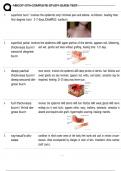
1. superficial burn// involves the epidermis only! minimal pain and edema. no blisters. healing time:
first degree burn 3-7 days.EXAMPLE: sunburn
2. superficial partial involves the epidermis AND upper portion of the dermis. appears red, blistering,
thickness burn// and wet. painful and heals without grafting. healing time: 7-21 days.
second degree
burn
3. deep partial more severe. involves the epidermis AND deep portion of dermis. hair follicles and
thickness burn// sweat glands are also involved. appears red, white, and elastic. sensation may be
deep second de- impaired. healing: 21-35 days.may leave scar.
gree burn
4. full thickness involves the epidermis AND dermis AND hair follicles AND sweat glands AND nerve
burn// third de- endings (so it wont hurt). appears white, waxy, leathery, nonelastic. sensation is
gree burn absent and requires skin graft. hypertrophic scarring. healing: months.
5. raynaud's dis- condition in which some areas of the body feel numb and cool in certain circum-
ease stances. often accompanied by changes in color of skin. treatment: dress warmer
(self care).
, NBCOT OTA COMPLETE STUDY GUIDE TEST.
6. cryotherapy commonly used to treat acute injuries, like an ankle sprain, and post surgical
repairs, like total knee replacement. it is indicated for spasticity to decrease
abnormal tone.
7. skier's thumb condition of rupture of the ulnar collaeral ligament of the MCP joint of the thumb.
usually the result og a fall while skiing with the thumb held in a ski pole, or a
similar injury.
8. de quervain's cululative trauma disorder in which stenosing tenosynovitis of the abductor polli-
syndrome cis longuss and extensor pollicis brevis results in pain and swelling over the radial
styloid.
9. rood 4 sequential 1. reciprocal inhibition/ innervation 2. co-contraction 3. heavy work 4. skill
phases of motor
control
10. rood phase 1- an early mobility pattern that is primarily a reflex governed by the spinal and supra
reciprocal inhibi- spinal centers.
tion/ innervation
phase
, NBCOT OTA COMPLETE STUDY GUIDE TEST.
11. rood phase 2- a simultaneous contraction of the agonist and the antagonist that provides stabil-
co-contraction ity in a static position, and is used to hold a position or object for a long duration
12. rood phase 3- proximal muscles contract and move while the distal segments are fixed. this is
heavy work also termed mobility superimposed on stability
13. rood phase 4-
skill
14. A fibers large, myelinated fast-conducting nerve fibers
15. delta nerve fibers carry pain, temperature, and touch signals
16. gamma nerve carry motor signals to muscle spindles
fibers
17. beta nerve fibers carry touch and pressure signals
18. alpha nerve carry somatic motor signals and proprioception
fibers
19. shoulder disartic- loss of the entire upper extremety
ulation
20. forequarter am- loss of clavicle, the scapula, and the entire upper extremity
putation
, NBCOT OTA COMPLETE STUDY GUIDE TEST.
21. above- elbow above the elbow at any level on the upper arm
amputation
22. elbow disarticu- amputation of the upper extremity distal to the elbow joint
lation
23. overhead sus- type of supportive orthoses. it incorporates an arm support that is placed in a sling
pension sling and suspended by an overhead rod. people with proximal weakness with muscle
grades in the 1-3 (of 5) range are appropriate candidates.
24. rood cone cone shaped splint used to reduce flexor spasticity of the hand
25. spasticity reduc- places the spastic distal extremity on submaximal stretch to reduce spasticity
tion splint


