NUR 4402 EKG Rhythm Strip Template and Nursing Implications
NUR 4402 Nursing Implications for Dysrhythmias
EKG Packet
Instructions- Systematic review of the EKG strip is a must and doing that systematic review with every
EKG strip will help. Use the underlying rhythm to determine regularity, intervals and rates.
• Look at the rhythm- Is it regular, irregular, look at the P-P and the R-R.
• Measure your intervals. PR interval, QRS interval and QT interval are measured in seconds
• Look at the P waves, are they present, are they upright in Lead II, absent, inverted or hidden.
• Measure the atrial rate and the ventricular rate, then the heart rate. They will normally be the
same. Except in heart blocks, ventricular standstill, atrial fibrillation and atrial flutter.
• Interpretation, put what you think the rhythm is showing. See example below.
• Treatments if any, what treatments are expected.
• If you are unable to determine (UTD) a measurement or interval or P wave or rates, you may put
UTD
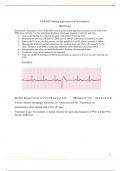
EXAMPLE
Rhythm: Regular (except for PVC) PR Interval: 0.20 QRS Interval: 0.10 QT Interval: 0.36
P waves: Present and upright Atrial rate: 66 Ventricular rate: 66 Heart Rate: 66
Interpretation: Sinus rhythm with 1 PVC (4th beat)
Treatment, if any: No treatment is needed. Monitor for increasing frequency of PVC or if the PVCs
become multifocal.
1
NUR 4402 EKG Rhythm Strip Template and Nursing Implications
, 1.
Rhythm: PR Interval: QRS Interval: QT Interval:
P waves: Atrial rate: Ventricular rate: Heart Rate:
Interpretation:
Treatment, if any:
2.
Rhythm: PR Interval: QRS Interval: QT Interval:
P waves: Atrial rate: Ventricular rate: Heart Rate:
Interpretation:
Treatment, if any:
2
, 3.
Rhythm: PR Interval: QRS Interval: QT Interval:
P waves: Atrial rate: Ventricular rate: Heart Rate:
Interpretation:
Treatment, if any:
4.
Rhythm: PR Interval: QRS Interval: QT Interval:
P waves: Atrial rate: Ventricular rate: Heart Rate:
Interpretation:
Treatment, if any:
3
NUR 4402 Nursing Implications for Dysrhythmias
EKG Packet
Instructions- Systematic review of the EKG strip is a must and doing that systematic review with every
EKG strip will help. Use the underlying rhythm to determine regularity, intervals and rates.
• Look at the rhythm- Is it regular, irregular, look at the P-P and the R-R.
• Measure your intervals. PR interval, QRS interval and QT interval are measured in seconds
• Look at the P waves, are they present, are they upright in Lead II, absent, inverted or hidden.
• Measure the atrial rate and the ventricular rate, then the heart rate. They will normally be the
same. Except in heart blocks, ventricular standstill, atrial fibrillation and atrial flutter.
• Interpretation, put what you think the rhythm is showing. See example below.
• Treatments if any, what treatments are expected.
• If you are unable to determine (UTD) a measurement or interval or P wave or rates, you may put
UTD
EXAMPLE
Rhythm: Regular (except for PVC) PR Interval: 0.20 QRS Interval: 0.10 QT Interval: 0.36
P waves: Present and upright Atrial rate: 66 Ventricular rate: 66 Heart Rate: 66
Interpretation: Sinus rhythm with 1 PVC (4th beat)
Treatment, if any: No treatment is needed. Monitor for increasing frequency of PVC or if the PVCs
become multifocal.
1
NUR 4402 EKG Rhythm Strip Template and Nursing Implications
, 1.
Rhythm: PR Interval: QRS Interval: QT Interval:
P waves: Atrial rate: Ventricular rate: Heart Rate:
Interpretation:
Treatment, if any:
2.
Rhythm: PR Interval: QRS Interval: QT Interval:
P waves: Atrial rate: Ventricular rate: Heart Rate:
Interpretation:
Treatment, if any:
2
, 3.
Rhythm: PR Interval: QRS Interval: QT Interval:
P waves: Atrial rate: Ventricular rate: Heart Rate:
Interpretation:
Treatment, if any:
4.
Rhythm: PR Interval: QRS Interval: QT Interval:
P waves: Atrial rate: Ventricular rate: Heart Rate:
Interpretation:
Treatment, if any:
3