
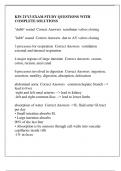
KIN 2YY3 EXAM STUDY QUESTIONS WITH
COMPLETE SOLUTIONS
"dubb" sound Correct Answers semilunar valves closing
"lubb" sound Correct Answers due to AV valves closing
3 processes for respiration Correct Answers ventilation
external and internal respiration
4 major regions of large intestine Correct Answers cecum,
colon, rectum, anal canal
6 processes involved in digestion Correct Answers ingestion,
secretion, motility, digestion, absorption, defecation
abdominal aorta Correct Answers -common hepatic branch -->
lead to liver
-right and left renal arteries --> lead to kidney
-left and right common iliac --> lead to lower limbs
absorption of water Correct Answers • 9L fluid enter GI tract
per day
• Small intestine absorbs 8L
• Large intestine absorbs
90% of the last liter
• Absorption is by osmosis through cell walls into vascular
capillaries inside villi
-1% in feces
,Accessory organs Correct Answers -teeth, tongue, gallbladder,
pancreas, liver
-mainly chemical digestion
-teeth and tongue mechanical digestion
Acini cells (pancreas) Correct Answers Exocrine cells
Secrete pancreatic juice
active transport Correct Answers -ATP dependent
Na+/K+ ATPase
ADH Correct Answers -increases water permeability of
principal cells by facultative water reabsorption
-insertion of aquaporin-2 channels in the membrane
-when osmolarity of plasma and interstitial fluid increases, more
ADH is secretes and facultative water reabsorption increases
adrenal glands Correct Answers -sits on top of kidney
-releases hormones part of fight or flight reposes (aldosterone)
Afterload Correct Answers pressure the contracting ventricles
must produce to overcome the pressure in the aorta and move
blood into the aorta
airway resistance Correct Answers -bronchioles reduced
resistance during inhalation, increased resistance during
exhalation
-SNS (NE) - reduced resistance
-PNS (ACh)- increased resistance
Albumins Correct Answers -58% of plasma
,-osmotic pressure, transport fatty acids, bilirubin, thyroid
hormones
alveolar sac Correct Answers where majority of gas exchange
happens
alveolar ventilation Correct Answers volume of air available
for gas exchange/minute
Va = tidal volume - anatomic dead space x respiratory rate
anal canal Correct Answers last 2-3cm of GI tract
stratified squamous
anal columns Correct Answers small longitudinal folds in the
anal canal
arteries and veins
if veins are enlarged they are hemmoroids
anastomoses Correct Answers provide alternate routes if one
artery is blocked
anatomic dead space Correct Answers formed by nasal cavity,
pharynx, larynx, trachea, bronchi, bronchioles, terminal
bronchioles
-no gas exchange
Anatomy of Female Urethra Correct Answers -4cm long;
between clitoris and vagina
-mucosa and muscularis
-stratified columnar to pseudo stratified columnar. But becomes
stratified squamous near the orifice
, -circular smooth muscle
anatomy of male urethra Correct Answers -20cm long; mucosa
and muscularis
-prostatic urethra: transitional epithelium which becomes
stratified columnar to pseudo stratified columnar
-intermediate urehtra: stratified columnar to pseudo stratified
columnar
-spongy urehtra: stratified columnar to pseudo stratified
columnar. But becomes stratified squamous near the end
-male urehtra carries sperm
Anatomy of Pituitary Gland Correct Answers anterior lobe
(adenohypophysis)
-makes up 75% of the weight
-secretes 7 hormones
posterior pituitary (neurohypophysis)
-made of neural tissue
-releases 2 hormones made by hypothalamus
anatomy of ureters Correct Answers -25-30cm long
-1-10 mm in diameter
-retroperitoneal
-renal pelvis to bladder
-enters posterior wall of bladder
-psychiological valve only (flow depends on pressure, gravity
and peristalsis)
angiotensin II Correct Answers -decreases GFR -
vasoconstriction of afferent arterioles
COMPLETE SOLUTIONS
"dubb" sound Correct Answers semilunar valves closing
"lubb" sound Correct Answers due to AV valves closing
3 processes for respiration Correct Answers ventilation
external and internal respiration
4 major regions of large intestine Correct Answers cecum,
colon, rectum, anal canal
6 processes involved in digestion Correct Answers ingestion,
secretion, motility, digestion, absorption, defecation
abdominal aorta Correct Answers -common hepatic branch -->
lead to liver
-right and left renal arteries --> lead to kidney
-left and right common iliac --> lead to lower limbs
absorption of water Correct Answers • 9L fluid enter GI tract
per day
• Small intestine absorbs 8L
• Large intestine absorbs
90% of the last liter
• Absorption is by osmosis through cell walls into vascular
capillaries inside villi
-1% in feces
,Accessory organs Correct Answers -teeth, tongue, gallbladder,
pancreas, liver
-mainly chemical digestion
-teeth and tongue mechanical digestion
Acini cells (pancreas) Correct Answers Exocrine cells
Secrete pancreatic juice
active transport Correct Answers -ATP dependent
Na+/K+ ATPase
ADH Correct Answers -increases water permeability of
principal cells by facultative water reabsorption
-insertion of aquaporin-2 channels in the membrane
-when osmolarity of plasma and interstitial fluid increases, more
ADH is secretes and facultative water reabsorption increases
adrenal glands Correct Answers -sits on top of kidney
-releases hormones part of fight or flight reposes (aldosterone)
Afterload Correct Answers pressure the contracting ventricles
must produce to overcome the pressure in the aorta and move
blood into the aorta
airway resistance Correct Answers -bronchioles reduced
resistance during inhalation, increased resistance during
exhalation
-SNS (NE) - reduced resistance
-PNS (ACh)- increased resistance
Albumins Correct Answers -58% of plasma
,-osmotic pressure, transport fatty acids, bilirubin, thyroid
hormones
alveolar sac Correct Answers where majority of gas exchange
happens
alveolar ventilation Correct Answers volume of air available
for gas exchange/minute
Va = tidal volume - anatomic dead space x respiratory rate
anal canal Correct Answers last 2-3cm of GI tract
stratified squamous
anal columns Correct Answers small longitudinal folds in the
anal canal
arteries and veins
if veins are enlarged they are hemmoroids
anastomoses Correct Answers provide alternate routes if one
artery is blocked
anatomic dead space Correct Answers formed by nasal cavity,
pharynx, larynx, trachea, bronchi, bronchioles, terminal
bronchioles
-no gas exchange
Anatomy of Female Urethra Correct Answers -4cm long;
between clitoris and vagina
-mucosa and muscularis
-stratified columnar to pseudo stratified columnar. But becomes
stratified squamous near the orifice
, -circular smooth muscle
anatomy of male urethra Correct Answers -20cm long; mucosa
and muscularis
-prostatic urethra: transitional epithelium which becomes
stratified columnar to pseudo stratified columnar
-intermediate urehtra: stratified columnar to pseudo stratified
columnar
-spongy urehtra: stratified columnar to pseudo stratified
columnar. But becomes stratified squamous near the end
-male urehtra carries sperm
Anatomy of Pituitary Gland Correct Answers anterior lobe
(adenohypophysis)
-makes up 75% of the weight
-secretes 7 hormones
posterior pituitary (neurohypophysis)
-made of neural tissue
-releases 2 hormones made by hypothalamus
anatomy of ureters Correct Answers -25-30cm long
-1-10 mm in diameter
-retroperitoneal
-renal pelvis to bladder
-enters posterior wall of bladder
-psychiological valve only (flow depends on pressure, gravity
and peristalsis)
angiotensin II Correct Answers -decreases GFR -
vasoconstriction of afferent arterioles


