
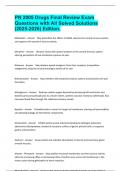
PN 2005 Drugs Final Review Exam
Questions with All Solved Solutions
(2025-2026) Edition.
Midazolam - Answer May potentiate the effects of GABA, depress the central nervous system,
and suppress the spread of seizure activity.
Morphine - Answer Uknown. Binds with opioid receptors in the central feverous system,
altering perceptions of and emotional response to pain.
Naloxone - Answer May displace opioid analgesics from their receptors (competitive
antagonism); drug has no pharmacologic activity of its own.
Nitrofurantoin - Answer May interfere with bacterial enzymes systems and bacterial cell-wall
formation.
Nitroglycerin - Answer Reduces cardiac oxygen demand by decreasing left ventricular end-
diastolic pressure (preload) and, to a lesser extent, systemic vascular resistance (afterload). Also
increases blood flow through the collateral coronary vessels.
Nystatin - Answer Probably binds to sterols in fungal cell membrane, altering cell permeability
and allowing leakage of intercellular components.
Omeprazole - Answer Inhibits proton pump activity by binding to hydrogen-potassium
adenosine triphosphatase, located at secretory surface of gastric parietal cells, to suppress
gastric acid secretion.
Oxytocin - Answer Cause potent and selective stimulation of uterine and mammary gland
smooth muscles.
Dilantin - Phenytoin - Answer May stabilize neuronal membranes and limit seizure activity
either by increasing efflux or decreasing influx of sodium ions across cell membranes in the
motor cortex during generation of nerve impulses.
, Prednisone - Answer Not clearly defined. Decreases inflammation, mainly by stabilizing
leukocyte lysosomal membranes; suppresses immune response; stimulates bone marrow; and
influences protein, fat, and carbohydrate metabolism.
Propranolol Hydrochloride - Answer Reduces cardio oxygen demand by blocking
catecholamine-induced increases in HR, BP and force of myocardial contraction. Drug depresses
renin secretion and prevents vasodilation of cerebral arteries.
Pseudoephedrine Hydrochloride - Answer Acts on alpha-adrenergic receptors in the mucosa of
the respiratory tract, producing vasoconstriction.
Psyllium (Metamucil) - Answer mucilage is to absorb excess water while stimulating normal
bowel elimination
Quetiapine Fumarate - Answer Blocks dopamine and serotonin 5-HT2a receptors. Its action
may be mediated through this antagonism.
Altace - Ramipril - Answer Prevents conversion of angiotensin 1 to angiotensin 2, a potent
vasoconstrictor. Less angiotensin 2 decrease peripheral arterial resistance, decreasing
aldosterone secretion, which reduces sodium and water retention and lowers blood pressure.
Ranitidine Hydrochloride - Answer Competitively inhibits action of histamine at H2 - receptor
sites of parietal cells, decreasing gastric acid secretion.
Risperidone - Answer Blocks dopamine, 5-HT2, alpha1 and alpha 2 adrenergic, and H1
histaminergic receptors in the brain
Senokot (Senna) - Answer Works by irritating and stimulating intestinal cells, producing
contractions in intestines, water influx to the intestines and bowel movements.
Seroquel - Answer Antagonist for D2 receptors and 5-HT2 receptors. Blocks 5HT1A, 5-HT2, D1,
D2, H1, A1 and A2 receptors. Doesn't act on cholinergic or benzodiazepine receptors.
Sertraline Hydrochloride - Answer Thought to be linked to drug's inhibition of central nervous
Questions with All Solved Solutions
(2025-2026) Edition.
Midazolam - Answer May potentiate the effects of GABA, depress the central nervous system,
and suppress the spread of seizure activity.
Morphine - Answer Uknown. Binds with opioid receptors in the central feverous system,
altering perceptions of and emotional response to pain.
Naloxone - Answer May displace opioid analgesics from their receptors (competitive
antagonism); drug has no pharmacologic activity of its own.
Nitrofurantoin - Answer May interfere with bacterial enzymes systems and bacterial cell-wall
formation.
Nitroglycerin - Answer Reduces cardiac oxygen demand by decreasing left ventricular end-
diastolic pressure (preload) and, to a lesser extent, systemic vascular resistance (afterload). Also
increases blood flow through the collateral coronary vessels.
Nystatin - Answer Probably binds to sterols in fungal cell membrane, altering cell permeability
and allowing leakage of intercellular components.
Omeprazole - Answer Inhibits proton pump activity by binding to hydrogen-potassium
adenosine triphosphatase, located at secretory surface of gastric parietal cells, to suppress
gastric acid secretion.
Oxytocin - Answer Cause potent and selective stimulation of uterine and mammary gland
smooth muscles.
Dilantin - Phenytoin - Answer May stabilize neuronal membranes and limit seizure activity
either by increasing efflux or decreasing influx of sodium ions across cell membranes in the
motor cortex during generation of nerve impulses.
, Prednisone - Answer Not clearly defined. Decreases inflammation, mainly by stabilizing
leukocyte lysosomal membranes; suppresses immune response; stimulates bone marrow; and
influences protein, fat, and carbohydrate metabolism.
Propranolol Hydrochloride - Answer Reduces cardio oxygen demand by blocking
catecholamine-induced increases in HR, BP and force of myocardial contraction. Drug depresses
renin secretion and prevents vasodilation of cerebral arteries.
Pseudoephedrine Hydrochloride - Answer Acts on alpha-adrenergic receptors in the mucosa of
the respiratory tract, producing vasoconstriction.
Psyllium (Metamucil) - Answer mucilage is to absorb excess water while stimulating normal
bowel elimination
Quetiapine Fumarate - Answer Blocks dopamine and serotonin 5-HT2a receptors. Its action
may be mediated through this antagonism.
Altace - Ramipril - Answer Prevents conversion of angiotensin 1 to angiotensin 2, a potent
vasoconstrictor. Less angiotensin 2 decrease peripheral arterial resistance, decreasing
aldosterone secretion, which reduces sodium and water retention and lowers blood pressure.
Ranitidine Hydrochloride - Answer Competitively inhibits action of histamine at H2 - receptor
sites of parietal cells, decreasing gastric acid secretion.
Risperidone - Answer Blocks dopamine, 5-HT2, alpha1 and alpha 2 adrenergic, and H1
histaminergic receptors in the brain
Senokot (Senna) - Answer Works by irritating and stimulating intestinal cells, producing
contractions in intestines, water influx to the intestines and bowel movements.
Seroquel - Answer Antagonist for D2 receptors and 5-HT2 receptors. Blocks 5HT1A, 5-HT2, D1,
D2, H1, A1 and A2 receptors. Doesn't act on cholinergic or benzodiazepine receptors.
Sertraline Hydrochloride - Answer Thought to be linked to drug's inhibition of central nervous


