PHY 150 3-2 Project One: Analyzing Payload Motion with Calculations
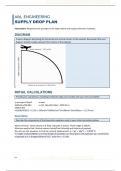
A&L ENGINEERING
SUPPLY DROP PLAN
Instructions: Respond to the prompts in the tables below and replace the text in brackets.
DIAGRAM
Create a diagram describing the horizontal and vertical motion of the payload. Remember that your
diagram should visually represent the motion of the payload.
INITIAL CALCULATIONS
Provide your calculations, including all relevant steps are included and your units are labeled.
y=yo+vyot+1/2ayt2 x=vxot
2650=0+1/2(9.8)t2 x=111.76m/s(23.26s) = 2599.53 m
2650=4.9t2
t=(2650/4.9)1/2 = 23.26 s 250mi/hr*1609m/1mi*1hr/60min*1min/60sec = 111.76 m/s
Description
Describe the components of the kinematics equations used in your initial calculations below.
What we know: Initial velocity is 0. Rate of gravity is 9.8m/s. Plane height is 2650m.
What we need to find: Vertical motion (Initial/Final Velocity) and Velocity of payload.
We will use this equation to find the vertical displacement y = yo + voy*t + 1/2*a*t^2
Y= Height of plane(2650)// yo=initial height of plane(0)// vyo intial plane velocity(1/2)// ay= acceleration
of payload as it is dropped (9.8m/s^2)//. Solve for t = 23.26s
®™ PHY 150 3-2 Project One: Analyzing Payload Motion with Calculations
, PHY 150 3-2 Project One: Analyzing Payload Motion with Calculations
MODIFIED SCENARIO ONE
Create a diagram showing the first modified scenario. Then adjust your initial calculations to
incorporate the changing variables from the scenario and describe how these changed variables affect
your calculations.
Diagram
Description
In this scenario I will be using Houston, TX as my dropoff location. Currently for 7/13/2023 the wind
speeds are 9mph according to localconditions.com. First off we need to convert 9mph to m/s.
We will do 9(0.44704 m/s)= 4.02 m/s (approximately).
Afterwards subract 4.02 m/s from the original velocity of 111.76 m/s and it equals 107.74m/s.
With the new velocity of 107.74m/s we multiply it by the time the payload takes to fall which would be
107.76m/s(23.26)= 2,506.03m. This would be the new distance that the payload will need to be dropped
off.
MODIFIED SCENARIO TWO
®™ PHY 150 3-2 Project One: Analyzing Payload Motion with Calculations
A&L ENGINEERING
SUPPLY DROP PLAN
Instructions: Respond to the prompts in the tables below and replace the text in brackets.
DIAGRAM
Create a diagram describing the horizontal and vertical motion of the payload. Remember that your
diagram should visually represent the motion of the payload.
INITIAL CALCULATIONS
Provide your calculations, including all relevant steps are included and your units are labeled.
y=yo+vyot+1/2ayt2 x=vxot
2650=0+1/2(9.8)t2 x=111.76m/s(23.26s) = 2599.53 m
2650=4.9t2
t=(2650/4.9)1/2 = 23.26 s 250mi/hr*1609m/1mi*1hr/60min*1min/60sec = 111.76 m/s
Description
Describe the components of the kinematics equations used in your initial calculations below.
What we know: Initial velocity is 0. Rate of gravity is 9.8m/s. Plane height is 2650m.
What we need to find: Vertical motion (Initial/Final Velocity) and Velocity of payload.
We will use this equation to find the vertical displacement y = yo + voy*t + 1/2*a*t^2
Y= Height of plane(2650)// yo=initial height of plane(0)// vyo intial plane velocity(1/2)// ay= acceleration
of payload as it is dropped (9.8m/s^2)//. Solve for t = 23.26s
®™ PHY 150 3-2 Project One: Analyzing Payload Motion with Calculations
, PHY 150 3-2 Project One: Analyzing Payload Motion with Calculations
MODIFIED SCENARIO ONE
Create a diagram showing the first modified scenario. Then adjust your initial calculations to
incorporate the changing variables from the scenario and describe how these changed variables affect
your calculations.
Diagram
Description
In this scenario I will be using Houston, TX as my dropoff location. Currently for 7/13/2023 the wind
speeds are 9mph according to localconditions.com. First off we need to convert 9mph to m/s.
We will do 9(0.44704 m/s)= 4.02 m/s (approximately).
Afterwards subract 4.02 m/s from the original velocity of 111.76 m/s and it equals 107.74m/s.
With the new velocity of 107.74m/s we multiply it by the time the payload takes to fall which would be
107.76m/s(23.26)= 2,506.03m. This would be the new distance that the payload will need to be dropped
off.
MODIFIED SCENARIO TWO
®™ PHY 150 3-2 Project One: Analyzing Payload Motion with Calculations