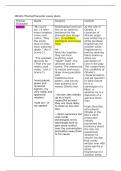
Othello Theme/Character essay plans
Theme/ Quote Analysis Context
Character
Othello "My soul's Shakespeare portrays as the role of
joy, / If after him as an optimist, Othello, a
every tempest bolstered by the character of
come such strength love brings African origin,
calms, / May him. A confident, was written by a
the winds intelligent and loving white Jacobean
blow till they man. Englishman for
have wakened another white
death," (Act 2 He Englishman to
Scene 1) feels like together, portray wearing
they can face black make-up
"The greatest anything, even alters our
discords be "death" itself - the perception of
/ That e'er our ultimate goal for race in the play.
hearts shall lovers. The references This undermines
make," (Act 2 to nature and music the credibility of
Scene 1). draw strong parallels Othello's
with characterisation,
traditional love and we question
'most potent, poetry, and convey to what extent
grave and how powerful love he is a
reverend makes Othello feel. stereotype of a
signors, my Moor, or
very noble and whether he is a
approved - tricolon sets othello depiction of a
masters' up as a loyal, genuine black
respectful servant - man.
'rude am i in they are more likely
my speech' to listen to him this Hugh Quarshie,
way. who played
Othello in the
- claims ignorance but RSC's 2015
uses racial production,
stereotypes to his initially
advantage here to expressed his
gain more control hesitancy about
over the conversation the role. He
and better sway them questioned
to his cause. whether he
should "accept
that a play
written over 400
years ago by a
white
Englishman for
another white
, Englishman in
blackface make-
up is an
authoritative
and credible
profile of a
genuine black
man"
'If she be Shakespeare implies
Othello’s trust is
false, O then greater than his own
heaven mocks self-doubt or
itself,” (Act 3 insecurity. The
Scene 3). declaration “O then
heaven mocks itself”
resembles someone
swearing to God, thus
“Think’st thou
demonstrating how
I’d make a life Desdemona’s honesty
of jealousy, / forms the foundation
To follow still of Othello’s
the changes of worldview.
the moon /
With fresh As Iago’s plot starts
suspicions?” to unfold,
(Act 3 Scene Shakespeare implies
3). Othello will be
resistant to his ploys.
“To be once in He appears aware of
doubt / Is once his own weaknesses
to be resolved
and of the
[...] I’ll see temptations of
before I doubt; jealousy. He
when I doubt, dismisses jealousy as
prove,” (Act 3 a fool’s errand,
Scene 3) swearing allegiance
to logic instead.
Shakespeare implies
Othello’s willingness
to communicate with
Desdemona, not
allowing any ill
feelings to fester, will
save their marriage.
However, Othello’s Honour killings
'and yet how insecurity in terms of against women
nature, erring race and social status for male pride
from itself' 3.3 that has pervaded the and reputation.
, play throughout
“Her name, seems to triumph. He
that was as justifies his
fresh / as aggressive projection
Dian’s visage, of insecurity as
is now ‘justice’ against his
begrimed and wife.
black / as mine
own face,” This simile shows that
(3.3). his race and her
betrayal are
intrinsically linked. In
the eyes of Othello,
“ justice of it Desdemona has
pleases,” (Act taken a fall from
4 Scene 1), grace, and now he
views her as he views
“Yet she must himself. He aligns his
die, else she’ll
“black” appearance
betray more with sin and shame,
men,” (Act 5 while coupling her
Scene 1): “name” with the
“fresh [...] face” of a
goddess, which
implies a good
reputation comes
from being the ‘right’
race.
He now sees that for
her to die ‘justice’
would be restored.
The intelligence and
justice we witnessed
at the start of the
play has become
twisted. Othello is
fighting for all men.
Her death is symbolic
of men’s victory over
cuckoldry and
deceitful female
sexuality.
Desdemona Idolisation of
2022 “a maid / That Perfect Jacobean wife: women for
paragons all beautiful, chaste, conforming to
, standards
description,” loyal no matter what. expected of
2.1 (cassio) Jacobean wife.
Desdemona’s chastity
“a maiden is much sought after
never bold,” and capitalised on.
1.3 (brabantio) Though her innocence
is partly a concoction
of male fantasy, there
are still aspects of her
‘I ne’er saw personality that make
this before’ her fit the ingenue
archetype. She is
ignorant of the
workings of military
“His
culture, creating
unkindness
may defeat my friction between her
life, / But never and Othello; what’s
taint my love,” more, she is tragically
unaware of toxic
(Act 4 Scene
masculinity. She
2).
maintains that her
husband is better
than such a base
emotion, even when
faced with the
ugliness of his fury.
despite Othello's
harsh words and
actions towards her,
accusing her of
adultery and even
striking her
Desdemona remains
faithful to him
wanting no bad word
said against him due
to her love.
“I do perceive Mediator-
here a divided
duty,” (Act 1 The conflicts of the
Scene 3). play are taken out on
her, with many
juxtapositions
symbolically clashing
within her identity.
This may have
Theme/ Quote Analysis Context
Character
Othello "My soul's Shakespeare portrays as the role of
joy, / If after him as an optimist, Othello, a
every tempest bolstered by the character of
come such strength love brings African origin,
calms, / May him. A confident, was written by a
the winds intelligent and loving white Jacobean
blow till they man. Englishman for
have wakened another white
death," (Act 2 He Englishman to
Scene 1) feels like together, portray wearing
they can face black make-up
"The greatest anything, even alters our
discords be "death" itself - the perception of
/ That e'er our ultimate goal for race in the play.
hearts shall lovers. The references This undermines
make," (Act 2 to nature and music the credibility of
Scene 1). draw strong parallels Othello's
with characterisation,
traditional love and we question
'most potent, poetry, and convey to what extent
grave and how powerful love he is a
reverend makes Othello feel. stereotype of a
signors, my Moor, or
very noble and whether he is a
approved - tricolon sets othello depiction of a
masters' up as a loyal, genuine black
respectful servant - man.
'rude am i in they are more likely
my speech' to listen to him this Hugh Quarshie,
way. who played
Othello in the
- claims ignorance but RSC's 2015
uses racial production,
stereotypes to his initially
advantage here to expressed his
gain more control hesitancy about
over the conversation the role. He
and better sway them questioned
to his cause. whether he
should "accept
that a play
written over 400
years ago by a
white
Englishman for
another white
, Englishman in
blackface make-
up is an
authoritative
and credible
profile of a
genuine black
man"
'If she be Shakespeare implies
Othello’s trust is
false, O then greater than his own
heaven mocks self-doubt or
itself,” (Act 3 insecurity. The
Scene 3). declaration “O then
heaven mocks itself”
resembles someone
swearing to God, thus
“Think’st thou
demonstrating how
I’d make a life Desdemona’s honesty
of jealousy, / forms the foundation
To follow still of Othello’s
the changes of worldview.
the moon /
With fresh As Iago’s plot starts
suspicions?” to unfold,
(Act 3 Scene Shakespeare implies
3). Othello will be
resistant to his ploys.
“To be once in He appears aware of
doubt / Is once his own weaknesses
to be resolved
and of the
[...] I’ll see temptations of
before I doubt; jealousy. He
when I doubt, dismisses jealousy as
prove,” (Act 3 a fool’s errand,
Scene 3) swearing allegiance
to logic instead.
Shakespeare implies
Othello’s willingness
to communicate with
Desdemona, not
allowing any ill
feelings to fester, will
save their marriage.
However, Othello’s Honour killings
'and yet how insecurity in terms of against women
nature, erring race and social status for male pride
from itself' 3.3 that has pervaded the and reputation.
, play throughout
“Her name, seems to triumph. He
that was as justifies his
fresh / as aggressive projection
Dian’s visage, of insecurity as
is now ‘justice’ against his
begrimed and wife.
black / as mine
own face,” This simile shows that
(3.3). his race and her
betrayal are
intrinsically linked. In
the eyes of Othello,
“ justice of it Desdemona has
pleases,” (Act taken a fall from
4 Scene 1), grace, and now he
views her as he views
“Yet she must himself. He aligns his
die, else she’ll
“black” appearance
betray more with sin and shame,
men,” (Act 5 while coupling her
Scene 1): “name” with the
“fresh [...] face” of a
goddess, which
implies a good
reputation comes
from being the ‘right’
race.
He now sees that for
her to die ‘justice’
would be restored.
The intelligence and
justice we witnessed
at the start of the
play has become
twisted. Othello is
fighting for all men.
Her death is symbolic
of men’s victory over
cuckoldry and
deceitful female
sexuality.
Desdemona Idolisation of
2022 “a maid / That Perfect Jacobean wife: women for
paragons all beautiful, chaste, conforming to
, standards
description,” loyal no matter what. expected of
2.1 (cassio) Jacobean wife.
Desdemona’s chastity
“a maiden is much sought after
never bold,” and capitalised on.
1.3 (brabantio) Though her innocence
is partly a concoction
of male fantasy, there
are still aspects of her
‘I ne’er saw personality that make
this before’ her fit the ingenue
archetype. She is
ignorant of the
workings of military
“His
culture, creating
unkindness
may defeat my friction between her
life, / But never and Othello; what’s
taint my love,” more, she is tragically
unaware of toxic
(Act 4 Scene
masculinity. She
2).
maintains that her
husband is better
than such a base
emotion, even when
faced with the
ugliness of his fury.
despite Othello's
harsh words and
actions towards her,
accusing her of
adultery and even
striking her
Desdemona remains
faithful to him
wanting no bad word
said against him due
to her love.
“I do perceive Mediator-
here a divided
duty,” (Act 1 The conflicts of the
Scene 3). play are taken out on
her, with many
juxtapositions
symbolically clashing
within her identity.
This may have