

HEART FAILURE
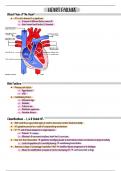
Blood Flow of The Heart
• HF is not a disease it's a syndrome
o A bunch of different factors cause HF
o Heart cannot meet bodies O2 demand
Risk Factors:
• Primary risk factors:
o Hypertension
o CAD
• Contributing factors:
o Advanced age
o Diabetes
o Tobacco use
o Metabolic syndrome
o Vascular disease
Classifications – L & R Sided HF:
• Both result from myocardial injury & result in decreased cardiac functional ability
• HF symptoms present as a result of compensatory mechanisms
• EF à amt of blood pumped in a single squeeze
o Preload à volume
o Afterload à pressure/resistance heart has to overcome
• New York Heart Association à guidelines classifying people w heart disease based on tolerance to physical activity
o Looks at symptoms pt is currently having à maintaining/exacerbation
• American College of Cardiology Foundation/ AHA à identifies disease progression & tx strategies
o Allows for identification of people at risk for developing HF à can't move back a stage
, 1
LEFT SIDED HF à left = lungs
• Most common form
o Inability of LV to empty or fill adequately during diastole
• Classified as:
o HFrEF à systolic HF à failure to pump à heart is stretched
§ Same volume less squeeze
§ Results in increased afterload
§ Hallmark sign is reduced EF
• Normal = <55-65%
• Dx HFrEF = <40%
• Can be as low as 5-10%
o HFpEF à diastolic HF à failure to relax à muscle too big à thickening/stiffening
§ Less volume same squeeze
• Both systolic and diastolic HF result in reduced CO and fluid congestion
• Clinical manifestations à all result from pulmonary edema & congestion
o Cough
o Crackles
o Wheezes
o Blood-tinged sputum
o Tachypnea
o Confusion
o Orthopnea
§ Dyspnea in the recumbent position that is resolved when the pt is siing
§ Results from fluid shifts when lying down
§ Ask pts about use of pillows or need for sleeping in a recliner
o Paroxysmal nocturnal dyspnea
§ Episodic sudden dyspnea that awakes the pt at night
§ From fluid accumulation in when the pt is lying flat
§ Pts awake feeling as if they are suffocating
• Run to window for air
o Exertional dyspnea
o Tachycardia
o Fatigue
o Cyanosis
o Restlessness
Pulmonary Edema
Blood Flow of The Heart
• HF is not a disease it's a syndrome
o A bunch of different factors cause HF
o Heart cannot meet bodies O2 demand
Risk Factors:
• Primary risk factors:
o Hypertension
o CAD
• Contributing factors:
o Advanced age
o Diabetes
o Tobacco use
o Metabolic syndrome
o Vascular disease
Classifications – L & R Sided HF:
• Both result from myocardial injury & result in decreased cardiac functional ability
• HF symptoms present as a result of compensatory mechanisms
• EF à amt of blood pumped in a single squeeze
o Preload à volume
o Afterload à pressure/resistance heart has to overcome
• New York Heart Association à guidelines classifying people w heart disease based on tolerance to physical activity
o Looks at symptoms pt is currently having à maintaining/exacerbation
• American College of Cardiology Foundation/ AHA à identifies disease progression & tx strategies
o Allows for identification of people at risk for developing HF à can't move back a stage
, 1
LEFT SIDED HF à left = lungs
• Most common form
o Inability of LV to empty or fill adequately during diastole
• Classified as:
o HFrEF à systolic HF à failure to pump à heart is stretched
§ Same volume less squeeze
§ Results in increased afterload
§ Hallmark sign is reduced EF
• Normal = <55-65%
• Dx HFrEF = <40%
• Can be as low as 5-10%
o HFpEF à diastolic HF à failure to relax à muscle too big à thickening/stiffening
§ Less volume same squeeze
• Both systolic and diastolic HF result in reduced CO and fluid congestion
• Clinical manifestations à all result from pulmonary edema & congestion
o Cough
o Crackles
o Wheezes
o Blood-tinged sputum
o Tachypnea
o Confusion
o Orthopnea
§ Dyspnea in the recumbent position that is resolved when the pt is siing
§ Results from fluid shifts when lying down
§ Ask pts about use of pillows or need for sleeping in a recliner
o Paroxysmal nocturnal dyspnea
§ Episodic sudden dyspnea that awakes the pt at night
§ From fluid accumulation in when the pt is lying flat
§ Pts awake feeling as if they are suffocating
• Run to window for air
o Exertional dyspnea
o Tachycardia
o Fatigue
o Cyanosis
o Restlessness
Pulmonary Edema


