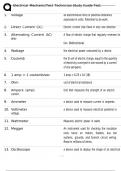
Electrical Mechanic/Test Technician Study Guide Test.
1. Voltage an electromotive force or potential ditterence
expressed in volts. Potential to do work.
2. Direct Current (DC) Electric current that flows in only one direction
3. Alternating Current (AC) A flow of electric charge that regularly reverses its
direc-
tion. Bidirectional.
4. Wattage the electrical power consumed by a device.
5. Coulomb the SI unit of electric charge, equal to the quantity
of electricity conveyed in one second by a current
of one ampere.
6. 1 amp = 1 coulomb/sec 1 amp = 6.25 x 10 (18)
7. Ohm unit of electrical resistance
8. Ampere (amp) Unit that measures the strength of an electric
current.
9. Ammeter a device used to measure current in amperes.
10. Voltmeter a device used to measure electrical potential or
voltage.
11. Wattmeter Measures electric power in watts
12. Megger An instrument used for checking the insulation
resis- tance on motors, feeders, bus bar
systems, grounds, and branch circuit wiring.
Read in millions of ohms.
13. Oscilloscope a device used to display the shape of an electrical
, Electrical Mechanic/Test Technician Study Guide Test.
wave.
14. Multimeter A measuring instrument for current, voltage, and
resis- tance.
, Electrical Mechanic/Test Technician Study Guide Test.
15. Frequency meter Used to measure the frequency of an AC signal.
16. micrometer A gauge which measures small distances or
thicknesses.
17. vernier caliper instrument used for measuring precise linear
dimen- sions
18. Wire gauge A standard measure of the diameter or thickness
of a strand of wire
19. Ohmeter a device used to measure resistance
20. Architect's Scale A specialized ruler used in making or measuring
re- duced scale drawings. It is marked with a
range of cal- ibrated ratios used for laying out
distances, with scales indicating feet, inches, and
fractions of inches. Used on drawings other than
site plans.
21. Planimeter Engineering tool designed to measure
distance as its pointer is traced around a
pattern.
22. Of the following electrical devices, C. Transformer
the one that is NOT normally used Transformers do not use direct current (DC).
Transform-
in direct current electrical
circuits is a .... 23. Of the following motors,
A. Circuit breaker the one
B. Double-pole switch
C. Transformer
D. Inverter
, Electrical Mechanic/Test Technician Study Guide Test.
ers work on alternating current (AC), which is so the transformer cannot work. If the input
electrical current that flows in a single direction. A terminals of a transformer are connected to a DC
transformer's principle is based on electromagnetic voltage, the transformer usually burns.
induction, which requires a voltage source that
C. Squirrel cage induction. Cheap and easy to
changes with time. A DC supply is unidirectional,
install -
that does NOT have brushes is the squirrel cage induction motors do not
contain brushes,
motor. slip rings, commutators, permanent magnets,
position
1. Voltage an electromotive force or potential ditterence
expressed in volts. Potential to do work.
2. Direct Current (DC) Electric current that flows in only one direction
3. Alternating Current (AC) A flow of electric charge that regularly reverses its
direc-
tion. Bidirectional.
4. Wattage the electrical power consumed by a device.
5. Coulomb the SI unit of electric charge, equal to the quantity
of electricity conveyed in one second by a current
of one ampere.
6. 1 amp = 1 coulomb/sec 1 amp = 6.25 x 10 (18)
7. Ohm unit of electrical resistance
8. Ampere (amp) Unit that measures the strength of an electric
current.
9. Ammeter a device used to measure current in amperes.
10. Voltmeter a device used to measure electrical potential or
voltage.
11. Wattmeter Measures electric power in watts
12. Megger An instrument used for checking the insulation
resis- tance on motors, feeders, bus bar
systems, grounds, and branch circuit wiring.
Read in millions of ohms.
13. Oscilloscope a device used to display the shape of an electrical
, Electrical Mechanic/Test Technician Study Guide Test.
wave.
14. Multimeter A measuring instrument for current, voltage, and
resis- tance.
, Electrical Mechanic/Test Technician Study Guide Test.
15. Frequency meter Used to measure the frequency of an AC signal.
16. micrometer A gauge which measures small distances or
thicknesses.
17. vernier caliper instrument used for measuring precise linear
dimen- sions
18. Wire gauge A standard measure of the diameter or thickness
of a strand of wire
19. Ohmeter a device used to measure resistance
20. Architect's Scale A specialized ruler used in making or measuring
re- duced scale drawings. It is marked with a
range of cal- ibrated ratios used for laying out
distances, with scales indicating feet, inches, and
fractions of inches. Used on drawings other than
site plans.
21. Planimeter Engineering tool designed to measure
distance as its pointer is traced around a
pattern.
22. Of the following electrical devices, C. Transformer
the one that is NOT normally used Transformers do not use direct current (DC).
Transform-
in direct current electrical
circuits is a .... 23. Of the following motors,
A. Circuit breaker the one
B. Double-pole switch
C. Transformer
D. Inverter
, Electrical Mechanic/Test Technician Study Guide Test.
ers work on alternating current (AC), which is so the transformer cannot work. If the input
electrical current that flows in a single direction. A terminals of a transformer are connected to a DC
transformer's principle is based on electromagnetic voltage, the transformer usually burns.
induction, which requires a voltage source that
C. Squirrel cage induction. Cheap and easy to
changes with time. A DC supply is unidirectional,
install -
that does NOT have brushes is the squirrel cage induction motors do not
contain brushes,
motor. slip rings, commutators, permanent magnets,
position