

Page |1
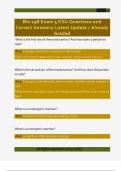
Bio 198 Exam 5 KSU Questions and
Correct Answers/ Latest Update / Already
Graded
What is the first law of thermodynamics? And how does it pertain to
cells?
Ans: Energy cannot be created or destroyed
Cells can't just create their own energy, they nee d a source.
What is the second law of thermodynamics? And how does this pertain
to cells?
Ans: Energy is transferred, and in every transfer some energy is
lost.
Cells need a constant input of energy because they lose some as
heat
What is an endergonic reaction?
Ans: A reaction that requires energy input.
What is an exergonic reaction?
Ans: a reaction that releases energy.
All rights reserved © 2025/ 2026 |
, Page |2
Describe the basic structure of ATP, where energy is stored, and how
energy is released.
Ans: -Made up of a triphosphate group, 5-carbon sugar, and
Adenine
-Energy is stored in the triphosphate group
-When energy is released, triphosphate group is released and
ADP and phosphate group is formed
What is the relationship of ATP and endergonic/exergonic reactions?
Ans: The making of ATP is an endergonic reaction because it
requires energy to build the triphosphate molecule.
The making of ADP is exergonic because it releases energy,
splitting the triphosphate molecules.
What is an Oxidation reaction? What type of reaction is it?
Ans: -Loss of electrons
-Exergonic Reaction
What is a Reduction reaction? What type of reaction is it?
Ans: -Gaining of electrons
-Endergonic Reaction
All rights reserved © 2025/ 2026 |
, Page |3
Describe the process of diffusion.
Ans: Diffusion (passive transport) is the spontaneous
movement of materials from HIGH to LOW concentration down
a concentration gradient (form of energy) through a selectively
permeable membrane (like a bouncer).
What factors influence diffusion rates?
Ans: -Temperature
-size of molecule
-time
-distance
-Solubility
-Surface Areaof membrane
-Solvent density
What is a selective permeable membrane? How does it influence
movement of materials, and what molecules can move through easily?
Ans: The membrane chooses which molecules are allowed to
pass. Only allows smaller molecules (ie. oxygen and carbon
dioxide) can move through easily
What is facilitated diffusion?
All rights reserved © 2025/ 2026 |
Bio 198 Exam 5 KSU Questions and
Correct Answers/ Latest Update / Already
Graded
What is the first law of thermodynamics? And how does it pertain to
cells?
Ans: Energy cannot be created or destroyed
Cells can't just create their own energy, they nee d a source.
What is the second law of thermodynamics? And how does this pertain
to cells?
Ans: Energy is transferred, and in every transfer some energy is
lost.
Cells need a constant input of energy because they lose some as
heat
What is an endergonic reaction?
Ans: A reaction that requires energy input.
What is an exergonic reaction?
Ans: a reaction that releases energy.
All rights reserved © 2025/ 2026 |
, Page |2
Describe the basic structure of ATP, where energy is stored, and how
energy is released.
Ans: -Made up of a triphosphate group, 5-carbon sugar, and
Adenine
-Energy is stored in the triphosphate group
-When energy is released, triphosphate group is released and
ADP and phosphate group is formed
What is the relationship of ATP and endergonic/exergonic reactions?
Ans: The making of ATP is an endergonic reaction because it
requires energy to build the triphosphate molecule.
The making of ADP is exergonic because it releases energy,
splitting the triphosphate molecules.
What is an Oxidation reaction? What type of reaction is it?
Ans: -Loss of electrons
-Exergonic Reaction
What is a Reduction reaction? What type of reaction is it?
Ans: -Gaining of electrons
-Endergonic Reaction
All rights reserved © 2025/ 2026 |
, Page |3
Describe the process of diffusion.
Ans: Diffusion (passive transport) is the spontaneous
movement of materials from HIGH to LOW concentration down
a concentration gradient (form of energy) through a selectively
permeable membrane (like a bouncer).
What factors influence diffusion rates?
Ans: -Temperature
-size of molecule
-time
-distance
-Solubility
-Surface Areaof membrane
-Solvent density
What is a selective permeable membrane? How does it influence
movement of materials, and what molecules can move through easily?
Ans: The membrane chooses which molecules are allowed to
pass. Only allows smaller molecules (ie. oxygen and carbon
dioxide) can move through easily
What is facilitated diffusion?
All rights reserved © 2025/ 2026 |


