
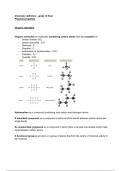
Chemistry definition - grade 12 final
Physical properties
Organic chemistry
Organic molecules as molecules containing carbon atoms with the exception of
- carbon dioxide -CO2
- carbon monoxide - CO
- Diamond - C
- Graphite - C
- carbonates (or bicarbonates) - CO3-2
- Carbides - C2-2
- Cyanide - CN-
Hydrocarbon as a compound containing only carbon and hydrogen atoms
A saturated compound as a compound in which all of the bonds between carbon atoms are
single bonds
An unsaturated compound as a compound in which there is at least one double and/or triple
bond between carbon atoms
A functional group as an atom or a group of atoms that form the centre of chemical activity in
the molecule
, A homologous series as a series of similar compounds which have the same functional group
and have the same general formula, in which each member differs from the previous one by a
single CH2 unit
Structural isomers as compounds having the same molecular formula but different structural
formulae
- #Chain isomers - Different type of chain structure, i.e. branching
- #Positional isomers - Different positions of the same functional group on the parent
chain
- #Functional isomers - Different functional groups
State that combustion reactions are exothermic and hence explain the importance of fossil
fuels in terms of their ability to transform chemical potential energy into thermal energy
Physical properties
Organic chemistry
Organic molecules as molecules containing carbon atoms with the exception of
- carbon dioxide -CO2
- carbon monoxide - CO
- Diamond - C
- Graphite - C
- carbonates (or bicarbonates) - CO3-2
- Carbides - C2-2
- Cyanide - CN-
Hydrocarbon as a compound containing only carbon and hydrogen atoms
A saturated compound as a compound in which all of the bonds between carbon atoms are
single bonds
An unsaturated compound as a compound in which there is at least one double and/or triple
bond between carbon atoms
A functional group as an atom or a group of atoms that form the centre of chemical activity in
the molecule
, A homologous series as a series of similar compounds which have the same functional group
and have the same general formula, in which each member differs from the previous one by a
single CH2 unit
Structural isomers as compounds having the same molecular formula but different structural
formulae
- #Chain isomers - Different type of chain structure, i.e. branching
- #Positional isomers - Different positions of the same functional group on the parent
chain
- #Functional isomers - Different functional groups
State that combustion reactions are exothermic and hence explain the importance of fossil
fuels in terms of their ability to transform chemical potential energy into thermal energy



