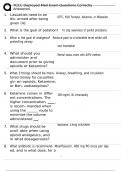
TCCC Deployed Med Exam Questions Correctly
Answered.
1. Casualties need to be
OTFC, IV/IO Fentanyl, Ketamine, or Midazolam
dis- armed after being
given (4):
2. What is the goal of sedation? To stop awareness of painful procedures
3. What is the goal of analgesia? Reduce pain to a tolerable level while still
protecting airway
and mentation
4. What should you Mental status exam with AVPU method
administer and
document prior to giving
opioids or Ketamine?
5. What 3 things should be moni- Airway, breathing, and circulation
tored closely for casualties
giv- en opioids, Ketamine,
or Ben- zodiazepines?
6. Ketamine comes in differ- 100 mg/ml, IN, intranasally
ent concentrations. The
higher concentration, ,
is recom- mended when
using the route to
minimize the volume
administered .
Naloxone, 0.4mg IV/IO/IM/IN
7. What drugs should be
avail- able when using
opioid analgesics, and
in what dosage/route?
8. What antibiotic is recommend- Moxifloxacin, 400 mg PO once per day
ed, and in what dose, for a
1/
22
, TCCC Deployed Med Exam Questions Correctly
Answered.
pa- tient who is able to
swallow?
2/
22
, TCCC Deployed Med Exam Questions Correctly
Answered.
9. What antibiotic is recommend- Ertapenem, 1 g IV/IO/IM once per day
ed, and in what does, for a
pa- tient who is UNABLE to
swal- low?
10. is/are Antibiotics
recommended for all
open combat wounds.
Hypothermia, heat loss
11. Burn patients are
particularly susceptible to
, so
empha- sis should be
placed on
20%, fluid resuscitation
prevention methods.
12. If burns are greater than
of body area, should be
ini- tiated as soon as IV/IO
access is established.
13. Fluid resuscitation for burn vic- Lactated ringers, normal saline, or Hextend
tims should be initiated with
, , or .
14. If Hextend is used for 1000, Lactated ringers, normal saline
fluid re- suscitation, no
more than ml
should be given, followed
by or as
need- ed.
Possible inhalation injury
15. What must be considered
in patients with facial
burns?
3/
22
Answered.
1. Casualties need to be
OTFC, IV/IO Fentanyl, Ketamine, or Midazolam
dis- armed after being
given (4):
2. What is the goal of sedation? To stop awareness of painful procedures
3. What is the goal of analgesia? Reduce pain to a tolerable level while still
protecting airway
and mentation
4. What should you Mental status exam with AVPU method
administer and
document prior to giving
opioids or Ketamine?
5. What 3 things should be moni- Airway, breathing, and circulation
tored closely for casualties
giv- en opioids, Ketamine,
or Ben- zodiazepines?
6. Ketamine comes in differ- 100 mg/ml, IN, intranasally
ent concentrations. The
higher concentration, ,
is recom- mended when
using the route to
minimize the volume
administered .
Naloxone, 0.4mg IV/IO/IM/IN
7. What drugs should be
avail- able when using
opioid analgesics, and
in what dosage/route?
8. What antibiotic is recommend- Moxifloxacin, 400 mg PO once per day
ed, and in what dose, for a
1/
22
, TCCC Deployed Med Exam Questions Correctly
Answered.
pa- tient who is able to
swallow?
2/
22
, TCCC Deployed Med Exam Questions Correctly
Answered.
9. What antibiotic is recommend- Ertapenem, 1 g IV/IO/IM once per day
ed, and in what does, for a
pa- tient who is UNABLE to
swal- low?
10. is/are Antibiotics
recommended for all
open combat wounds.
Hypothermia, heat loss
11. Burn patients are
particularly susceptible to
, so
empha- sis should be
placed on
20%, fluid resuscitation
prevention methods.
12. If burns are greater than
of body area, should be
ini- tiated as soon as IV/IO
access is established.
13. Fluid resuscitation for burn vic- Lactated ringers, normal saline, or Hextend
tims should be initiated with
, , or .
14. If Hextend is used for 1000, Lactated ringers, normal saline
fluid re- suscitation, no
more than ml
should be given, followed
by or as
need- ed.
Possible inhalation injury
15. What must be considered
in patients with facial
burns?
3/
22