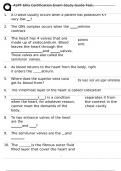
ASPT EKG Certification Exam Study Guide Test.
1. A U wave usually occurs when a patient has potassium K+
very low ?
2. The QRS complex occurs when the ventricles
contract.
3. The heart has 4 valves that are pulmonic
made up of endocardium. Blood aortic
leaves the heart through the
and valves.
These valves are also called the
semilunar valves.
4. As blood returns to the heart from the body, right
it enters the atrium.
5. Where does the superior vena cava the head, neck and upper extremeties
get its blood from?
6. The innermost layer of the heart is called? Endocardium
7. ( ) is a condition separates it from
when the heart, for whatever reason, the content in the
cannot meet the demands of the chest cavity.
body.
8. Te two entrance valves of the heart
are the
and ?
9. The semilunar valves are the and
.
10. The is the fibrous outer fluid
filled layer that cover the heart and
1/
22
, ASPT EKG Certification Exam Study Guide Test.
congestive heart failure (CHF)
tricuspid, bicuspid
pulmonic aortic
pericardium
2/
22
, ASPT EKG Certification Exam Study Guide Test.
11. The EKG records the electrical cardiac cycle
impulses called the .
12. The cardiac cycle is represented by P wave
the
QRS
, , and _ ?
complex T
wave
13. The contraction of the atria is the ? P wave
14. The contraction of the ventricles is QRS complex
the
?
15. The T wave is the ? relaxation of the ventricles
16. The U wave is the? not always seen but represents
depolar- ization. Also possible low
potassium lev- els.
17. The right and left atria are known as receiving chambers
the
.
mitral valve
18. When blood is on its way from the
left atri- um to the left ventricle, it
goes through the
.
alveoli
19. The only way to oxygenate the blood
is
through the and in the lungs. capillaries
20. The right and left side of the heart is sepa- rated by the
3/
22
1. A U wave usually occurs when a patient has potassium K+
very low ?
2. The QRS complex occurs when the ventricles
contract.
3. The heart has 4 valves that are pulmonic
made up of endocardium. Blood aortic
leaves the heart through the
and valves.
These valves are also called the
semilunar valves.
4. As blood returns to the heart from the body, right
it enters the atrium.
5. Where does the superior vena cava the head, neck and upper extremeties
get its blood from?
6. The innermost layer of the heart is called? Endocardium
7. ( ) is a condition separates it from
when the heart, for whatever reason, the content in the
cannot meet the demands of the chest cavity.
body.
8. Te two entrance valves of the heart
are the
and ?
9. The semilunar valves are the and
.
10. The is the fibrous outer fluid
filled layer that cover the heart and
1/
22
, ASPT EKG Certification Exam Study Guide Test.
congestive heart failure (CHF)
tricuspid, bicuspid
pulmonic aortic
pericardium
2/
22
, ASPT EKG Certification Exam Study Guide Test.
11. The EKG records the electrical cardiac cycle
impulses called the .
12. The cardiac cycle is represented by P wave
the
QRS
, , and _ ?
complex T
wave
13. The contraction of the atria is the ? P wave
14. The contraction of the ventricles is QRS complex
the
?
15. The T wave is the ? relaxation of the ventricles
16. The U wave is the? not always seen but represents
depolar- ization. Also possible low
potassium lev- els.
17. The right and left atria are known as receiving chambers
the
.
mitral valve
18. When blood is on its way from the
left atri- um to the left ventricle, it
goes through the
.
alveoli
19. The only way to oxygenate the blood
is
through the and in the lungs. capillaries
20. The right and left side of the heart is sepa- rated by the
3/
22