

IPC A 610 FINAL EXAM QUESTION AND ANSWERS (VERIFIED AND
IPC A 610
WELL DETAILED ANSWERS) LATEST UPDATE 2025/2026
Study online at https://quizlet.com/_b12gp
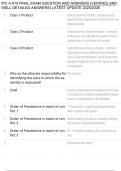
1. Class 1 Product General Electronics Product - includes products
where the major requirement is function of the com-
pleted assembly.
2. Class 2 Product Dedicated Service Electronic Product - Continued
performance and extended life required. Uninter-
rupted service is desired but not required.
3. Class 3 Product High Performance Electrical Product - Continued
high performance or performance-on-demand is
critical. Equipment downtime cannot be tolerated.
Equipment might be used for life-support or other
critical systems.
4. Who as the ultimate responsibility for The Customer.
identifying the class to which the as-
sembly is evaluated?
5. Shall Invokes a requirement for manufacturers of all class-
es or product, and failure to comply with the require-
ment is a noncompliance to this standard.
6. Order of Precedence in event of con- 1. Procurement as agreed and documented be-
flict 1 tween customer and supplier.
7. Order of Precedence in event of con- Master drawing or master ass. drawing reflecting
flict 2 the customer's detailed requirements.
8. Order of Precedence in event of con- IPC-1-610 when invoked by the customer or con-
flict 3 tract.
9. Procurement documents
1/7
, IPC A 610
Study online at https://quizlet.com/_b12gp
If documents other than IPC-A-610
are cited, the order of precedence
shall be defined in the _
10. Target Condition A condition that is close to perfect, but is not always
achievable and may not be necessary to ensure the
reliability of the assembly.
11. Acceptable Condition A condition that, while not necessarily perfect, will
maintain integrity and reliability of the assembly
12. Defect Condition The form, fit or function of the assembly is inade-
quate for use in its end use environment.
13. A defect for Class 1... automatically implies a defect for Class 2 and 3. A
defect for Class 2 implies a defect for Class 3.
14. Disposition The determination of how defects should be treated.
These include rework, use as is, scrap, and repair.
15. Who dispositions defect conditions? The manufacturer, based on design, service and cus-
tomer requirements.
16. Process Indicator Conditions A condition (not a defect) that does not affect the
form, fit or function of a product.
17. Process indicators should be... monitored as part of the process control system
18. Is disposition of individual process in- No, and affected products should be used as-is.
dicators required?
19. Conditions Not Specified A condition that is neither a defect, nor a process
indicator. A condition not specified may be consid-
2/7
IPC A 610
WELL DETAILED ANSWERS) LATEST UPDATE 2025/2026
Study online at https://quizlet.com/_b12gp
1. Class 1 Product General Electronics Product - includes products
where the major requirement is function of the com-
pleted assembly.
2. Class 2 Product Dedicated Service Electronic Product - Continued
performance and extended life required. Uninter-
rupted service is desired but not required.
3. Class 3 Product High Performance Electrical Product - Continued
high performance or performance-on-demand is
critical. Equipment downtime cannot be tolerated.
Equipment might be used for life-support or other
critical systems.
4. Who as the ultimate responsibility for The Customer.
identifying the class to which the as-
sembly is evaluated?
5. Shall Invokes a requirement for manufacturers of all class-
es or product, and failure to comply with the require-
ment is a noncompliance to this standard.
6. Order of Precedence in event of con- 1. Procurement as agreed and documented be-
flict 1 tween customer and supplier.
7. Order of Precedence in event of con- Master drawing or master ass. drawing reflecting
flict 2 the customer's detailed requirements.
8. Order of Precedence in event of con- IPC-1-610 when invoked by the customer or con-
flict 3 tract.
9. Procurement documents
1/7
, IPC A 610
Study online at https://quizlet.com/_b12gp
If documents other than IPC-A-610
are cited, the order of precedence
shall be defined in the _
10. Target Condition A condition that is close to perfect, but is not always
achievable and may not be necessary to ensure the
reliability of the assembly.
11. Acceptable Condition A condition that, while not necessarily perfect, will
maintain integrity and reliability of the assembly
12. Defect Condition The form, fit or function of the assembly is inade-
quate for use in its end use environment.
13. A defect for Class 1... automatically implies a defect for Class 2 and 3. A
defect for Class 2 implies a defect for Class 3.
14. Disposition The determination of how defects should be treated.
These include rework, use as is, scrap, and repair.
15. Who dispositions defect conditions? The manufacturer, based on design, service and cus-
tomer requirements.
16. Process Indicator Conditions A condition (not a defect) that does not affect the
form, fit or function of a product.
17. Process indicators should be... monitored as part of the process control system
18. Is disposition of individual process in- No, and affected products should be used as-is.
dicators required?
19. Conditions Not Specified A condition that is neither a defect, nor a process
indicator. A condition not specified may be consid-
2/7


