ATLS FINAL EXAM.
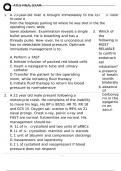
1. A 23-year-old man is brought immediately to the ED D. Transfer
the patient to
from the hospitals parking lot where he was shot in the the
operating room, while
lower abdomen. Examination reveals a single 3. Which of
bullet wound. He is breathing and has a the
thready pulse. How- ever, he is unconsious and following is
has no detectable blood pressure. Optimale MOST
immediate management is to: RELIABLE
to confirm
A. Perform a FAST endotrach
B. Initiate infusion of packed red blood cells eal
C. Insert a nasogastric tube and urinary intubation?
catheter a. presence
D. Transfer the patient to the operating of breath
room, while initiating fluid therapy sounds
E. Initiate fluid therapy to return his blood bilaterally
pressure to normotensive b. absence
of
2. A 22 year old male present following a borboryg
mi in the
motorcycle crash. He complains of the inability
epigatriu
to move his legs. His BP is 80/50, HR 70, RR 18 m on
and GCS 15. Oxygen sat- uration is 99% on 21 ascul-
nasal prongs. Chest x-ray, pelvic x-ray and
FAST are normal. Extremities are normal. His
management should be:
A: 1L of iv . crystalloid and two units of pRBCs
B. 1L of iv. crystalloid, mannitol and iv steroids
C. 1 unit of albumin and compression stockings
D. Vasopressors and laparotomy
E. 1 L of cystalloid and vasopressors if blood
pressure does not respond
, ATLS FINAL EXAM.
initiating fluid therapy
E. 1 L of cystalloid and va- sopressors if blood pres- sure does not
respond
e. chest xray with endotra- cheal tube tip appearing above the carina
, ATLS FINAL EXAM.
tation
c. presence of CO2 in exhaled air via capnography
d. appearance of fog in the endotracheal tube
e. chest xray with endotracheal tube tip
appearing above the carina
4. A 6 month old infant, being held in her mothers arms, E. Perform
needle
is ejected on impact from a vehicle that is cricothyroidotomy with
struck head on by an oncoming car traveling at jet insufflation
64kph. The infant arrives in the ED with
multiple facial injuries, is lethar- gic, and is in
severe respiratoy distress. Respiratory support
is not effective using a bag mask device, and
her oxygen saturation is falling. Repeated
attempts at orotracheal intubation are
unsuccessful. the most appropriate procedure
to perform next is: A.Administer heliox and
racemic epinephrine
B. Perform nasotracheal intubation
C. Perform surgical cricothyroidotomy
D. Repeat orotracheal intubation
E. Perform needle cricothyroidotomy with jet
insuffla- tion
5. A 28 year olf male is brought to the ED. He was involved a. glasgow
coma
in a fight, during which he was beaten with a
wooden stick. His chest shows multiple severe
bruises. His ar- way is clear, resp rate is 22, hear
rate 126, and systolic blood pressure is 90
mmHG. Which of the following should be
, ATLS FINAL EXAM.
performed during the primary survey
a. glasgow coma
b. tetanus status
c. cervical spine xray
1. A 23-year-old man is brought immediately to the ED D. Transfer
the patient to
from the hospitals parking lot where he was shot in the the
operating room, while
lower abdomen. Examination reveals a single 3. Which of
bullet wound. He is breathing and has a the
thready pulse. How- ever, he is unconsious and following is
has no detectable blood pressure. Optimale MOST
immediate management is to: RELIABLE
to confirm
A. Perform a FAST endotrach
B. Initiate infusion of packed red blood cells eal
C. Insert a nasogastric tube and urinary intubation?
catheter a. presence
D. Transfer the patient to the operating of breath
room, while initiating fluid therapy sounds
E. Initiate fluid therapy to return his blood bilaterally
pressure to normotensive b. absence
of
2. A 22 year old male present following a borboryg
mi in the
motorcycle crash. He complains of the inability
epigatriu
to move his legs. His BP is 80/50, HR 70, RR 18 m on
and GCS 15. Oxygen sat- uration is 99% on 21 ascul-
nasal prongs. Chest x-ray, pelvic x-ray and
FAST are normal. Extremities are normal. His
management should be:
A: 1L of iv . crystalloid and two units of pRBCs
B. 1L of iv. crystalloid, mannitol and iv steroids
C. 1 unit of albumin and compression stockings
D. Vasopressors and laparotomy
E. 1 L of cystalloid and vasopressors if blood
pressure does not respond
, ATLS FINAL EXAM.
initiating fluid therapy
E. 1 L of cystalloid and va- sopressors if blood pres- sure does not
respond
e. chest xray with endotra- cheal tube tip appearing above the carina
, ATLS FINAL EXAM.
tation
c. presence of CO2 in exhaled air via capnography
d. appearance of fog in the endotracheal tube
e. chest xray with endotracheal tube tip
appearing above the carina
4. A 6 month old infant, being held in her mothers arms, E. Perform
needle
is ejected on impact from a vehicle that is cricothyroidotomy with
struck head on by an oncoming car traveling at jet insufflation
64kph. The infant arrives in the ED with
multiple facial injuries, is lethar- gic, and is in
severe respiratoy distress. Respiratory support
is not effective using a bag mask device, and
her oxygen saturation is falling. Repeated
attempts at orotracheal intubation are
unsuccessful. the most appropriate procedure
to perform next is: A.Administer heliox and
racemic epinephrine
B. Perform nasotracheal intubation
C. Perform surgical cricothyroidotomy
D. Repeat orotracheal intubation
E. Perform needle cricothyroidotomy with jet
insuffla- tion
5. A 28 year olf male is brought to the ED. He was involved a. glasgow
coma
in a fight, during which he was beaten with a
wooden stick. His chest shows multiple severe
bruises. His ar- way is clear, resp rate is 22, hear
rate 126, and systolic blood pressure is 90
mmHG. Which of the following should be
, ATLS FINAL EXAM.
performed during the primary survey
a. glasgow coma
b. tetanus status
c. cervical spine xray