4/16/25, 1:04 AM Gurleen Bajwa - AFF811/FIN801 011 - Financial Risk Management - W2025 - Toronto Metropolitan University
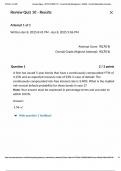
Review Quiz 10 - Results X
Attempt 1 of 1
Written Apr 8, 2025 8:41 PM - Apr 8, 2025 9:06 PM
Attempt Score 93.75 %
Overall Grade (Highest Attempt) 93.75 %
Question 1 points
A firm has issued 5-year bonds that have a continuously compounded YTM of
4.15% and an expected recovery rate of 53% in case of default. The
continuously compounded risk-free interest rate is 3.40%. What is the implied
risk-neutral default probability for these bonds in year 2?
Note: Your answer must be expressed in percentage terms and accurate to
within 0.01%.
Answer:
156 v
w Hide question 1 feedback
https://courses.torontomu.ca/d2l/Ims/quizzing/user/quiz_submissions_attempt.d21?isprv=&Qqi=441873&ai=10682624&isInPopup=0&cfql=-0&fromQB=0&... 1/7
, 4/16/25, 1:04 AM Gurleen Bajwa - AFF811/FIN801 011 - Financial Risk Management - W2025 - Toronto Metropolitan University
Feedback
The appropriate calculations are:
Lambda = (YTM -r) / (1 - Recovery rate)
Risk-neutral default probability in year N = exp(-Lambda x (N - 1)) - exp(-
Lambda x N)
Question 2 points
A bank is long a 3-year European call option that has a Black-Scholes-Merton
price of $6.15. The counterparty in this OTC trade has a default intensity of
0.010 and an expected recovery rate of 48% in case of default. What is the
CVA for each put?
Note: Your answer must be accurate to within one cent.
Answer:
0.09 v
w Hide question 2 feedback
Feedback
The appropriate calculations are:
Risk-neutral default probability in year N = exp(-Lambda x (N-1)) - exp(-
Lambda x N)
CVA = (1- Recovery rate) x (Sum of risk-neutral default probabilities in
years 1 to N x Call price)
Question 3 points
A bank has the following two netting sets with a particular counterparty:
https://courses.torontomu.ca/d2l/Ims/quizzing/user/quiz_submissions_attempt.d21?isprv=&Qqi=441873&ai=10682624&isInPopup=0&cfql=-0&fromQB=0&... 2/7
Review Quiz 10 - Results X
Attempt 1 of 1
Written Apr 8, 2025 8:41 PM - Apr 8, 2025 9:06 PM
Attempt Score 93.75 %
Overall Grade (Highest Attempt) 93.75 %
Question 1 points
A firm has issued 5-year bonds that have a continuously compounded YTM of
4.15% and an expected recovery rate of 53% in case of default. The
continuously compounded risk-free interest rate is 3.40%. What is the implied
risk-neutral default probability for these bonds in year 2?
Note: Your answer must be expressed in percentage terms and accurate to
within 0.01%.
Answer:
156 v
w Hide question 1 feedback
https://courses.torontomu.ca/d2l/Ims/quizzing/user/quiz_submissions_attempt.d21?isprv=&Qqi=441873&ai=10682624&isInPopup=0&cfql=-0&fromQB=0&... 1/7
, 4/16/25, 1:04 AM Gurleen Bajwa - AFF811/FIN801 011 - Financial Risk Management - W2025 - Toronto Metropolitan University
Feedback
The appropriate calculations are:
Lambda = (YTM -r) / (1 - Recovery rate)
Risk-neutral default probability in year N = exp(-Lambda x (N - 1)) - exp(-
Lambda x N)
Question 2 points
A bank is long a 3-year European call option that has a Black-Scholes-Merton
price of $6.15. The counterparty in this OTC trade has a default intensity of
0.010 and an expected recovery rate of 48% in case of default. What is the
CVA for each put?
Note: Your answer must be accurate to within one cent.
Answer:
0.09 v
w Hide question 2 feedback
Feedback
The appropriate calculations are:
Risk-neutral default probability in year N = exp(-Lambda x (N-1)) - exp(-
Lambda x N)
CVA = (1- Recovery rate) x (Sum of risk-neutral default probabilities in
years 1 to N x Call price)
Question 3 points
A bank has the following two netting sets with a particular counterparty:
https://courses.torontomu.ca/d2l/Ims/quizzing/user/quiz_submissions_attempt.d21?isprv=&Qqi=441873&ai=10682624&isInPopup=0&cfql=-0&fromQB=0&... 2/7