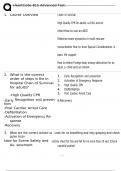
HeartCode BLS Advanced Test.
1. Course Overview Chain of survival
High Quality CPR for adults, a child, and an
infant How to use an AED
Ettective team dynamics in multi-rescuer
resuscitation How to treat Special Considerations in
basic life support
How to relieve Foreign-body airway obstruction for an
adult, a child and an infant
2. What is the correct 1. Early Recognition and prevention
order of steps in the In-
2. Activation of Emergency Response
Hospital Chain of Survival
3. High Quality CPR
for adults?
4. Defibrillation
5. Post Cardiac Arrest Care
-High Quality CPR
-Early Recognition and preven- 6.Recovery
tion
-Post Cardiac Arrest Care
-Defibrillation
-Activation of Emergency Re-
sponse
-Recovery
3. What are the correct actions to -Look for no breathing and only gasping and check
pulse (scan
take for Scene Safety and victims chest for rise and fall for no more than 10 sec) (Check
As- sessment carotid pulse)
, HeartCode BLS Advanced Test.
-Verify Scene Safety
-Check for Responsiveness (Tap shoulders,
Shout 'Are you
, HeartCode BLS Advanced Test.
OK?")
- Activate the Emergency Response System and get
an AED (Activate ERS via mobile device) (Get the AED or
send someone to do)
4. To minimize delay in Assess breathing and pulse at the same time. (no
starting CPR you may..... more than 10 sec)
5. What do we know about Gasping is not normal breathing and is a sign of
gasp- ing? cardiac arrest.
6. Pulse check on an adult 1. Locate the Trachea (on the side closest to you), using 2
or 3 fingers
2. Slide those fingers into the grove between the
trachea and the muscles at the side of the neck,
where you can feel the carotid pulse
3. Feel for a pulse for at least 5 but no more than
10 seconds (No pulse, begin CPR starting with chest
compressions)
7. What is the correct chest
com- pression rate for 100 to 120/min
adults ?
8. What can Feedback -Compression Depth
devices monitor?
-Compression Rate
-Chest Recoil
Feedback devices can monitor CPR and provide real-time
feed- back
1. Course Overview Chain of survival
High Quality CPR for adults, a child, and an
infant How to use an AED
Ettective team dynamics in multi-rescuer
resuscitation How to treat Special Considerations in
basic life support
How to relieve Foreign-body airway obstruction for an
adult, a child and an infant
2. What is the correct 1. Early Recognition and prevention
order of steps in the In-
2. Activation of Emergency Response
Hospital Chain of Survival
3. High Quality CPR
for adults?
4. Defibrillation
5. Post Cardiac Arrest Care
-High Quality CPR
-Early Recognition and preven- 6.Recovery
tion
-Post Cardiac Arrest Care
-Defibrillation
-Activation of Emergency Re-
sponse
-Recovery
3. What are the correct actions to -Look for no breathing and only gasping and check
pulse (scan
take for Scene Safety and victims chest for rise and fall for no more than 10 sec) (Check
As- sessment carotid pulse)
, HeartCode BLS Advanced Test.
-Verify Scene Safety
-Check for Responsiveness (Tap shoulders,
Shout 'Are you
, HeartCode BLS Advanced Test.
OK?")
- Activate the Emergency Response System and get
an AED (Activate ERS via mobile device) (Get the AED or
send someone to do)
4. To minimize delay in Assess breathing and pulse at the same time. (no
starting CPR you may..... more than 10 sec)
5. What do we know about Gasping is not normal breathing and is a sign of
gasp- ing? cardiac arrest.
6. Pulse check on an adult 1. Locate the Trachea (on the side closest to you), using 2
or 3 fingers
2. Slide those fingers into the grove between the
trachea and the muscles at the side of the neck,
where you can feel the carotid pulse
3. Feel for a pulse for at least 5 but no more than
10 seconds (No pulse, begin CPR starting with chest
compressions)
7. What is the correct chest
com- pression rate for 100 to 120/min
adults ?
8. What can Feedback -Compression Depth
devices monitor?
-Compression Rate
-Chest Recoil
Feedback devices can monitor CPR and provide real-time
feed- back