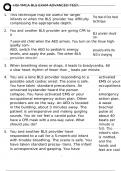
HSI YMCA BLS EXAM ADVANCED TEST.
1. This technique may be useful for larger
The Heel of One Hand
infants or when the BLS provider has difficulty
technique
compressing the appropriate depth.
2. You and another BLS provider are giving CPR to
a BLS provider should
con-
7-year-old child when the AED arrives. You turn on the tinue high-
quality com-
AED, switch the AED to pediatric energy pressions while the
levels, and apply the pads. The other BLS AED is charging
provider should:
3. When breathing slows or stops, it leads to bradycardia, 60
a slow heart rhythm of fewer than _ beats per minute.
4. You are a lone BLS provider responding to a activated
possible adult cardiac arrest. The scene is safe. EMS or your
You have taken standard precautions. An occupationa
untrained bystander heard the person l
collapse. You have activated EMS or your emergency
occupational emergency action plan. Other action plan.
providers are on the way. An AED is located A weak
in the building, about 3 minutes away. The brachial
patient is unresponsive and making gurgling pulse at
sounds. You do not feel a carotid pulse. You about 40
have a CPR mask with a one-way valve. What beats per
should you do? minute is
felt. The
5. You and another BLS provider have infant's skin
responded to a call for a 5-month-old infant is mottled,
with trouble breathing. The scene is safe. You and the
have taken standard precau- tions. The infant hands and
is unresponsive and gasping. You have feet are cool
1/
7
, HSI YMCA BLS EXAM ADVANCED TEST.
to touch. Other BLS providers Send the bystander to
get the AED. Start high-
quality CPR.
You should
start high-
quality CPR
2/
7
1. This technique may be useful for larger
The Heel of One Hand
infants or when the BLS provider has difficulty
technique
compressing the appropriate depth.
2. You and another BLS provider are giving CPR to
a BLS provider should
con-
7-year-old child when the AED arrives. You turn on the tinue high-
quality com-
AED, switch the AED to pediatric energy pressions while the
levels, and apply the pads. The other BLS AED is charging
provider should:
3. When breathing slows or stops, it leads to bradycardia, 60
a slow heart rhythm of fewer than _ beats per minute.
4. You are a lone BLS provider responding to a activated
possible adult cardiac arrest. The scene is safe. EMS or your
You have taken standard precautions. An occupationa
untrained bystander heard the person l
collapse. You have activated EMS or your emergency
occupational emergency action plan. Other action plan.
providers are on the way. An AED is located A weak
in the building, about 3 minutes away. The brachial
patient is unresponsive and making gurgling pulse at
sounds. You do not feel a carotid pulse. You about 40
have a CPR mask with a one-way valve. What beats per
should you do? minute is
felt. The
5. You and another BLS provider have infant's skin
responded to a call for a 5-month-old infant is mottled,
with trouble breathing. The scene is safe. You and the
have taken standard precau- tions. The infant hands and
is unresponsive and gasping. You have feet are cool
1/
7
, HSI YMCA BLS EXAM ADVANCED TEST.
to touch. Other BLS providers Send the bystander to
get the AED. Start high-
quality CPR.
You should
start high-
quality CPR
2/
7