
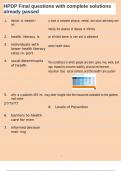
HPDP Final questions with complete solutions
already passed
1. What is health? a state of complete physical, mental, and social well-being and
not
merely the absence of disease or infirmity
2. health literacy is an oft-cited barrier to care and to adherence
3. individuals with worse health status
lower health literacy
rates re- port
4. social determinants The conditions in which people are born, grow, live, work, and
of health age, shaped by economic stability, physical environment,
education, food, social context, and the health care system
5. why is a patients SES im- may otter insight into the resources available to the patient,
mat make
portant?
8. Levels of Prevention
6. barriers to health
care for men
7. informed decision
mak- ing
1/
23
, HPDP Final questions with complete solutions
already passed
em eligible for social programs, otter
insight into underlying health beliefs
st, lack of insurance, fear, cultural/linguistic
ditterences, lack of aware- ness,
inconvenient hours, not able to get
timely apt
ood communication of the risks and
benefits of screening are impor-
tant.
nformed Decision Making in screening
involves the patient: under- standing
the screening test, its risks, benefits,
and alternatives, un- derstanding
their personal values and
preferences, weighing the pros and
cons of the test, clarifying their
decisional preferences, finding
additional information, if needed, and
deciding on an action plan
2/
23
, HPDP Final questions with complete solutions
already passed
Primary: prevent/promotion
Secondary: screen-early detection
Tertiary: treat- to prevent further deterioration, rehab
9. screening basics screening is the process of using tests on a large scale to
identify the
presence of disease in apparently healthy people
10. Lead screening all children on medicaid be screened with blood lead test 12-24
months
or at ages 36-72 months if not previously screened
11. lead screening USPSTF grade I (insuflcient evidence)
12. most common basal cell carcinoma
form of skin
cancer
13. most lethal form of skin malignant melanoma
cancer
14. Skin cancer USPSTF grade I (insuflcient)
15. leading cause of lung cancer
cancer deaths?
16. Lung cancer USPSTF Grade B (recommends yearly low dose CT adults 55-80 with 30
pack a
year hx and currently smoke or have quit in the last 15 years)
17. USPSTF prostate na- tion
cancer screening
18. impacts of an aging
3/
23
already passed
1. What is health? a state of complete physical, mental, and social well-being and
not
merely the absence of disease or infirmity
2. health literacy is an oft-cited barrier to care and to adherence
3. individuals with worse health status
lower health literacy
rates re- port
4. social determinants The conditions in which people are born, grow, live, work, and
of health age, shaped by economic stability, physical environment,
education, food, social context, and the health care system
5. why is a patients SES im- may otter insight into the resources available to the patient,
mat make
portant?
8. Levels of Prevention
6. barriers to health
care for men
7. informed decision
mak- ing
1/
23
, HPDP Final questions with complete solutions
already passed
em eligible for social programs, otter
insight into underlying health beliefs
st, lack of insurance, fear, cultural/linguistic
ditterences, lack of aware- ness,
inconvenient hours, not able to get
timely apt
ood communication of the risks and
benefits of screening are impor-
tant.
nformed Decision Making in screening
involves the patient: under- standing
the screening test, its risks, benefits,
and alternatives, un- derstanding
their personal values and
preferences, weighing the pros and
cons of the test, clarifying their
decisional preferences, finding
additional information, if needed, and
deciding on an action plan
2/
23
, HPDP Final questions with complete solutions
already passed
Primary: prevent/promotion
Secondary: screen-early detection
Tertiary: treat- to prevent further deterioration, rehab
9. screening basics screening is the process of using tests on a large scale to
identify the
presence of disease in apparently healthy people
10. Lead screening all children on medicaid be screened with blood lead test 12-24
months
or at ages 36-72 months if not previously screened
11. lead screening USPSTF grade I (insuflcient evidence)
12. most common basal cell carcinoma
form of skin
cancer
13. most lethal form of skin malignant melanoma
cancer
14. Skin cancer USPSTF grade I (insuflcient)
15. leading cause of lung cancer
cancer deaths?
16. Lung cancer USPSTF Grade B (recommends yearly low dose CT adults 55-80 with 30
pack a
year hx and currently smoke or have quit in the last 15 years)
17. USPSTF prostate na- tion
cancer screening
18. impacts of an aging
3/
23


