
PEDS ATI STUDY GUIDE
Study online at https://quizlet.com/_5pmleh
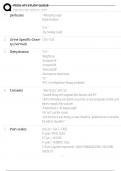
1. pertussis = Whooping cough
Droplet isolation
*S+S:*
-Dry, hacking cough
2. Urine Specific Gravi- 1.010-1.025
ty (normal)
3. Dehydration *S+S:*
-Weight loss
-Increased HR
-Increased RR
-Decreased BP
-Decreased or absent tears
*Tx:*
*#1)* Oral rehydration therapy (pedialyte)
4. Carseats -*Rear-facing* until 2 yrs
-Forward facing until outgrown then booster until 4'9"
-LATCH child safety seat system: secure the car seat using lower anchors and
tethers instead of the seat belt
-Positioned at a *45 degree angle*
-Do *not* pad the carseat
-Seat harness in rear-facing car seats should be *positioned at or just below
the infant's shoulders*
5. Pain scales 2mo-7yr = FLACC / CRIES
3+ years =FACES SCALE
3-13 yrs = OUCHER
5+ years = NUMERIC SCALE
3-18 yrs (cognitive impairment) = NON-COMMUNICATING CHILD PAIN
CHECKLIST
, PEDS ATI STUDY GUIDE
Study online at https://quizlet.com/_5pmleh
6. Hydrotherapy for -Extremely painful procedure which requires analgesia and/or sedation prior
debridement of a to procedure
wound -Apply mesh gauze to the child's wound following procedure
-Apply topical antimicrobial ointment after procedure
-Prophylactic antibiotic therapy is *not* recommended for children who have
burns
7. diabetes insipidus = Antidiuretic hormone is not secreted adequately, or the kidney is resistant
to its effect
*S+S:*
-Polyuria
-Polydipsia
-Dehydration
-Increased sodium levels
-Diluted urine
8. Nephrotic Syn- S+S:
drome -Edema/Facial edema (increased glomerular permeability, which increases
protein loss)
Tx:
-*Tx of choice corticosteroids* (decreases glomerular permeability, decreas-
ing edema)
-Low sodium diet
-Fluid restriction
9. peak expiratory flow = measures the child's airflow
meter -This should be done *twice daily* with the skill repeated in a sequence of
three, waiting *30 seconds* between each measurement.
-The parent should *record the highest of the three readings*
Study online at https://quizlet.com/_5pmleh
1. pertussis = Whooping cough
Droplet isolation
*S+S:*
-Dry, hacking cough
2. Urine Specific Gravi- 1.010-1.025
ty (normal)
3. Dehydration *S+S:*
-Weight loss
-Increased HR
-Increased RR
-Decreased BP
-Decreased or absent tears
*Tx:*
*#1)* Oral rehydration therapy (pedialyte)
4. Carseats -*Rear-facing* until 2 yrs
-Forward facing until outgrown then booster until 4'9"
-LATCH child safety seat system: secure the car seat using lower anchors and
tethers instead of the seat belt
-Positioned at a *45 degree angle*
-Do *not* pad the carseat
-Seat harness in rear-facing car seats should be *positioned at or just below
the infant's shoulders*
5. Pain scales 2mo-7yr = FLACC / CRIES
3+ years =FACES SCALE
3-13 yrs = OUCHER
5+ years = NUMERIC SCALE
3-18 yrs (cognitive impairment) = NON-COMMUNICATING CHILD PAIN
CHECKLIST
, PEDS ATI STUDY GUIDE
Study online at https://quizlet.com/_5pmleh
6. Hydrotherapy for -Extremely painful procedure which requires analgesia and/or sedation prior
debridement of a to procedure
wound -Apply mesh gauze to the child's wound following procedure
-Apply topical antimicrobial ointment after procedure
-Prophylactic antibiotic therapy is *not* recommended for children who have
burns
7. diabetes insipidus = Antidiuretic hormone is not secreted adequately, or the kidney is resistant
to its effect
*S+S:*
-Polyuria
-Polydipsia
-Dehydration
-Increased sodium levels
-Diluted urine
8. Nephrotic Syn- S+S:
drome -Edema/Facial edema (increased glomerular permeability, which increases
protein loss)
Tx:
-*Tx of choice corticosteroids* (decreases glomerular permeability, decreas-
ing edema)
-Low sodium diet
-Fluid restriction
9. peak expiratory flow = measures the child's airflow
meter -This should be done *twice daily* with the skill repeated in a sequence of
three, waiting *30 seconds* between each measurement.
-The parent should *record the highest of the three readings*


