PBSI 301 Exam 3 (tamu) questions and answers
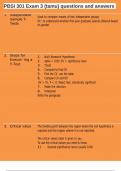
1. Independent
Used to compare means of two independent groups
Sample T-
EX : to understand whether first-year graduate salaries dittered based
Tests on gender
2. Steps for 1. Null/ Research Hypothesis
Execut- ing a 2. alpha = 0.05/ 5% = significance level
T-Test 3. T-test
4. Compute to find OV
5. Find the CV, use the table
6. Compare CV and OV
OV > CV, P < .0, Reject Null, statistically significant.
7. Make the decision.
8. Interpret
Write the paragraph.
3. Critical value The dividing point between the region where the null hypothesis is
rejected and the region where it is not rejected.
The critical values table is given to you.
To use the critical values you need to know:
1) Desired significance level (usually 0.05)
1/
11
, PBSI 301 Exam 3 (tamu) questions and answers
2) The number (N) of participants
3) Whether the hypothesis is directional or non-directional
4. Obtained Values Test statistic calculated by the researcher using the data he/she has
collected;
compared to critical values
- If the OV > CV, then the obtained value falls within the critical region, and
therefore is statistically significant = reject Ho
5. Degrees of Free- Number of values that are free to vary in a t-test
dom for Indepen- Large DF: distribution is normal, small CV
dent T Small DF: flatter, needs a bigger t-value, larger CV
6. 1 vs 2 Tailed Tests Looks at the ditterence between the means of two samples of data
1- tailed:
directional EX)
no ditterence
2- tailed:
nondirectional EX)
ditterent/ditterences
2/
11
1. Independent
Used to compare means of two independent groups
Sample T-
EX : to understand whether first-year graduate salaries dittered based
Tests on gender
2. Steps for 1. Null/ Research Hypothesis
Execut- ing a 2. alpha = 0.05/ 5% = significance level
T-Test 3. T-test
4. Compute to find OV
5. Find the CV, use the table
6. Compare CV and OV
OV > CV, P < .0, Reject Null, statistically significant.
7. Make the decision.
8. Interpret
Write the paragraph.
3. Critical value The dividing point between the region where the null hypothesis is
rejected and the region where it is not rejected.
The critical values table is given to you.
To use the critical values you need to know:
1) Desired significance level (usually 0.05)
1/
11
, PBSI 301 Exam 3 (tamu) questions and answers
2) The number (N) of participants
3) Whether the hypothesis is directional or non-directional
4. Obtained Values Test statistic calculated by the researcher using the data he/she has
collected;
compared to critical values
- If the OV > CV, then the obtained value falls within the critical region, and
therefore is statistically significant = reject Ho
5. Degrees of Free- Number of values that are free to vary in a t-test
dom for Indepen- Large DF: distribution is normal, small CV
dent T Small DF: flatter, needs a bigger t-value, larger CV
6. 1 vs 2 Tailed Tests Looks at the ditterence between the means of two samples of data
1- tailed:
directional EX)
no ditterence
2- tailed:
nondirectional EX)
ditterent/ditterences
2/
11