

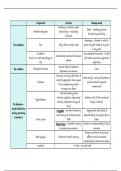
Components Function Damage causes
Breathing, circulation, heart
Death – breathing & heart
Medulla oblongata functioning – involuntary
functioning would stop
functions
Narcolepsy – disorder in which a
The hindbrain Pons Relay station, sleep & wake person may fall asleep at any time
in any place
Cerebellum Uncoordinated movements - trouble
Coordinated movements, balance &
*touch nose with index finger to with balance & posture, dysmetria,
posture
test dysarthria
Arousal (state of readiness)
The midbrain Reticular formation Coma
Sleep/wake consciousness
Processes incoming information &
Wide variety – sensory disturbances,
sends to appropriate brain region
Thalamus visual problems & cognitive
Role in emphasising certain
impairments
messages over others
Controls pituitary gland
Emotion regulation, sleep, sexual Problems with all the mentioned
Hypothalamus
activity, temperature, hunger & things it controls
The forebrain –
thirst
complex functions,
Amygdala – emotions & learning Inappropriate lack of fear &
sensory processing
and memory of emotional events impaired ability to recognise fear in
& emotions
Limbic system FEAR others
Hippocampus – involved in memory Amnesia or impaired ability to form
& encoding new memories memories
Change in posture & muscle tone,
Basal ganglia Movement, mood & memory affects normal movements
Cerebral palsy & Parkinsons disease
Cerebrum 4 lobes – see next table
Breathing, circulation, heart
Death – breathing & heart
Medulla oblongata functioning – involuntary
functioning would stop
functions
Narcolepsy – disorder in which a
The hindbrain Pons Relay station, sleep & wake person may fall asleep at any time
in any place
Cerebellum Uncoordinated movements - trouble
Coordinated movements, balance &
*touch nose with index finger to with balance & posture, dysmetria,
posture
test dysarthria
Arousal (state of readiness)
The midbrain Reticular formation Coma
Sleep/wake consciousness
Processes incoming information &
Wide variety – sensory disturbances,
sends to appropriate brain region
Thalamus visual problems & cognitive
Role in emphasising certain
impairments
messages over others
Controls pituitary gland
Emotion regulation, sleep, sexual Problems with all the mentioned
Hypothalamus
activity, temperature, hunger & things it controls
The forebrain –
thirst
complex functions,
Amygdala – emotions & learning Inappropriate lack of fear &
sensory processing
and memory of emotional events impaired ability to recognise fear in
& emotions
Limbic system FEAR others
Hippocampus – involved in memory Amnesia or impaired ability to form
& encoding new memories memories
Change in posture & muscle tone,
Basal ganglia Movement, mood & memory affects normal movements
Cerebral palsy & Parkinsons disease
Cerebrum 4 lobes – see next table


