
• Wrong document? Swap it for free
  • Written by students who passed
  • Immediately available after payment
  • Read online or as PDF
Sell
Where do you study
Your language
Document preview thumbnail
Preview 2 out of 14 pages
Exam (elaborations)

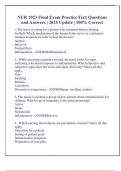
NUR 1023 Final Exam Practice Test| Questions and Answers | 2025 Update | 100% Correct

Document preview thumbnail
Preview 2 out of 14 pages

NUR 1023 Final Exam Practice Test| Questions and Answers | 2025 Update | 100% Correct 1. The nurse is caring for a patient who sustained bruises playing football. Which mechanism of the human body serves as a defensive immune response in order to heal the bruises? Asepsis Infection Normal flora Inflammation - ANSWERinflammation 2. While assessing a patient's wound, the nurse looks for signs indicating a localized response to inflammation. Which objective and subjective signs does the nurse anticipate observing? Select all that apply. Pain Swelling Redness Laceration Decrease in temperature - ANSWERpain, swelling, redness 3. The nurse is teaching a group of new parents about immunizations for children. Which type of immunity is the nurse promoting? Active Innate Nonspecific Inflammatory - ANSWERActive 4. Which nursing interventions are prevention-oriented? Select all that apply. Education for a patient Setting of patient goals Immunization programs Preparation of care plan 5. Administration of vaccines - ANSWEREducation for a patient, Immunization programs, Administration of vaccines 6. The nurse is caring for a patient who has undergone a cystoscopy. Which possible complications would the nurse assess for after the procedure? Select all that apply. Hematuria Bladder atony Bladder edema Bladder prolapse Urinary retention - ANSWER1, 3, 5 7. Which nursing intervention would be priority if a child has accidentally sprayed furniture polish into both eyes? Call the Poison Control Center. Rinse both eyes with water. Instill antihistamine eye drops. Give syrup of ipecac. - ANSWERrinse both eyes with water 8. While providing a bed bath, the nurse observes that a patient has reddened areas on the back. Which measure taken by the nurse would be most helpful in this situation? Keeping the patient in a supine position Exposing the reddened areas of the patient to light Applying talcum powder all over the reddened areas Not massaging any reddened areas of the patient - ANSWERNot massaging any reddened areas of the patient 9. The nurse is assessing a patient who is receiving intravenous (IV) therapy. The patient has developed phlebitis and reports pain with erythema. Which grade on the phlebitis scale of severity does the nurse assign the patient? 0 1 2 3 - ANSWERright answer is 2 A score of 0 on the scale indicates no symptoms of phlebitis. A score of 1 on the scale indicates redness with or without pain. A numeric scale is used to grade the severity of phlebitis; pain with erythema at the site of the IV infusion indicates a severity grade of 2. A score of 3 indicates redness, pain with erythema, and a red streak along the vein and palpable venous cord. 10. Which clinical manifestations does the nurse expect to find in a patient who has a febrile nonhemolytic reaction after receiving a blood transfusion? Select all that apply. Malaise Chest pain Facial flushing Laryngeal swelling A 2-degree (Fahrenheit) increase in body temperature - ANSWERMalaise Facial flushing A 2-degree (Fahrenheit) increase in body temperature The nurse educator is teaching a group of student nurses about infections and the body's defense mechanisms. Which statement made by the student nurse indicates effective learning? "All infectious agents have the same shapes and sizes." "Inflammation is the establishment of a pathogen from an infectious agent." "Asepsis is being free from or preventing contact with disease-causing microorganisms. "Infection is the invasion of disease-causing and non-disease-causing organisms in a susceptible host." - ANSWER"Asepsis is being free from or preventing contact with disease-causing microorganisms. 11. The nurse is caring for a patient with burn injuries. Arrange the order in which the immune system reacts to the stress of a burn injury. 1. A pain signal is sent to the brain. 2.A general response is triggered. 3.The hypothalamus receives a signal. 4.The white blood corpuscles migrate to the site. 5.The immune cells affect adjacent blood vessels. - ANSWER1. A pain signal is sent to the brain. 3.The hypothalamus receives a signal. 5.The immune cells affect adjacent blood vessels. 4.The white blood corpuscles migrate to the site. 2.A general response is triggered. 12. Which neurotransmitter regulates the process of inflammation? Cytokines Serotonin Substance P Prostaglandins - ANSWERCytokines 13. The nurse is caring for an unconscious patient who is on respiratory support. Upon assessment, the nurse finds that the patient has decreased urine output, a temperature of 95°F (35°C), low blood pressure of 90/60 mm Hg, increased heart rate of 120 beats per minute, and increased respiratory rate of 28 labored breaths per minute. Which condition does the nurse interpret from these assessment findings? Varicella Leukemia Septicemia Aplastic anemia - ANSWERSepticemia 14. While assessing a postoperative patient, the nurse observes that the skin around the incision is warm and red, and the area is tender to touch. The patient tells the nurse, "I have pain at the incision site at a level of 8 out of 10." Which condition does the nurse interpret from the assessment? Septicemia Local infection Healing process Systemic infection - ANSWERLocal infection 15. The nurse is caring for a patient who is receiving intravenous (IV) therapy. Which assessment finding in this patient would indicate phlebitis? Blanched skin Reddened area Increased heart rate Increased blood pressure - ANSWERreddened area 16. A nurse is teaching nursing students about the Health Promotion Model (HPM). Which components belong to the HPM? Select all that apply. Behavioral outcomes Individual characteristics and experiences Behavior-specific knowledge and affect Individual's perception of susceptibility to illness Likelihood that a person will take preventive action - ANSWERBehavioral outcomes Individual characteristics and experiences Behavior-specific knowledge and affect 17. An adult patient with peripheral vascular disease (PVD) has developed gangrene of the left foot. Which measures would be considered secondary preventive measures in this case? Select all that apply. Referring the patient to an occupational therapist Amputating the left foot under sterile environment Conducting Doppler studies on the right leg to detect any changes Administering antibiotics to prevent septicemia Mobilizing the patient to prevent pressure ulcers - ANSWER-Amputating the left foot under sterile environment -Conducting Doppler studies on the right leg to detect any changes -Administering antibiotics to prevent septicemia 18. Which concepts provide a useful framework for implementing the nursing process as explained in the Health Belief Model (HBM)? Select all that apply. Self-efficacy Cues to action Perceived benefits Physical limitations Perceived susceptibility - ANSWERSelf-efficacy Cues to action Perceived benefits Perceived susceptibility 19. Which interventions should the nurse provide a 16-year-old adolescent to promote normal growth and development? Select all that apply. Explain all procedures to the patient before performing them. Refrain from including family members in the plan of care. Provide measures to promote socialization in the adolescent. Encourage the patient to verbalize his or her queries and feelings. Teach the patient to follow the hospital rules and regulations - ANSWERExplain all procedures to the patient before performing them. -Provide measures to promote socialization in the adolescent. -Encourage the patient to verbalize his or her queries and feelings. 20. An older adult reports an increased inability to distinguish between various colors. Which normative age-related change is this due to? Decrease in optical nerve cells Increased eye lens density Stiffening of the eye lens Eye lens yellowing - ANSWEReye lens yellowing 21. Which lifestyle factors should the nurse encourage to promote well-being in a group of middle-aged adults? Select all that apply. Life investment Exercise A good marital life Competitive social relationships Mastery of a single role - ANSWERLife investment Exercise A good marital life 22. Nine-year-old Brian has a difficult time making friends at school and being chosen to play on the team. He also has trouble completing his homework and, as a result, receives little positive feedback from his parents or teacher. According to Erikson's theory, failure at this stage of development may result in which outcome? A sense of guilt A poor sense of self Feelings of inferiority Mistrust - ANSWERFeelings of inferiority 23. The mother of a child reports to the nurse, "My child enjoys going to school, drawing pictures, and playing with friends." Which stage of psychosexual development is the child experiencing? Anal Phallic Latency Genital - ANSWERlatency 24. Sexual activity in older adulthood depends on which factors? Select all that apply. Physical mobility Moral and religious beliefs Chronologic age Sex drive Presence of illness - ANSWERPhysical mobility Moral and religious beliefs Sex drive Presence of illness 25. The type of injury a child is most vulnerable to at a specific age is most closely related to which factor? Provision of adult supervision Educational level of the parent Physical health of the child Developmental level of the child - ANSWERDevelopmental level of the child 26. A 7-year-old child is asked to choose between two different sizes of cups of ice cream and takes the large cup with 4 small scoops of ice cream rather than the small cup with a single large scoop. The small cup is totally filled with ice cream, and the large cup is half filled. According to Piaget's theory, which ability has influenced the child's decision? Centration Object permanence Animism Oral stage - ANSWERcentration 27. When preparing a 4-year-old child for a procedure, which method is most developmentally appropriate for the nurse to use? Allowing the child to watch another child undergoing the same procedure Showing the child pictures of what he or she will experience Talking to the child in simple terms about what will happen Preparing

Content preview

NUR 1023 Final Exam Practice Test| Questions
and Answers | 2025 Update | 100% Correct
1. The nurse is caring for a patient who sustained bruises playing
football. Which mechanism of the human body serves as a defensive
immune response in order to heal the bruises?
Asepsis
Infection
Normal flora
Inflammation - ANSWERinflammation

2. While assessing a patient's wound, the nurse looks for signs
indicating a localized response to inflammation. Which objective and
subjective signs does the nurse anticipate observing? Select all that
apply.
Pain
Swelling
Redness
Laceration
Decrease in temperature - ANSWERpain, swelling, redness

3. The nurse is teaching a group of new parents about immunizations for
children. Which type of immunity is the nurse promoting?
Active
Innate
Nonspecific
Inflammatory - ANSWERActive

4. Which nursing interventions are prevention-oriented? Select all that
apply.
Education for a patient
Setting of patient goals
Immunization programs
Preparation of care plan

, 5. Administration of vaccines - ANSWEREducation for a patient,
Immunization programs, Administration of vaccines

6. The nurse is caring for a patient who has undergone a cystoscopy.
Which possible complications would the nurse assess for after the
procedure? Select all that apply.
Hematuria
Bladder atony
Bladder edema
Bladder prolapse
Urinary retention - ANSWER1, 3, 5

7. Which nursing intervention would be priority if a child has
accidentally sprayed furniture polish into both eyes?
Call the Poison Control Center.
Rinse both eyes with water.
Instill antihistamine eye drops.
Give syrup of ipecac. - ANSWERrinse both eyes with water

8. While providing a bed bath, the nurse observes that a patient has
reddened areas on the back. Which measure taken by the nurse would be
most helpful in this situation?
Keeping the patient in a supine position
Exposing the reddened areas of the patient to light
Applying talcum powder all over the reddened areas
Not massaging any reddened areas of the patient - ANSWERNot
massaging any reddened areas of the patient

9. The nurse is assessing a patient who is receiving intravenous (IV)
therapy. The patient has developed phlebitis and reports pain with
erythema. Which grade on the phlebitis scale of severity does the nurse
assign the patient?
0
1
2


Document information

Uploaded on
July 10, 2025
Number of pages
14
Written in
2024/2025
Type
Exam (elaborations)
Contains
Questions & answers
$16.49

Wrong document? Swap it for free Within 14 days of purchase and before downloading, you can choose a different document. You can simply spend the amount again.
Written by students who passed
Immediately available after payment
Read online or as PDF

Sold
1
Followers
0
Items
24
Last sold
9 months ago


Why students choose Stuvia

Created by fellow students, verified by reviews

Quality you can trust: written by students who passed their tests and reviewed by others who've used these notes.

Didn't get what you expected? Choose another document

No worries! You can instantly pick a different document that better fits what you're looking for.

Pay as you like, start learning right away

No subscription, no commitments. Pay the way you're used to via credit card and download your PDF document instantly.

Student with book image

“Bought, downloaded, and aced it. It really can be that simple.”

Alisha Student

Working on your references?

Create accurate citations in APA, MLA and Harvard with our free citation generator.

Working on your references?

Frequently asked questions
