

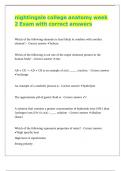
nightingale college anatomy week |! |! |! |!
2 Exam with correct answers
|! |! |! |!
Which of the following elements is least likely to combine with another
|! |! |! |! |! |! |! |! |! |! |! |!
element? - Correct answer ✔helium |! |! |! |!
Which of the following is not one of the major elements present in the
|! |! |! |! |! |! |! |! |! |! |! |! |! |!
human body? - Correct answer ✔zinc |! |! |! |! |!
AB + CD → AD + CB is an example of a(n) _____ reaction. - Correct answer
|! |! |! |! |! |! |! |! |! |! |! |! |! |! |! |! |!
✔exchange
An example of a catabolic process is - Correct answer ✔hydrolysis
|! |! |! |! |! |! |! |! |! |!
The approximate pH of gastric fluid is - Correct answer ✔2
|! |! |! |! |! |! |! |! |! |!
A solution that contains a greater concentration of hydroxide ions (OH-) than
|! |! |! |! |! |! |! |! |! |! |!
hydrogen ions (H+) is a(n) _____ solution - Correct answer ✔alkaline
|! |! |! |! |! |! |! |! |! |! |! |!
(basic)
Which of the following represents properties of water? - Correct answer
|! |! |! |! |! |! |! |! |! |! |!
✔High specific heat |! |!
High heat of vaporization
|! |! |!
Strong polarity |!
, Answer : All of the above |! |! |! |! |!
Atomic mass is determined by the number of - Correct answer ✔protons and
|! |! |! |! |! |! |! |! |! |! |! |! |!
neutrons.
The study of metabolism includes examination of - Correct answer
|! |! |! |! |! |! |! |! |! |!
✔catabolism
anabolism.
ATP requirements.
|!
Answer : all of the above. |! |! |! |! |!
A example of a catabolic process is - Correct answer ✔hydrolysis
|! |! |! |! |! |! |! |! |! |!
The octet rule refers to the - Correct answer ✔stability of the atom when
|! |! |! |! |! |! |! |! |! |! |! |! |! |!
there are eight electrons in the outermost energy level.
|! |! |! |! |! |! |! |!
Substances that accept hydrogen ions are called - Correct answer ✔base
|! |! |! |! |! |! |! |! |! |!
When atoms combine, they may gain, lose, or share - Correct answer
|! |! |! |! |! |! |! |! |! |! |! |!
✔electrons
Acids - Correct answer ✔are proton donors.
|! |! |! |! |! |!
taste sour. |!
release hydrogen ions in an aqueous solution.
|! |! |! |! |! |!
2 Exam with correct answers
|! |! |! |!
Which of the following elements is least likely to combine with another
|! |! |! |! |! |! |! |! |! |! |! |!
element? - Correct answer ✔helium |! |! |! |!
Which of the following is not one of the major elements present in the
|! |! |! |! |! |! |! |! |! |! |! |! |! |!
human body? - Correct answer ✔zinc |! |! |! |! |!
AB + CD → AD + CB is an example of a(n) _____ reaction. - Correct answer
|! |! |! |! |! |! |! |! |! |! |! |! |! |! |! |! |!
✔exchange
An example of a catabolic process is - Correct answer ✔hydrolysis
|! |! |! |! |! |! |! |! |! |!
The approximate pH of gastric fluid is - Correct answer ✔2
|! |! |! |! |! |! |! |! |! |!
A solution that contains a greater concentration of hydroxide ions (OH-) than
|! |! |! |! |! |! |! |! |! |! |!
hydrogen ions (H+) is a(n) _____ solution - Correct answer ✔alkaline
|! |! |! |! |! |! |! |! |! |! |! |!
(basic)
Which of the following represents properties of water? - Correct answer
|! |! |! |! |! |! |! |! |! |! |!
✔High specific heat |! |!
High heat of vaporization
|! |! |!
Strong polarity |!
, Answer : All of the above |! |! |! |! |!
Atomic mass is determined by the number of - Correct answer ✔protons and
|! |! |! |! |! |! |! |! |! |! |! |! |!
neutrons.
The study of metabolism includes examination of - Correct answer
|! |! |! |! |! |! |! |! |! |!
✔catabolism
anabolism.
ATP requirements.
|!
Answer : all of the above. |! |! |! |! |!
A example of a catabolic process is - Correct answer ✔hydrolysis
|! |! |! |! |! |! |! |! |! |!
The octet rule refers to the - Correct answer ✔stability of the atom when
|! |! |! |! |! |! |! |! |! |! |! |! |! |!
there are eight electrons in the outermost energy level.
|! |! |! |! |! |! |! |!
Substances that accept hydrogen ions are called - Correct answer ✔base
|! |! |! |! |! |! |! |! |! |!
When atoms combine, they may gain, lose, or share - Correct answer
|! |! |! |! |! |! |! |! |! |! |! |!
✔electrons
Acids - Correct answer ✔are proton donors.
|! |! |! |! |! |!
taste sour. |!
release hydrogen ions in an aqueous solution.
|! |! |! |! |! |!


