

Written by students who passed Immediately available after payment Read online or as PDF Wrong document? Swap it for free 4.6 TrustPilot
logo-home
Document preview thumbnail
Preview 2 out of 5 pages
Exam (elaborations)

NSG 481: Biostatistics and Applied Epidemiology Quiz 1_ Complete Questions and Answers.

Document preview thumbnail
Preview 2 out of 5 pages

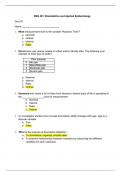
NSG 481: Biostatistics and Applied Epidemiology Quiz #1 Name: 1. What measurement level is the variable “Reaction Time”? a. Nominal b. Ordinal c. Interval d. Ratio 2. Statisticians use various scales to collect and/or identify data. The following is an example of what type of scale? Pain Intensity 0 No pain 1 Minor/little pain 2 Moderate pain 3 Severe pain a. Nominal b. Interval c. Ratio d. Ordinal 3. Someone who ranks a list of cities from slowest to fastest pace of life is operating at the level of measurement. a. Nominal b. Interval c. Ratio d. Ordinal 4. An investigator studies how concept-formulation ability changes with age. Age is a discrete variable. a. True b. False 5. What is the purpose of descriptive statistics? a. To summarize, organize, simplify data. b. To examine relationships between variables by measuring two different variables for each individual. c. To report the discrepancy or amount of error exists between a sample statistic and the corresponding population parameter. d. To report a characteristic or condition that changes or has different values for different individuals 6. Central Tendency refers to: a. An organized tabulation of number of individuals located in each categories on the scale of measurement b. A measurement or observation c. A numerical value that describes a sample d. A statistical measure to determine a single score that defines the center of a distribution 7. Which of the following is not a measure of central tendency? a. Mean b. Median c. Mode d. Standard deviation 8. Which measure of central tendency will be most affected if one extremely large score is added to a distribution? a. Mean b. Median c. Mode d. Standard deviation 9. In the below distribution of scores, what is the mean? X f 12 3 11 0 10 1 9 1 8 1 7 1 a. 12 b. 10 (70/7=10) c. 11.5 d. 13.5 10. The median is represented by which score? X f 12 3 11 0 10 1 9 1 8 1 7 1 a. 12 b. 10 c. 9 d. 9 11. Symmetrical distributions are the best described by which of the following statements? a. They have equal number of data points that appear to the left and to the right of the center b. They have a U-shaped distribution-Bell shape c. They tend to pile up toward one of end of the scale and taper off gradually at the other end. d. All of the above 12. The direction of skewness is determined by the relative position of the: a. Peak of the distribution b. Midpoint of the distribution c. Tail of the distribution d. Class limits of the distribution 13. Three measures of variability include the following a. Mean, medina, and mode b. Mean, standard deviation, and data c. Range, variance, and standard deviation d. Mode, range, standard deviation 14. Standard deviation refers to a. The average difference between the mean and each of the scores in the data set b. A difference score based on the lowest and highest value in the set c. Scores that have been standardized to have a mean of zero d. Grouping scores so as that the range in each set is standardized and equal 15. Which of the following statements best describes variance: a. A measure of the spread of the recorded values on a variable b. The larger the variance, the further the individual cases are from the mean c. The most commonly used measure of variability d. All of the above 16. Which measure of central tendency represents the point of maximum frequency in a distribution? a. Mode b. Median c. Mean d. None of the above 17. The variance and standard deviation assume: a. Nominal data b. Ordinal data c. Interval/ratio data d. A normal distribution 18. Calculate the SS (Sum of squares) for this table using the formula (SS=∑ X2 - [(∑ (∑ X )2 ∑ X 2− 19. Calculate the sample (not population) variance for above table using the formula s2= SS n−1 . 20. Calculate the standard deviation of the sample (not population) of scores in the s =√ SS Wegesin and Stern (2004) found greater consistency (less variability) in the memory performance scores for younger women than for older women. The following data represent memory scores obtained for two women, one older and one younger, over a series of memory trials. Calculate the variance of the sample (not for population) for each women using the formula SS=∑ X2 - [(∑ X)2/n] . 21. Younger: 8, 6, 6, 7, 8, 7, 8, 8 Sample; SS =5.58 22. Older: 7 ,5 8 ,5 ,7 ,6, 8, 5 23. Are the scores for the younger woman more consistent (less variable?)

Content preview

NSG 481: Biostatistics and Applied Epidemiology

Quiz #1

Name:

1. What measurement level is the variable “Reaction Time”?
a. Nominal
b. Ordinal
c. Interval
d. Ratio

2. Statisticians use various scales to collect and/or identify data. The following is an
example of what type of scale?

Pain Intensity
0 No pain
1 Minor/little pain
2 Moderate pain
3 Severe pain

a. Nominal
b. Interval
c. Ratio
d. Ordinal

3. Someone who ranks a list of cities from slowest to fastest pace of life is operating at
the level of measurement.
a. Nominal
b. Interval
c. Ratio
d. Ordinal

4. An investigator studies how concept-formulation ability changes with age. Age is a
discrete variable.
a. True
b. False

5. What is the purpose of descriptive statistics?
a. To summarize, organize, simplify data.
b. To examine relationships between variables by measuring two different
variables for each individual.

, c. To report the discrepancy or amount of error exists between a sample statistic
and the corresponding population parameter.
d. To report a characteristic or condition that changes or has different values for
different individuals

6. Central Tendency refers to:
a. An organized tabulation of number of individuals located in each categories
on the scale of measurement
b. A measurement or observation
c. A numerical value that describes a sample
d. A statistical measure to determine a single score that defines the center of a
distribution

7. Which of the following is not a measure of central tendency?
a. Mean
b. Median
c. Mode
d. Standard deviation

8. Which measure of central tendency will be most affected if one extremely large score
is added to a distribution?

a. Mean
b. Median
c. Mode
d. Standard deviation

9. In the below distribution of scores, what is the mean?
X f
12 3
11 0
10 1
9 1
8 1
7 1
a. 12
b. 10 (70/7=10)
c. 11.5
d. 13.5

10. The median is represented by which score?
X f
12 3

Document information

Uploaded on
July 7, 2025
Number of pages
5
Written in
2024/2025
Type
Exam (elaborations)
Contains
Questions & answers
$13.99

Wrong document? Swap it for free Within 14 days of purchase and before downloading, you can choose a different document. You can simply spend the amount again.
Written by students who passed
Immediately available after payment
Read online or as PDF

Seller avatar
Reputation scores are based on the amount of documents a seller has sold for a fee and the reviews they have received for those documents. There are three levels: Bronze, Silver and Gold. The better the reputation, the more your can rely on the quality of the sellers work.
MindCraft
3.8
(49)
Sold
387
Followers
10
Items
2836
Last sold
6 hours ago


Why students choose Stuvia

Created by fellow students, verified by reviews

Quality you can trust: written by students who passed their tests and reviewed by others who've used these notes.

Didn't get what you expected? Choose another document

No worries! You can instantly pick a different document that better fits what you're looking for.

Pay as you like, start learning right away

No subscription, no commitments. Pay the way you're used to via credit card and download your PDF document instantly.

Student with book image

“Bought, downloaded, and aced it. It really can be that simple.”

Alisha Student

Working on your references?

Create accurate citations in APA, MLA and Harvard with our free citation generator.

Working on your references?

Frequently asked questions
