
CSLB Practice Test With Complete Solutions.
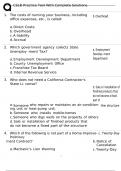
1. The costs of running your business, including b. Overhead
office expenses, etc., is called:
a. Direct Costs
b. Overhead
c. A liability
d. Accrual
2. Which government agency collects State
a. Employment
Unemploy- ment Tax?
Develop- ment
a. Employment Development Department Department
b. County Unemployment Office
c. Franchise Tax Board
d. Internal Revenue Service
3. Who does not need a California Contractor's
State Li- cense?
d. Sale or installation of
finished products that
do not become a fixed
part of
a. Someone who repairs or maintains an air-condition- the structure
ing unit or heat-pump unit.
b. Someone who installs mobile-homes
c. Someone who digs wells on the property of others
d. Sale or installation of finished products that
do not become a fixed part of the structure
4. Which of the following is not part of a Home-Improve- c. Twenty-Day
Preliminary
ment Contract? b. Notice of
Cancellation
a. Mechanic's Lien Warning c. Twenty-Day
1/
17
, CSLB Practice Test With Complete Solutions.
Preliminary Notice Notice
d. All of the above.
2/
17
, CSLB Practice Test With Complete Solutions.
5. Prime Contractor must pay subcontractor d. All of the
when? above
a. 10-days after Prime-contractor received
payment
b. When Prime-contractor receives withheld
retention monies
c. 30-days after completion
d. As soon as subcontractor completes the work
6. The Contractor's Surety Bond is necessary
for most contractors to obtain their license.
This bond is in the amount of:
a. $2,500
b. $7,000
c. $15,000
d. $25,000
7. How long with the CSLB hold a contractor
responsible for observable defects?
a. 5-years
b. 4-years
c. 3-years
d. 2-years
8. In which of the following circumstances
must a li- censed contractor provide their
license number?
a. On all contracts
b. On all advertising
c. On all "20-day Preliminary Notices"
3/
17


