BSW FINAL EXAM REVIEW TEST.
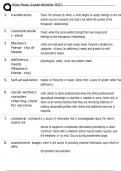
1. transference Freud. the process by which a client begins to assign feelings to the soc
worker such as a romantic one, that is not within the context of the
therapeutic relationship.
2. countertransfe Freud. when the social worker brings their own issues and
r- ence feelings to the therapeutic relationship.
3. Maslow's clients are motivated to meet certain needs. Pyramid is divided into
Hierar- chy of categories of basic (or deficiency) needs and growth (or self-
Needs actualization) needs.
4. deficiency physiological, safety, social and esteem needs
needs
(Maslow's
Hierar- chy)
5. Self-actualization highest on Hierarchy of needs. Stems from a place of growth rather than
deficiency.
6. social workers refer clients to other professionals when the other professionals'
consider specialized knowledge or expertise is needed to serve clients fully or
referring client when social workers believe that they are not being ettective or
for services making reasonable profess with clients and additional services is
required.
7. collateral contact is a source of information that is knowledgeable about the client's
situation and
serves to support or corroborate information provided by a client.
Communi- cation with a collateral contact may be made in person, over
the telephone, or by mail. Occurs during assessment stage.
8. assessment stage a client is the source of providing essential information upon which to
define
the problem and solutions
1/
36
, BSW FINAL EXAM REVIEW TEST.
9. Engagement stage First stage of problem-solving process where sw meets clt., establishe
the clt's
rationale for seeking help and begins to establish rapport.
10. planning stage goals are developed to help the client move toward their preferred
lifestyle.
2/
36
, BSW FINAL EXAM REVIEW TEST.
11. intervention stage client and sw work together to help the client make progress towards
goals and
objectives
12. Generalist engagement, assessment, planning, implementation, eval., termination,
Inter- vention follow up
Model (GIM)
13. formative typically assessed during their development or early implementation to
evalua- tion provide information about how best to revise and modify for
improvement. This type of evaluation often is helpful for pilot projects
and new programs, but can be used for progress monitoring of
ongoing programs
14. Summative
evalu- ation Occurs at the end of services and provide an overall description of
their ef- fectiveness. It examines outcomes to determine whether
objectives were met. Enables decisions to be made regarding future
service directions that cannot be made during implementation. (Cost-
benefit analyses)
15. needs assessment a systematic process for determining and addressing needs, or "gap
between
current conditions and desired conditions or "wants". The discrepancy
between the current condition and wanted condition must be
measured to appropriately identify the need.
16. cost-benefit seek to measure the financial gain of a program against its costs.
analy- sis Used to determine options that provide the best approach to achieve
benefits while preserving savings
17. self-disclosure when a therapist shares their own personal views or experience with
client
with the purpose of improving the client's emotional or mental state.
3/
36
, BSW FINAL EXAM REVIEW TEST.
Counselors must be very careful when using this. Otherwise the
session can become more about the counselor than the client, and
that does not serve the clients' needs.
18. interactionist
4/
36
1. transference Freud. the process by which a client begins to assign feelings to the soc
worker such as a romantic one, that is not within the context of the
therapeutic relationship.
2. countertransfe Freud. when the social worker brings their own issues and
r- ence feelings to the therapeutic relationship.
3. Maslow's clients are motivated to meet certain needs. Pyramid is divided into
Hierar- chy of categories of basic (or deficiency) needs and growth (or self-
Needs actualization) needs.
4. deficiency physiological, safety, social and esteem needs
needs
(Maslow's
Hierar- chy)
5. Self-actualization highest on Hierarchy of needs. Stems from a place of growth rather than
deficiency.
6. social workers refer clients to other professionals when the other professionals'
consider specialized knowledge or expertise is needed to serve clients fully or
referring client when social workers believe that they are not being ettective or
for services making reasonable profess with clients and additional services is
required.
7. collateral contact is a source of information that is knowledgeable about the client's
situation and
serves to support or corroborate information provided by a client.
Communi- cation with a collateral contact may be made in person, over
the telephone, or by mail. Occurs during assessment stage.
8. assessment stage a client is the source of providing essential information upon which to
define
the problem and solutions
1/
36
, BSW FINAL EXAM REVIEW TEST.
9. Engagement stage First stage of problem-solving process where sw meets clt., establishe
the clt's
rationale for seeking help and begins to establish rapport.
10. planning stage goals are developed to help the client move toward their preferred
lifestyle.
2/
36
, BSW FINAL EXAM REVIEW TEST.
11. intervention stage client and sw work together to help the client make progress towards
goals and
objectives
12. Generalist engagement, assessment, planning, implementation, eval., termination,
Inter- vention follow up
Model (GIM)
13. formative typically assessed during their development or early implementation to
evalua- tion provide information about how best to revise and modify for
improvement. This type of evaluation often is helpful for pilot projects
and new programs, but can be used for progress monitoring of
ongoing programs
14. Summative
evalu- ation Occurs at the end of services and provide an overall description of
their ef- fectiveness. It examines outcomes to determine whether
objectives were met. Enables decisions to be made regarding future
service directions that cannot be made during implementation. (Cost-
benefit analyses)
15. needs assessment a systematic process for determining and addressing needs, or "gap
between
current conditions and desired conditions or "wants". The discrepancy
between the current condition and wanted condition must be
measured to appropriately identify the need.
16. cost-benefit seek to measure the financial gain of a program against its costs.
analy- sis Used to determine options that provide the best approach to achieve
benefits while preserving savings
17. self-disclosure when a therapist shares their own personal views or experience with
client
with the purpose of improving the client's emotional or mental state.
3/
36
, BSW FINAL EXAM REVIEW TEST.
Counselors must be very careful when using this. Otherwise the
session can become more about the counselor than the client, and
that does not serve the clients' needs.
18. interactionist
4/
36