

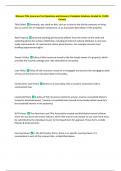
Missouri Title Insurance Test Questions and Answers |Complete Solutions Graded A+ |100%
Correct
Title Defect Generally, any cloud on title, such as a claim to the title by someone or thing
due to a prior lien or improper conveyance, or an inaccurate description of the property.
Real Property Land and anything permanently affixed, from the center of the earth and
extending above the surface indefinitely, including all inherent natural attributes in any man-
made improvements of a permanent nature place thereon. For example minerals trees
buildings appurtenant rights
Owner's Policy Policy of title insurance issued to the fee simple owner of a property, which
provides the insured coverage over risks described on the policy.
Loan Policy Policy of title insurance issued to a mortgagee and ensures the mortgagees deed
of trust on the land over risks described on the policy.
Construction Loan Policy Similar to a loan policy, this is issued in conjunction with a
construction loan.
Leasehold Policy A policy of title insurance related to a lease; may be a Leasehold Owner's
(issued to leasehold owner / lessee) or Leasehold Loan (issued to the lender whose security is
the leasehold interest in the property).
ALTA Forms The American Land Title Association created and distributed several uniform
forms for use across the entire industry, which title insurers can choose to use; each form must
be submitted by the individual insurer to the Department for approval. These forms include
Policies & Endorsements.
Insuring Clause In the ALTA policy forms, there is no specific insuring clause, it is
enumerated in each of the covered risks, as identified above.
, Terms, Conditions and Stipulations Governing language of a title policy (please refer to
Sample Policies for specific reference):
The TERMS section of the policy will provide specific definitions of the various terms and
phrases in the policy, such as Insured or Land.
CONDITIONS and STIPULATIONS are specifically listed in the policy, and set out the claims
process, the requirements for submitting a claim, the specified areas of protection, and duties
of the Insured and the Insurance Company under the policy.
Exclusions Specifically set out matters that the policy will not protect against.
Subrogation Subrogation is the substitution of one person in the place of another with
reference to a lawful claim or right. It commonly occurs in insurance matters, when an
insurance company which pays it insured client for injuries and loses stance is the party which
the injured person contains cause the damages to him/her. A subrogee is the party which has
the legal right to attempt to collect a claim of another in exchange for paying the others
expenses or debts claimed against a third-party. There are two types of subrogation
Legal or Equitable Subrogation (operation of law)
Conventional Subrogation (understanding or agreement)
Legal/Equitable Subrogation Arises by operation of law were one pay the debt owed by
another under circumstances that in fairness entitles the payer to the security or obligation
held by the creditor.
Conventional Subrogation Based on an understanding or agreement within an interested
party to the matter who pays the debt of another becomes entitled to the rights of the creditor.
The substitution of another person in place of the creditor whose rights he succeeds in relation
to the debt.
Correct
Title Defect Generally, any cloud on title, such as a claim to the title by someone or thing
due to a prior lien or improper conveyance, or an inaccurate description of the property.
Real Property Land and anything permanently affixed, from the center of the earth and
extending above the surface indefinitely, including all inherent natural attributes in any man-
made improvements of a permanent nature place thereon. For example minerals trees
buildings appurtenant rights
Owner's Policy Policy of title insurance issued to the fee simple owner of a property, which
provides the insured coverage over risks described on the policy.
Loan Policy Policy of title insurance issued to a mortgagee and ensures the mortgagees deed
of trust on the land over risks described on the policy.
Construction Loan Policy Similar to a loan policy, this is issued in conjunction with a
construction loan.
Leasehold Policy A policy of title insurance related to a lease; may be a Leasehold Owner's
(issued to leasehold owner / lessee) or Leasehold Loan (issued to the lender whose security is
the leasehold interest in the property).
ALTA Forms The American Land Title Association created and distributed several uniform
forms for use across the entire industry, which title insurers can choose to use; each form must
be submitted by the individual insurer to the Department for approval. These forms include
Policies & Endorsements.
Insuring Clause In the ALTA policy forms, there is no specific insuring clause, it is
enumerated in each of the covered risks, as identified above.
, Terms, Conditions and Stipulations Governing language of a title policy (please refer to
Sample Policies for specific reference):
The TERMS section of the policy will provide specific definitions of the various terms and
phrases in the policy, such as Insured or Land.
CONDITIONS and STIPULATIONS are specifically listed in the policy, and set out the claims
process, the requirements for submitting a claim, the specified areas of protection, and duties
of the Insured and the Insurance Company under the policy.
Exclusions Specifically set out matters that the policy will not protect against.
Subrogation Subrogation is the substitution of one person in the place of another with
reference to a lawful claim or right. It commonly occurs in insurance matters, when an
insurance company which pays it insured client for injuries and loses stance is the party which
the injured person contains cause the damages to him/her. A subrogee is the party which has
the legal right to attempt to collect a claim of another in exchange for paying the others
expenses or debts claimed against a third-party. There are two types of subrogation
Legal or Equitable Subrogation (operation of law)
Conventional Subrogation (understanding or agreement)
Legal/Equitable Subrogation Arises by operation of law were one pay the debt owed by
another under circumstances that in fairness entitles the payer to the security or obligation
held by the creditor.
Conventional Subrogation Based on an understanding or agreement within an interested
party to the matter who pays the debt of another becomes entitled to the rights of the creditor.
The substitution of another person in place of the creditor whose rights he succeeds in relation
to the debt.


