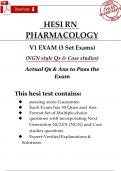
HESI RN
PHARMACOLOGY
V1 EXAM (3 Set Exams)
(NGN style Qs & Case studies)
Actual Qs & Ans to Pass the
Exam
This hesi test contains:
passing score Guarantee
Each Exam has 55 Ques and Ans
Format Set of Multiple-choice
questions with incorporating Next
Generation NCLEX (NGN) and Case
studies questions
Expert-Verified Explanations &
Solutions
, Contents
HESI RN PHARMACOLOGY V1 EXAM...............................2
SET 1............................................................................................. 2
HESI RN PHARMACOLOGY V1 EXAM.............................30
SET 2........................................................................................... 30
HESI RN PHARMACOLOGY V1 EXAM.............................55
SET 3........................................................................................... 55
,HESI RN PHARMACOLOGY V1 EXAM
SET 1
1) A client taking atorvastatin develops an increased serum creatine
phosphokinase (CK) level. The nurse should assess the client for the
onset of which problem?
A. Muscle tenderness
B. Nausea and vomiting
C. Excessive bruising
D. Peripheral edema
ANSWER: A. Muscle tenderness
, Expert-Verified Explanation:
• Statins (e.g., atorvastatin) can cause myopathy, which may progress to
rhabdomyolysis in severe cases. An elevated CK level often signifies
muscle injury. Muscle tenderness, especially in large muscle groups, is one
of the earliest clinical signs of myopathy. If untreated, severe myopathy
can become life-threatening.
─────────────────────────────────
───────────────────────
2) An increase in which serum laboratory value indicates to the nurse
that a prescription for atorvastatin is having the desired effect for a
client at risk for coronary artery disease?
A. LDL (Low-density lipoprotein)
B. Triglycerides
C. HDL (High-density lipoprotein)
D. VLDL (Very low-density lipoprotein)
ANSWER: C. HDL (High-density lipoprotein)
Expert-Verified Explanation:
• Atorvastatin lowers LDL primarily but can also modestly raise HDL
(“good cholesterol”). An increase in HDL is protective and a sign that
therapy is working. Therapeutic success can also include a decrease in
LDL.
─────────────────────────────────
───────────────────────
3) [NGN - Case Study]
Patient Data — History & Physical:
• 36-year-old female with moderate persistent asthma on
fluticasone/salmeterol twice daily, albuterol as needed
• Reports more severe symptoms, frequent albuterol use, FEV₁ of 60–65%
PHARMACOLOGY
V1 EXAM (3 Set Exams)
(NGN style Qs & Case studies)
Actual Qs & Ans to Pass the
Exam
This hesi test contains:
passing score Guarantee
Each Exam has 55 Ques and Ans
Format Set of Multiple-choice
questions with incorporating Next
Generation NCLEX (NGN) and Case
studies questions
Expert-Verified Explanations &
Solutions
, Contents
HESI RN PHARMACOLOGY V1 EXAM...............................2
SET 1............................................................................................. 2
HESI RN PHARMACOLOGY V1 EXAM.............................30
SET 2........................................................................................... 30
HESI RN PHARMACOLOGY V1 EXAM.............................55
SET 3........................................................................................... 55
,HESI RN PHARMACOLOGY V1 EXAM
SET 1
1) A client taking atorvastatin develops an increased serum creatine
phosphokinase (CK) level. The nurse should assess the client for the
onset of which problem?
A. Muscle tenderness
B. Nausea and vomiting
C. Excessive bruising
D. Peripheral edema
ANSWER: A. Muscle tenderness
, Expert-Verified Explanation:
• Statins (e.g., atorvastatin) can cause myopathy, which may progress to
rhabdomyolysis in severe cases. An elevated CK level often signifies
muscle injury. Muscle tenderness, especially in large muscle groups, is one
of the earliest clinical signs of myopathy. If untreated, severe myopathy
can become life-threatening.
─────────────────────────────────
───────────────────────
2) An increase in which serum laboratory value indicates to the nurse
that a prescription for atorvastatin is having the desired effect for a
client at risk for coronary artery disease?
A. LDL (Low-density lipoprotein)
B. Triglycerides
C. HDL (High-density lipoprotein)
D. VLDL (Very low-density lipoprotein)
ANSWER: C. HDL (High-density lipoprotein)
Expert-Verified Explanation:
• Atorvastatin lowers LDL primarily but can also modestly raise HDL
(“good cholesterol”). An increase in HDL is protective and a sign that
therapy is working. Therapeutic success can also include a decrease in
LDL.
─────────────────────────────────
───────────────────────
3) [NGN - Case Study]
Patient Data — History & Physical:
• 36-year-old female with moderate persistent asthma on
fluticasone/salmeterol twice daily, albuterol as needed
• Reports more severe symptoms, frequent albuterol use, FEV₁ of 60–65%