

WGU C963 American politics and US Constitution
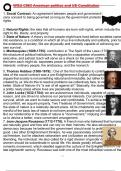
1. Social Contract: An agreement between people and government in which citi-
zens consent to being governed so long as the government protects their natural
rights.
2. Natural Rights: the idea that all humans are born with rights, which include the
right to life, liberty, and property
3. State of Nature: A theory on how people might have lived before societies came
into existence. is a condition in which all of us live individually and solitarily, prior to
the existence of society. We are physically and mentally capable of achieving our
own survival.
4. Montesquieu (1689-1755): contribution in The Spirit of the Laws (1748) regards
the structure of political institutions. He argues for a separation of powers: l egislative,
executive, and judicial. Each will serve as a check on the power of the other, limiting
the harm each might do. separates power to offset the power of different social
interests: ordinary people, the aristocracy, and the monarch.
5. Thomas Hobbes (1588-1679):: One of the first individuals to contribute to the
idea of the social contract was a pre-Enlightenment English philosopher. Hobbes
argues that society is not something natural and immutable, but rather it i s something
created by us. We do this to resolve problems we collectively face, to make our lives
better. State of Nature: it's "a war of all against all." Basically, the stateof nature is
a pretty nasty place where lives are perpetually insecure.
6. John Locke (1632-1704): we are autonomous individuals, capable of using
reason, and are driven to advance our personal interests. Our primary interest is
survival, which we want to make secure and comfortable. To achieve thi s security
and comfort, we acquire property. Two Treatises of Government, disagrees, saying
the state of nature is a relatively decent place. All its inhabitants are rational people,
mindful of the basic law of nature to not harm another, and people will getalong okay.
But our relationship in the state of nature is "inconvenient," implying an incentive for
us to devise a better, more convenient arrangement.
7. Jean-Jacques Rousseau (1712-1778): A French man who believed that humans
are naturally good and free and can rely on their instincts. He also advocated a
democracy because he believed the government should exist to protect common
good. Like other Enlightenment thinkers, he was passionately committed to individ-
ual freedom, but he attacked rationalism and civilization as destroying, rather than
liberating, the individual. He also called for a rigid division of gender roles, believing
women should be subordinate in social life. His ideals greatly influenced the early
romantic movement, which rebelled against the culture of the Enlightenment in the
late eighteenth century. Rousseau was both one of the most influential voices of the
, WGU C963 American politics and US Constitution
Enlightenment and, in his rejection of rationalism and social discourse, a harbinger
of reaction against Enlightenment ideas.
8. Constitution is influenced by the Enlightenment: (Separation of powers) em-
bodies Montesquieu's principles by separating the legislative, executive, and judicial
power, placing each into the hands of different political actors.
9. Bill of Rights influenced by Enlightenment: · The First Amendment gives us
a definitive declaration for the protection of natural rights. Protections of individual
conscience as well as protections for democratic participation (John Lock ideology).
· The Second Amendment, which also embodies Lockean ideas, permits the pos-
session of arms for the "security of a free State."14 In this Amendment, the right to
rebellion is established.
· Due process says all citizens are subject to fair and equitable treat ment.
· The Fourth - Eighth Amendments serve to both limit the power gove rnment has
over us and lay out procedures which must be followed when dealing with us.
· The Ninth Amendment makes it clear that the list of rights protected in the first eight
Amendments is not exhaustive and that we, the people, can assert additional natura
rights when we see fit (at least in theory.)
· The Tenth Amendment makes clear that powers not specifically granted to the
federal government are retained by the states and the people (these last two are
Lockean ideals)
10. Declaration of Independence influenced by Enlightenment: Locke maintains
that society is a rational but voluntary expression. Government, which serves to
regulate the terms of the social contact on which society is created, serves to protect
our natural rights and serve as a democratic conduit for our interests. Most important
of our natural rights are liberty and property.
11. National Government under the Articles of Confederation: unicameral con-
gress, or one chamber known as the Confederation Congress. no executive or
judicial branch. Functions in order to make sure that the national government did
not have too much power and that the power of the states remained protected. had
the authority to exchange ambassadors and make treaties with foreigngovernments
and Indian tribes, declare war, coin currency and borrow money, and settle disputes
between states. Each state legislature appointed delegates to the Congress; these
men could be recalled at any time. Regardless of its size or the number of delegates
it chose to send, each state would have only one vote. Delegates could serve for
, WGU C963 American politics and US Constitution
no more than three consecutive years, lest a class of elite professional politicians
develop. The nation would have no independent chief executive or judiciary. Nine
votes were required before the central government could act, and the Articles of
Confederation could be changed only by unanimous approval of all 13 states.
12. Powers under the Articles of Confederation (national government):: The
Power to Borrow and Coin Money
The Power to Declare War
The Power to Make Treaties and Alliances with Other Nations
The Power to Regulate Trade with the Native Americans
The Power to Settle Disputes among Other States
13. The Power to Borrow and Coin Money (National Government):The national
government could make the currency of the United States, known as Continental
currency. It could also borrow money from other nations to cover the country's debts
that remained from fighting during the American Revolution. This power to borrow
and coin money was limited, as the national government had to rely on the states
for enough money to cover debts and back any loans taken from other countries.
14. The Power to Declare War (National Government): The national government
could declare war as it deemed appropriate with other nations. It could also appoint
military officials. However, this power was limited. The national government could
declare war, but there was no national military to draw soldiers from. T he soldiers
came from the individual states.
15. The Power to Make Treaties and Alliances with Other Nations (National
Government): The national government could enter into treaties or agreements with
other nations as it deemed appropriate. Under this power, the national government
could also appoint foreign ambassadors.
16. The Power to Regulate Trade with the Native Americans (National Govern-
ment):: The national government was given power to negotiate and regulate trade
with the Native Americans. Native Americans were not considered citizens of the
United States and were treated as foreign nations by the both the national and state
governments.
17. The Power to Settle Disputes among Other States (National G overnment)-
: the national government had the authority to settle any and all boundary disputes
that arose between the states, which were bound to happen in this newly formed
country.
18. Problems with the Articles of Confederation (Power to Raise an Army or
Navy):: Although the central government could declare war and agree to peace,
it had to depend upon the states to provide soldiers. If state governors chose not
to honor the national government's request, the country would lack an adequate
, WGU C963 American politics and US Constitution
defense. The lack of a national army meant that the national government could not
draft any soldiers into the military.
19. Problems with the Articles of Confederation (Taxation): Articles of Confeder-
ation gave the national government no power to impose and collect taxes. To avoid
any perception of "taxation without representation," the Articles of C onfederation
allowed only state governments to levy taxes. To pay for its expenses, the national
government had to request money from the states, which were required to provide
funds in proportion to the value of the land within their borders. The states, however,
were often negligent in this duty, and the national government was underfunded as
a result. The national government could not impose taxes on citizens. It could only
request money from the states.
20. Problems with the Articles of Confederation (Regulating Trade):: The na-
tional government did not possess the power to regulate trade among the different
states. This lack of authority not only affected the national government, but the states
as well. The national economy suffered as foreign countries began to form trade
agreements with individual states, agreements for which the national government
could not regulate or tax.
21. Problems with the articles of confederation National Government:: · Each
state had only one vote in Congress regardless of its size.
· The national government could not impose taxes on citizens. It could only request
money from the states.
· The national government could not regulate foreign trade or interstate commerce.
· The national government could not raise an army. It had to request the states to
send men.
· The Articles could not be changed without a unanimous vote to do so.
· There was no national judicial system.
22. New Jersey Plan (small state plan): A plan that called for a one-house national
legislature; each state would receive one vote. Each state would have one vote.
Thus, smaller states would have the same power in the national legisl ature as larger
states.
· Unicameral legislature (one chamber)
· Representation: State based (each state equally represented)
· Role of National Government: provides defense but does not override state author-
ity
23. Virginia Plan (large state plan): The number of a state's representatives in
each chamber was to be based on the state's population. In each state, representa-
tives in the lower chamber would be elected by popular vote. These representatives
would then select their state's representatives in the upper chamber from among
candidates proposed by the state's legislature. Once a representative's term in the
1. Social Contract: An agreement between people and government in which citi-
zens consent to being governed so long as the government protects their natural
rights.
2. Natural Rights: the idea that all humans are born with rights, which include the
right to life, liberty, and property
3. State of Nature: A theory on how people might have lived before societies came
into existence. is a condition in which all of us live individually and solitarily, prior to
the existence of society. We are physically and mentally capable of achieving our
own survival.
4. Montesquieu (1689-1755): contribution in The Spirit of the Laws (1748) regards
the structure of political institutions. He argues for a separation of powers: l egislative,
executive, and judicial. Each will serve as a check on the power of the other, limiting
the harm each might do. separates power to offset the power of different social
interests: ordinary people, the aristocracy, and the monarch.
5. Thomas Hobbes (1588-1679):: One of the first individuals to contribute to the
idea of the social contract was a pre-Enlightenment English philosopher. Hobbes
argues that society is not something natural and immutable, but rather it i s something
created by us. We do this to resolve problems we collectively face, to make our lives
better. State of Nature: it's "a war of all against all." Basically, the stateof nature is
a pretty nasty place where lives are perpetually insecure.
6. John Locke (1632-1704): we are autonomous individuals, capable of using
reason, and are driven to advance our personal interests. Our primary interest is
survival, which we want to make secure and comfortable. To achieve thi s security
and comfort, we acquire property. Two Treatises of Government, disagrees, saying
the state of nature is a relatively decent place. All its inhabitants are rational people,
mindful of the basic law of nature to not harm another, and people will getalong okay.
But our relationship in the state of nature is "inconvenient," implying an incentive for
us to devise a better, more convenient arrangement.
7. Jean-Jacques Rousseau (1712-1778): A French man who believed that humans
are naturally good and free and can rely on their instincts. He also advocated a
democracy because he believed the government should exist to protect common
good. Like other Enlightenment thinkers, he was passionately committed to individ-
ual freedom, but he attacked rationalism and civilization as destroying, rather than
liberating, the individual. He also called for a rigid division of gender roles, believing
women should be subordinate in social life. His ideals greatly influenced the early
romantic movement, which rebelled against the culture of the Enlightenment in the
late eighteenth century. Rousseau was both one of the most influential voices of the
, WGU C963 American politics and US Constitution
Enlightenment and, in his rejection of rationalism and social discourse, a harbinger
of reaction against Enlightenment ideas.
8. Constitution is influenced by the Enlightenment: (Separation of powers) em-
bodies Montesquieu's principles by separating the legislative, executive, and judicial
power, placing each into the hands of different political actors.
9. Bill of Rights influenced by Enlightenment: · The First Amendment gives us
a definitive declaration for the protection of natural rights. Protections of individual
conscience as well as protections for democratic participation (John Lock ideology).
· The Second Amendment, which also embodies Lockean ideas, permits the pos-
session of arms for the "security of a free State."14 In this Amendment, the right to
rebellion is established.
· Due process says all citizens are subject to fair and equitable treat ment.
· The Fourth - Eighth Amendments serve to both limit the power gove rnment has
over us and lay out procedures which must be followed when dealing with us.
· The Ninth Amendment makes it clear that the list of rights protected in the first eight
Amendments is not exhaustive and that we, the people, can assert additional natura
rights when we see fit (at least in theory.)
· The Tenth Amendment makes clear that powers not specifically granted to the
federal government are retained by the states and the people (these last two are
Lockean ideals)
10. Declaration of Independence influenced by Enlightenment: Locke maintains
that society is a rational but voluntary expression. Government, which serves to
regulate the terms of the social contact on which society is created, serves to protect
our natural rights and serve as a democratic conduit for our interests. Most important
of our natural rights are liberty and property.
11. National Government under the Articles of Confederation: unicameral con-
gress, or one chamber known as the Confederation Congress. no executive or
judicial branch. Functions in order to make sure that the national government did
not have too much power and that the power of the states remained protected. had
the authority to exchange ambassadors and make treaties with foreigngovernments
and Indian tribes, declare war, coin currency and borrow money, and settle disputes
between states. Each state legislature appointed delegates to the Congress; these
men could be recalled at any time. Regardless of its size or the number of delegates
it chose to send, each state would have only one vote. Delegates could serve for
, WGU C963 American politics and US Constitution
no more than three consecutive years, lest a class of elite professional politicians
develop. The nation would have no independent chief executive or judiciary. Nine
votes were required before the central government could act, and the Articles of
Confederation could be changed only by unanimous approval of all 13 states.
12. Powers under the Articles of Confederation (national government):: The
Power to Borrow and Coin Money
The Power to Declare War
The Power to Make Treaties and Alliances with Other Nations
The Power to Regulate Trade with the Native Americans
The Power to Settle Disputes among Other States
13. The Power to Borrow and Coin Money (National Government):The national
government could make the currency of the United States, known as Continental
currency. It could also borrow money from other nations to cover the country's debts
that remained from fighting during the American Revolution. This power to borrow
and coin money was limited, as the national government had to rely on the states
for enough money to cover debts and back any loans taken from other countries.
14. The Power to Declare War (National Government): The national government
could declare war as it deemed appropriate with other nations. It could also appoint
military officials. However, this power was limited. The national government could
declare war, but there was no national military to draw soldiers from. T he soldiers
came from the individual states.
15. The Power to Make Treaties and Alliances with Other Nations (National
Government): The national government could enter into treaties or agreements with
other nations as it deemed appropriate. Under this power, the national government
could also appoint foreign ambassadors.
16. The Power to Regulate Trade with the Native Americans (National Govern-
ment):: The national government was given power to negotiate and regulate trade
with the Native Americans. Native Americans were not considered citizens of the
United States and were treated as foreign nations by the both the national and state
governments.
17. The Power to Settle Disputes among Other States (National G overnment)-
: the national government had the authority to settle any and all boundary disputes
that arose between the states, which were bound to happen in this newly formed
country.
18. Problems with the Articles of Confederation (Power to Raise an Army or
Navy):: Although the central government could declare war and agree to peace,
it had to depend upon the states to provide soldiers. If state governors chose not
to honor the national government's request, the country would lack an adequate
, WGU C963 American politics and US Constitution
defense. The lack of a national army meant that the national government could not
draft any soldiers into the military.
19. Problems with the Articles of Confederation (Taxation): Articles of Confeder-
ation gave the national government no power to impose and collect taxes. To avoid
any perception of "taxation without representation," the Articles of C onfederation
allowed only state governments to levy taxes. To pay for its expenses, the national
government had to request money from the states, which were required to provide
funds in proportion to the value of the land within their borders. The states, however,
were often negligent in this duty, and the national government was underfunded as
a result. The national government could not impose taxes on citizens. It could only
request money from the states.
20. Problems with the Articles of Confederation (Regulating Trade):: The na-
tional government did not possess the power to regulate trade among the different
states. This lack of authority not only affected the national government, but the states
as well. The national economy suffered as foreign countries began to form trade
agreements with individual states, agreements for which the national government
could not regulate or tax.
21. Problems with the articles of confederation National Government:: · Each
state had only one vote in Congress regardless of its size.
· The national government could not impose taxes on citizens. It could only request
money from the states.
· The national government could not regulate foreign trade or interstate commerce.
· The national government could not raise an army. It had to request the states to
send men.
· The Articles could not be changed without a unanimous vote to do so.
· There was no national judicial system.
22. New Jersey Plan (small state plan): A plan that called for a one-house national
legislature; each state would receive one vote. Each state would have one vote.
Thus, smaller states would have the same power in the national legisl ature as larger
states.
· Unicameral legislature (one chamber)
· Representation: State based (each state equally represented)
· Role of National Government: provides defense but does not override state author-
ity
23. Virginia Plan (large state plan): The number of a state's representatives in
each chamber was to be based on the state's population. In each state, representa-
tives in the lower chamber would be elected by popular vote. These representatives
would then select their state's representatives in the upper chamber from among
candidates proposed by the state's legislature. Once a representative's term in the


