

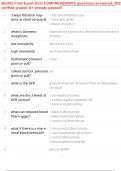
Bio202 Final Exam GCU COMPREHENSIVE questions answered, 2025
Bio202 Final Exam GCU
verifiedStudy
graded A+ already passed!
online at https://quizlet.com/_cguvst
1. 3 ways filtration hap- 1. fenestrated endothelium (picky)
pens at renal corpuscle 2. lamina densa (pickier)
3. filtration slits (pickiest)
2. what is Glomeru- inflammation of the glomeruli that affects the filtration mechanism of
lonephritis the kidneys
3. low osmolarity little solute lots of water
4. high osmolarity lots of solute little bit of water
5. hydrostatic pressure to push
push or pull?
6. colloid osmotic pressure pull
push or pull?
7. what is the GFR glomerular filtration rate; the amount of filtrate the kidneys produce
each minute
8. what are the 3 levels of 1. auto regulation (local level)
GFR control? 2. autonomic regulation (sympathetic ANS)
3. hormonal regulation (kidneys)
9. what can reduced blood 1. dilation of afferent arteriole
flow trigger? 2. dilation of glomerular capillaries
3. constriction of efferent arterioles
10. what if there is a rise in 1. stretches walls of afferent arterioles
renal blood pressure? 2. causes juxtaglomerular cells to contract
3. constricts afferent arterioles
4. decreases glomerular blood flow
11. RAAS and ANP/BNP
, Bio202 Final Exam GCU
Study online at https://quizlet.com/_cguvst
hormonal regulation of
GFR
12. do protons raise or lower lower, make it more acidic
pH?
13. does bicarbonate raise raise, make it more basic
or lower the pH?
14. in the descending limb renal pelvis
fluid flows toward?
15. in the ascending limb renal cortex
fluid flows toward?
16. what is the countercur- Loop of Henle
rent multiplier?
17. 4 processes of the DCT 1. acid/base balance
2. selective reabsorption of Na and Ca
3. maintenance of GFR
4. selective reabsorption of water (ADH)
18. 3 of juxtaglomerular ap- 1. macula densa
paratus cell types 2. juxtaglomerular cells
3. mesangial cells
19. what determines the fi- ADH
nal osmotic concentra-
tion and volume of
urine?
20. 3 main organic waste 1. Urea-breakdown of amino acids
products 2. Creatinine-breakdown of creatine phosphate (from cellular respira-
Bio202 Final Exam GCU
verifiedStudy
graded A+ already passed!
online at https://quizlet.com/_cguvst
1. 3 ways filtration hap- 1. fenestrated endothelium (picky)
pens at renal corpuscle 2. lamina densa (pickier)
3. filtration slits (pickiest)
2. what is Glomeru- inflammation of the glomeruli that affects the filtration mechanism of
lonephritis the kidneys
3. low osmolarity little solute lots of water
4. high osmolarity lots of solute little bit of water
5. hydrostatic pressure to push
push or pull?
6. colloid osmotic pressure pull
push or pull?
7. what is the GFR glomerular filtration rate; the amount of filtrate the kidneys produce
each minute
8. what are the 3 levels of 1. auto regulation (local level)
GFR control? 2. autonomic regulation (sympathetic ANS)
3. hormonal regulation (kidneys)
9. what can reduced blood 1. dilation of afferent arteriole
flow trigger? 2. dilation of glomerular capillaries
3. constriction of efferent arterioles
10. what if there is a rise in 1. stretches walls of afferent arterioles
renal blood pressure? 2. causes juxtaglomerular cells to contract
3. constricts afferent arterioles
4. decreases glomerular blood flow
11. RAAS and ANP/BNP
, Bio202 Final Exam GCU
Study online at https://quizlet.com/_cguvst
hormonal regulation of
GFR
12. do protons raise or lower lower, make it more acidic
pH?
13. does bicarbonate raise raise, make it more basic
or lower the pH?
14. in the descending limb renal pelvis
fluid flows toward?
15. in the ascending limb renal cortex
fluid flows toward?
16. what is the countercur- Loop of Henle
rent multiplier?
17. 4 processes of the DCT 1. acid/base balance
2. selective reabsorption of Na and Ca
3. maintenance of GFR
4. selective reabsorption of water (ADH)
18. 3 of juxtaglomerular ap- 1. macula densa
paratus cell types 2. juxtaglomerular cells
3. mesangial cells
19. what determines the fi- ADH
nal osmotic concentra-
tion and volume of
urine?
20. 3 main organic waste 1. Urea-breakdown of amino acids
products 2. Creatinine-breakdown of creatine phosphate (from cellular respira-


