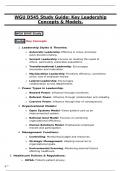
WGU D545 Study Guide: Key Leadership
Concepts & Models.
WGU D545 Study
Guide Key Concepts
1. Leadership Styles & Theories:
o Autocratic Leadership: Effective in crises; promotes
quick decision-making.
o Servant Leadership: Focuses on meeting the needs of
others, particularly vulnerable populations.
o Transformational Leadership: Encourages
innovation and motivation.
o Machiavellian Leadership: Prioritizes efficiency, sometimes
at the cost of employee morale.
o Lateral Leadership: Encourages
collaboration across departments.
2. Power Types in Leadership:
o Reward Power: Influence through incentives.
o Referent Power: Influence through relationships and empathy.
o Coercive Power: Influence through fear of consequences.
3. Organizational Models:
o Open Systems Model: Views patient care as an
interconnected system.
o Rational Goal Model: Focuses on achieving
organizational efficiency.
o Human Relations Model: Emphasizes employee
morale and participation.
4. Management Functions:
o Controlling: Monitoring budget and resources.
o Strategic Management: Aligning resources to
organizational goals.
o Environmental Scanning: Monitoring external factors
affecting healthcare.
5. Healthcare Policies & Regulations:
o HIPAA: Protects patient privacy.
®™
Concepts & Models.
WGU D545 Study
Guide Key Concepts
1. Leadership Styles & Theories:
o Autocratic Leadership: Effective in crises; promotes
quick decision-making.
o Servant Leadership: Focuses on meeting the needs of
others, particularly vulnerable populations.
o Transformational Leadership: Encourages
innovation and motivation.
o Machiavellian Leadership: Prioritizes efficiency, sometimes
at the cost of employee morale.
o Lateral Leadership: Encourages
collaboration across departments.
2. Power Types in Leadership:
o Reward Power: Influence through incentives.
o Referent Power: Influence through relationships and empathy.
o Coercive Power: Influence through fear of consequences.
3. Organizational Models:
o Open Systems Model: Views patient care as an
interconnected system.
o Rational Goal Model: Focuses on achieving
organizational efficiency.
o Human Relations Model: Emphasizes employee
morale and participation.
4. Management Functions:
o Controlling: Monitoring budget and resources.
o Strategic Management: Aligning resources to
organizational goals.
o Environmental Scanning: Monitoring external factors
affecting healthcare.
5. Healthcare Policies & Regulations:
o HIPAA: Protects patient privacy.
®™