
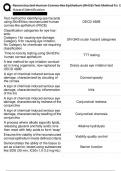
Reconstructed Human Cornea-like Epithelium (RHCE) Test Method for E
Hazard Identification
Test method for identifying eye hazards
using SkinEthics reconstructed human OECD 492B
cornea-like epithelium (RhCE)
Classification categories for eye haz-
ards:
Category I for causing eye damage,
UN GHS ocular hazard categories
Category II for causing eye irritation,
No Category for chemicals not requiring
classification
Time-to-toxicity testing using SkinEthic
TTT testing
human corneal epithelium
A test method for eye irritation conduct-
ed in living organisms, now replaced by Draize acute eye irritation test
OECD 492B
A sign of chemical-induced serious eye
damage, characterized by clouding of Corneal opacity
the cornea
A sign of chemical-induced serious eye
damage, characterized by inflammation Iritis
of the iris
A sign of chemical-induced serious eye
damage, characterized by redness of the Conjunctival redness
conjunctiva
A sign of chemical-induced serious eye
damage, characterized by swelling of the Conjunctival chemosis
conjunctiva
A process where alkalis saponify lipids,
releasing glycerol and fatty acids; ions Alkaline hydrolysis
then react with fatty acids to form 'soap'
Ensures the viability of the reconstructed
Viability quality control
corneal epithelium meets defined criteria
Demonstrates the ability of the tissue to
act as a barrier, tested using substances Barrier function
like SDS (30 min, IC50=1.0-3.2 mg/mL)
1/3
Hazard Identification
Test method for identifying eye hazards
using SkinEthics reconstructed human OECD 492B
cornea-like epithelium (RhCE)
Classification categories for eye haz-
ards:
Category I for causing eye damage,
UN GHS ocular hazard categories
Category II for causing eye irritation,
No Category for chemicals not requiring
classification
Time-to-toxicity testing using SkinEthic
TTT testing
human corneal epithelium
A test method for eye irritation conduct-
ed in living organisms, now replaced by Draize acute eye irritation test
OECD 492B
A sign of chemical-induced serious eye
damage, characterized by clouding of Corneal opacity
the cornea
A sign of chemical-induced serious eye
damage, characterized by inflammation Iritis
of the iris
A sign of chemical-induced serious eye
damage, characterized by redness of the Conjunctival redness
conjunctiva
A sign of chemical-induced serious eye
damage, characterized by swelling of the Conjunctival chemosis
conjunctiva
A process where alkalis saponify lipids,
releasing glycerol and fatty acids; ions Alkaline hydrolysis
then react with fatty acids to form 'soap'
Ensures the viability of the reconstructed
Viability quality control
corneal epithelium meets defined criteria
Demonstrates the ability of the tissue to
act as a barrier, tested using substances Barrier function
like SDS (30 min, IC50=1.0-3.2 mg/mL)
1/3


