
ESOL TEST UPDATED Exam
Questions and CORRECT Answers
Save
Terms in this set (382)
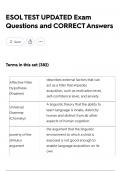
describes external factors that can
Affective Filter
act as a filter that impedes
Hypothesis
acquistion, such as motivation level,
(Krashen)
self-confidence level, and anxiety
A linguistic theory that the ability to
Universal
learn language is innate, distinctly
Grammar
human and distinct from all other
(Chomsky)
aspects of human cognition.
the argument that the linguistic
poverty of the environment to which a child is
stimulus exposed is not good enough to
argument enable language acquisition on its
own
, a stage of language acquisition;
pre-speech infants learn to pay attention to
stage speech, inflection, and rhythm
before they begin to speak
at about 2 months the infant begins
cooing stage
to make vowel-like sounds
beginning at about 4 months, the
stage of speech development in
which the infant spontaneously
babbling stage
utters various sounds at first
unrelated to the household
language
the stage in speech development,
one-word stage from about 1 to 2, during which a
child speaks mostly in single words
when children define words more
underextension
narrowly than adults do
beginning about age 2, the stage in
speech development during which a
two-word stage
child speaks mostly two-word
statements
, stage of language acquisition;
telegraphic stage, children begin
early multiword using elements of grammar and
stage repeating longer sentences, though
they are still unable to create their
own
stage of language acquisition;
later multiword children average four to six words
stage per sentence and can learn as many
as twenty words per day
process that occurs when students
language who are learning a new language
transfer transfer knowledge from L1 to L2;
can be positive or negative.
Words that look similar and have the
Cognates
same origin in two languages.
Questions and CORRECT Answers
Save
Terms in this set (382)
describes external factors that can
Affective Filter
act as a filter that impedes
Hypothesis
acquistion, such as motivation level,
(Krashen)
self-confidence level, and anxiety
A linguistic theory that the ability to
Universal
learn language is innate, distinctly
Grammar
human and distinct from all other
(Chomsky)
aspects of human cognition.
the argument that the linguistic
poverty of the environment to which a child is
stimulus exposed is not good enough to
argument enable language acquisition on its
own
, a stage of language acquisition;
pre-speech infants learn to pay attention to
stage speech, inflection, and rhythm
before they begin to speak
at about 2 months the infant begins
cooing stage
to make vowel-like sounds
beginning at about 4 months, the
stage of speech development in
which the infant spontaneously
babbling stage
utters various sounds at first
unrelated to the household
language
the stage in speech development,
one-word stage from about 1 to 2, during which a
child speaks mostly in single words
when children define words more
underextension
narrowly than adults do
beginning about age 2, the stage in
speech development during which a
two-word stage
child speaks mostly two-word
statements
, stage of language acquisition;
telegraphic stage, children begin
early multiword using elements of grammar and
stage repeating longer sentences, though
they are still unable to create their
own
stage of language acquisition;
later multiword children average four to six words
stage per sentence and can learn as many
as twenty words per day
process that occurs when students
language who are learning a new language
transfer transfer knowledge from L1 to L2;
can be positive or negative.
Words that look similar and have the
Cognates
same origin in two languages.


