

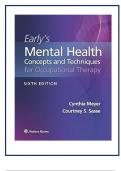
,EARLY’S OT MENTAL HEALTH: TEST
BANK FOR 2025 CERTIFICATION &
REVIEW
Comprehensive Review with NCLEX®-Style
Questions & Rationales – Cynthia Meyer &
Courtney Sasse, 6th Edition
• 23-Chapter Full Coverage | 20 MCQs Per
Chapter
• Verified Answers & Evidence-Based
Rationales
• Designed for OT/OTA Certification
Success
• Pass with Confidence – Ideal for
Coursework, Licensure & Board
,SECTION ONE: Principles of Occupational Therapy in Mental Health
Unit 1: History and Foundations
Chapter 1: History and Foundational Concepts
Chapter 2: Medical and Psychological Theories, Frames of Reference, and Models of Mental Health
and Mental Illness
Chapter 3: Occupational Therapy Frames of Reference and Practice Models
SECTION TWO: Mental Illness
Chapter 4: Understanding Psychiatric Diagnoses
SECTION THREE: Service Provision
Chapter 5: Human Occupation and Mental Health Throughout the Life Span With Those We Serve
SECTION THREE: Service Provision
Chapter 6: Methods and Models of Interaction and Intervention
Chapter 7: Service Areas, Environments, and Focuses
SECTION FOUR: Professional Practice Considerations
Chapter 8: Medications, Medical-Based Treatments, Complementary Practices, and Detoxification
Chapter 9: Safety Considerations and Techniques
Chapter 10: Using Evidence
Chapter 11: Professional Issues: Supervision, Teams, Roles, and Self-Management
Chapter 12: Evaluation and Data Collection
Chapter 13: Determining Type and Approach to Intervention
,Chapter 14: Matching Occupational Demands to Intervention Types
Chapter 15: Therapeutic Use of Self
Chapter 16: Group Concepts and Techniques in OT
Chapter 17: Facilitating Recovery Using Biopsychosocial Models
Chapter 18: Anxiety and Occupational Engagement
Chapter 20: Hallucinations, Delusions, and Paranoia
Chapter 22: Anger, Hostility, and Aggression
Chapter 23: Substance-Related and Addictive Disorders
,Chapter 1
Introduction (4 questions)
1. Which of the following best describes the primary focus
of occupational therapy in mental health?
A. Remediation of muscular strength deficits
B. Promotion of meaningful engagement in daily activities
C. Administration of psychotropic medications
D. Diagnosis of psychiatric disorders
Correct: B
Rationale: OT in mental health centers on enabling clients to
engage in occupations that support health and well-being; A, C,
and D are outside the OT scope.
2. The term “occupation” in OT most closely refers to:
A. Only paid employment
B. All self-care, productivity, and leisure activities
C. Social roles exclusively
D. The place where one works
Correct: B
Rationale: “Occupation” is an umbrella for self-care,
productivity, and leisure; C and D are too narrow, A is
incomplete.
3. Which model first emphasized the person-environment-
occupation interaction?
A. Biopsychosocial Model
B. Model of Human Occupation (MOHO)
, C. Canadian Model of Occupational Performance
D. Psychoanalytic Model
Correct: C
Rationale: The CMOP highlights P-E-O interactions; MOHO
followed later, A and D aren’t OT-specific.
4. In the context of OT, “mental health recovery” most
accurately means:
A. Complete cure of all symptoms
B. Living a hopeful, satisfying life with or without
symptoms
C. Total independence from all supports
D. Quick relapse prevention
Correct: B
Rationale: Recovery emphasizes quality of life and self-
determination even if symptoms persist; A and C are
unrealistic, D is too narrow.
Mental Health and Mental Illness (4 questions)
5. Which definition of mental illness emphasizes clinically
significant disturbance in cognition, emotion regulation,
or behavior?
A. World Health Organization’s health definition
B. Diagnostic and Statistical Manual of Mental Disorders
C. Occupational Performance Model
D. Moral Treatment principles
,Correct: B
Rationale: The DSM-5 defines mental disorders by clinically
significant disturbances; A is broad health, C and D are OT or
historical.
6. A continuum model of mental health suggests that:
A. All clients either have illness or complete health
B. People move fluidly between wellness and illness
C. Mental illness is a fixed, permanent state
D. Only medication can shift someone to wellness
Correct: B
Rationale: Continuum models view mental health as dynamic;
A and C are wrong dichotomies, D overemphasizes meds.
7. Which factor is considered a protective factor for mental
health?
A. Chronic stressors
B. Strong social support
C. Early childhood trauma
D. Substance misuse
Correct: B
Rationale: Social support buffers stress; A and C are risks, D is a
risk behavior.
8. The “biopsychosocial” perspective in mental health
implies all EXCEPT:
A. Biological factors
B. Psychological processes
, C. Social environment
D. Only genetic determinism
Correct: D
Rationale: The model rejects single-factor explanations; D is
antithetical to the biopsychosocial view.
Relation of Occupation to Mental Health (4 questions)
9. Engaging in meaningful leisure pursuits can:
A. Increase symptoms of depression
B. Promote self-efficacy and stress reduction
C. Replace the need for any clinical intervention
D. Only benefit cognitive functions
Correct: B
Rationale: Leisure supports self-esteem and coping; A and D
are too narrow/incorrect, C overstates.
10. Which principle underlies activity scheduling in
depression?
A. Psychoeducation around medication
B. Structuring rewarding activities to counteract
withdrawal
C. Avoidance of all challenging tasks
D. Group-based social outings only
Correct: B
Rationale: Activity scheduling breaks the cycle of inactivity; A,
C, D don’t capture the principle.
, 11. An OT’s use of a work simulation task for a client
with schizophrenia exemplifies:
A. Psychoanalysis
B. Task adaptation to improve vocational performance
C. Purely physical conditioning
D. Group dynamics training
Correct: B
Rationale: Simulations adapt tasks for functional performance;
A and D aren’t task-focused, C ignores cognition.
12. Sensory modulation approaches in mental health OT
are designed to:
A. Diagnose sensory processing disorders exclusively
B. Help clients regulate arousal via sensory input
C. Focus solely on vestibular activities
D. Replace all other psychiatric treatments
Correct: B
Rationale: Sensory modulation teaches clients to adjust
arousal; A is too narrow, C and D are incorrect.
A Few Words About Language (4 questions)
13. Person-first language aims to:
A. Emphasize the disability before the person
B. Place the individual before the diagnosis
C. Eliminate use of any diagnostic terms
D. Focus only on psychiatric labels
, Correct: B
Rationale: Person-first language (“person with schizophrenia”)
respects individuality; A and D are opposite, C is unrealistic.
14. Stigmatizing language in mental health can:
A. Improve client self-esteem
B. Perpetuate shame and social exclusion
C. Be beneficial for all clients
D. Only affect families, not clients
Correct: B
Rationale: Negative labels reinforce stigma; A and C are false, D
underestimates client impact.
15. Which term is preferred under person-first
language?
A. Suicidal person
B. Addict
C. Person experiencing suicidal ideation
D. Bipolar patient
Correct: C
Rationale: C emphasizes experience, not identity; A, B, D are
non–person-first or label-centric.
16. Using “recovered client” vs. “in recovery” illustrates
why:
A. Labels never matter
B. Static descriptors can imply permanence
BANK FOR 2025 CERTIFICATION &
REVIEW
Comprehensive Review with NCLEX®-Style
Questions & Rationales – Cynthia Meyer &
Courtney Sasse, 6th Edition
• 23-Chapter Full Coverage | 20 MCQs Per
Chapter
• Verified Answers & Evidence-Based
Rationales
• Designed for OT/OTA Certification
Success
• Pass with Confidence – Ideal for
Coursework, Licensure & Board
,SECTION ONE: Principles of Occupational Therapy in Mental Health
Unit 1: History and Foundations
Chapter 1: History and Foundational Concepts
Chapter 2: Medical and Psychological Theories, Frames of Reference, and Models of Mental Health
and Mental Illness
Chapter 3: Occupational Therapy Frames of Reference and Practice Models
SECTION TWO: Mental Illness
Chapter 4: Understanding Psychiatric Diagnoses
SECTION THREE: Service Provision
Chapter 5: Human Occupation and Mental Health Throughout the Life Span With Those We Serve
SECTION THREE: Service Provision
Chapter 6: Methods and Models of Interaction and Intervention
Chapter 7: Service Areas, Environments, and Focuses
SECTION FOUR: Professional Practice Considerations
Chapter 8: Medications, Medical-Based Treatments, Complementary Practices, and Detoxification
Chapter 9: Safety Considerations and Techniques
Chapter 10: Using Evidence
Chapter 11: Professional Issues: Supervision, Teams, Roles, and Self-Management
Chapter 12: Evaluation and Data Collection
Chapter 13: Determining Type and Approach to Intervention
,Chapter 14: Matching Occupational Demands to Intervention Types
Chapter 15: Therapeutic Use of Self
Chapter 16: Group Concepts and Techniques in OT
Chapter 17: Facilitating Recovery Using Biopsychosocial Models
Chapter 18: Anxiety and Occupational Engagement
Chapter 20: Hallucinations, Delusions, and Paranoia
Chapter 22: Anger, Hostility, and Aggression
Chapter 23: Substance-Related and Addictive Disorders
,Chapter 1
Introduction (4 questions)
1. Which of the following best describes the primary focus
of occupational therapy in mental health?
A. Remediation of muscular strength deficits
B. Promotion of meaningful engagement in daily activities
C. Administration of psychotropic medications
D. Diagnosis of psychiatric disorders
Correct: B
Rationale: OT in mental health centers on enabling clients to
engage in occupations that support health and well-being; A, C,
and D are outside the OT scope.
2. The term “occupation” in OT most closely refers to:
A. Only paid employment
B. All self-care, productivity, and leisure activities
C. Social roles exclusively
D. The place where one works
Correct: B
Rationale: “Occupation” is an umbrella for self-care,
productivity, and leisure; C and D are too narrow, A is
incomplete.
3. Which model first emphasized the person-environment-
occupation interaction?
A. Biopsychosocial Model
B. Model of Human Occupation (MOHO)
, C. Canadian Model of Occupational Performance
D. Psychoanalytic Model
Correct: C
Rationale: The CMOP highlights P-E-O interactions; MOHO
followed later, A and D aren’t OT-specific.
4. In the context of OT, “mental health recovery” most
accurately means:
A. Complete cure of all symptoms
B. Living a hopeful, satisfying life with or without
symptoms
C. Total independence from all supports
D. Quick relapse prevention
Correct: B
Rationale: Recovery emphasizes quality of life and self-
determination even if symptoms persist; A and C are
unrealistic, D is too narrow.
Mental Health and Mental Illness (4 questions)
5. Which definition of mental illness emphasizes clinically
significant disturbance in cognition, emotion regulation,
or behavior?
A. World Health Organization’s health definition
B. Diagnostic and Statistical Manual of Mental Disorders
C. Occupational Performance Model
D. Moral Treatment principles
,Correct: B
Rationale: The DSM-5 defines mental disorders by clinically
significant disturbances; A is broad health, C and D are OT or
historical.
6. A continuum model of mental health suggests that:
A. All clients either have illness or complete health
B. People move fluidly between wellness and illness
C. Mental illness is a fixed, permanent state
D. Only medication can shift someone to wellness
Correct: B
Rationale: Continuum models view mental health as dynamic;
A and C are wrong dichotomies, D overemphasizes meds.
7. Which factor is considered a protective factor for mental
health?
A. Chronic stressors
B. Strong social support
C. Early childhood trauma
D. Substance misuse
Correct: B
Rationale: Social support buffers stress; A and C are risks, D is a
risk behavior.
8. The “biopsychosocial” perspective in mental health
implies all EXCEPT:
A. Biological factors
B. Psychological processes
, C. Social environment
D. Only genetic determinism
Correct: D
Rationale: The model rejects single-factor explanations; D is
antithetical to the biopsychosocial view.
Relation of Occupation to Mental Health (4 questions)
9. Engaging in meaningful leisure pursuits can:
A. Increase symptoms of depression
B. Promote self-efficacy and stress reduction
C. Replace the need for any clinical intervention
D. Only benefit cognitive functions
Correct: B
Rationale: Leisure supports self-esteem and coping; A and D
are too narrow/incorrect, C overstates.
10. Which principle underlies activity scheduling in
depression?
A. Psychoeducation around medication
B. Structuring rewarding activities to counteract
withdrawal
C. Avoidance of all challenging tasks
D. Group-based social outings only
Correct: B
Rationale: Activity scheduling breaks the cycle of inactivity; A,
C, D don’t capture the principle.
, 11. An OT’s use of a work simulation task for a client
with schizophrenia exemplifies:
A. Psychoanalysis
B. Task adaptation to improve vocational performance
C. Purely physical conditioning
D. Group dynamics training
Correct: B
Rationale: Simulations adapt tasks for functional performance;
A and D aren’t task-focused, C ignores cognition.
12. Sensory modulation approaches in mental health OT
are designed to:
A. Diagnose sensory processing disorders exclusively
B. Help clients regulate arousal via sensory input
C. Focus solely on vestibular activities
D. Replace all other psychiatric treatments
Correct: B
Rationale: Sensory modulation teaches clients to adjust
arousal; A is too narrow, C and D are incorrect.
A Few Words About Language (4 questions)
13. Person-first language aims to:
A. Emphasize the disability before the person
B. Place the individual before the diagnosis
C. Eliminate use of any diagnostic terms
D. Focus only on psychiatric labels
, Correct: B
Rationale: Person-first language (“person with schizophrenia”)
respects individuality; A and D are opposite, C is unrealistic.
14. Stigmatizing language in mental health can:
A. Improve client self-esteem
B. Perpetuate shame and social exclusion
C. Be beneficial for all clients
D. Only affect families, not clients
Correct: B
Rationale: Negative labels reinforce stigma; A and C are false, D
underestimates client impact.
15. Which term is preferred under person-first
language?
A. Suicidal person
B. Addict
C. Person experiencing suicidal ideation
D. Bipolar patient
Correct: C
Rationale: C emphasizes experience, not identity; A, B, D are
non–person-first or label-centric.
16. Using “recovered client” vs. “in recovery” illustrates
why:
A. Labels never matter
B. Static descriptors can imply permanence


