

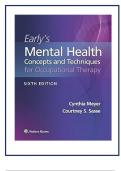
,Mental Health in OT – 2025 Exam Success
Guide with Rationales & 460 Q&As
Comprehensive Review with NCLEX®-Style Questions &
Rationales – Cynthia Meyer & Courtney Sasse, 6th Edition
• 23-Chapter Full Coverage | 20 MCQs Per Chapter
• Verified Answers & Evidence-Based Rationales
• Designed for OT/OTA Certification Success
• Pass with Confidence – Ideal for Coursework, Licensure &
Board Prep
SECTION ONE: Principles of Occupational Therapy in Mental Health
,Unit 1: History and Foundations
Chapter 1: History and Foundational Concepts
Chapter 2: Medical and Psychological Theories, Frames of Reference, and Models of Mental Health
and Mental Illness
Chapter 3: Occupational Therapy Frames of Reference and Practice Models
SECTION TWO: Mental Illness
Chapter 4: Understanding Psychiatric Diagnoses
SECTION THREE: Service Provision
Chapter 5: Human Occupation and Mental Health Throughout the Life Span With Those We Serve
SECTION THREE: Service Provision
Chapter 6: Methods and Models of Interaction and Intervention
Chapter 7: Service Areas, Environments, and Focuses
SECTION FOUR: Professional Practice Considerations
Chapter 8: Medications, Medical-Based Treatments, Complementary Practices, and Detoxification
Chapter 9: Safety Considerations and Techniques
Chapter 10: Using Evidence
Chapter 11: Professional Issues: Supervision, Teams, Roles, and Self-Management
Chapter 12: Evaluation and Data Collection
Chapter 13: Determining Type and Approach to Intervention
Chapter 14: Matching Occupational Demands to Intervention Types
Chapter 15: Therapeutic Use of Self
,Chapter 16: Group Concepts and Techniques in OT
Chapter 17: Facilitating Recovery Using Biopsychosocial Models
Chapter 18: Anxiety and Occupational Engagement
Chapter 20: Hallucinations, Delusions, and Paranoia
Chapter 22: Anger, Hostility, and Aggression
Chapter 23: Substance-Related and Addictive Disorders
,Chapter 1
Introduction (4 questions)
1. Which principle best captures the primary aim of
occupational therapy in mental health?
A. Curing psychiatric diagnoses through medication
B. Enabling engagement in meaningful occupations to
promote well-being
C. Providing long-term institutional care
D. Focusing exclusively on symptom reduction
o Correct: B
Rationale: OT’s core is fostering meaningful
occupation for health; distractors reflect non-OT
roles.
2. The term “holistic care” in OT refers to addressing:
A. Only physical impairments
B. Cognitive and emotional needs exclusively
C. Physical, psychological, social, and spiritual domains
D. Financial status of the client
o Correct: C
Rationale: Holistic care spans all life domains;
financial status may be considered but is not primary
focus.
3. Which statement aligns with the biopsychosocial model
foundational to OT?
A. Biology alone determines mental health status.
, B. Mental health emerges from interacting biological,
psychological, and social factors.
C. Social factors are irrelevant if biology is addressed.
D. Psychological factors can be ignored once social support
is provided.
o Correct: B
Rationale: OT embraces integrated factors;
distractors over-emphasize single domains.
4. Early’s text defines “occupation” as:
A. Any paid work activity
B. Activities that give life meaning and structure
C. Only leisure pursuits
D. Tasks solely prescribed by a therapist
o Correct: B
Rationale: OT defines occupation broadly as
meaningful activity; other options are too narrow.
Mental Health and Mental Illness (4 questions)
5. According to Early, “mental health” is best described as:
A. Absence of any psychiatric diagnosis
B. Ability to cope with stress, realize potential, and
contribute to community
C. Permanent emotional stability with no fluctuations
D. Exclusive focus on social functioning
, o Correct: B
Rationale: Mental health involves adaptive
functioning; absence of diagnosis does not guarantee
health.
6. Which factor is NOT typically considered a risk factor for
mental illness?
A. Genetic predisposition
B. Chronic stress
C. Strong social support
D. Neurochemical imbalances
o Correct: C
Rationale: Social support is protective; others
increase risk.
7. The diathesis-stress model suggests:
A. Stress alone causes mental illness
B. Only genetic factors matter
C. Mental illness emerges when predisposition meets
environmental stress
D. Occupational engagement has no effect on illness onset
o Correct: C
Rationale: Diathesis (predisposition) plus stress
triggers disorders; OT interventions can reduce stress
impact.
8. Which scenario illustrates “mental health promotion”
rather than illness treatment?
, A. Teaching coping skills to a person with depression
B. Instituting workplace wellness workshops to build
resilience
C. Managing antipsychotic medications
D. Conducting cognitive assessments for dementia
o Correct: B
Rationale: Promotion is universal and preventive;
other options are clinical treatments.
Relation of Occupation to Mental Health (4 questions)
9. Engagement in meaningful occupation improves mental
health primarily by:
A. Eliminating stressors permanently
B. Structuring time, fostering self-efficacy, and supporting
identity
C. Guaranteeing symptom remission
D. Replacing all medical interventions
o Correct: B
Rationale: Meaningful activity builds routine,
competence, and identity; doesn’t guarantee
remission.
10. Which example best illustrates “activity synthesis” in
mental health OT?
A. Prescribing the same craft project to all clients
B. Grading a cooking task to match client’s current ability
, and goals
C. Ignoring client preferences when selecting tasks
D. Using only paper-and-pencil cognitive exercises
o Correct: B
Rationale: Activity synthesis adapts tasks to client
needs; distractors ignore individualization.
11. An OT uses role-play in group therapy to:
A. Assess physical strength
B. Practice social and coping skills in a safe environment
C. Ignore emotional content
D. Replace medication management
o Correct: B
Rationale: Role-play fosters rehearsal of skills; it does
not substitute pharmacotherapy.
12. Which outcome is LEAST likely related to
occupational engagement in mental health?
A. Enhanced self-esteem
B. Improved social connectedness
C. Guaranteed elimination of psychotic symptoms
D. Higher participation in community roles
o Correct: C
Rationale: Engagement supports many outcomes but
does not guarantee symptom elimination.
A Few Words About Language (4 questions)
, 13. Why does Early emphasize person-first language in
mental health OT?
A. To highlight the diagnosis over the individual
B. To respect client identity and reduce stigma
C. To use lengthy phrases for legal protection
D. To avoid any clinical terminology
o Correct: B
Rationale: Person-first language respects
individuality; other options misunderstand the goal.
14. Which is an example of appropriate person-first
language?
A. “Schizophrenic client”
B. “Client diagnosed with schizophrenia”
C. “Crazy behavior”
D. “Borderline personality case”
o Correct: B
Rationale: Option B emphasizes person before
condition; others label the person by diagnosis.
15. The term “consumer” in mental health refers to:
A. Only individuals who shop for services
B. Anyone receiving mental health services
C. Mental health professionals
D. Family members exclusively
Guide with Rationales & 460 Q&As
Comprehensive Review with NCLEX®-Style Questions &
Rationales – Cynthia Meyer & Courtney Sasse, 6th Edition
• 23-Chapter Full Coverage | 20 MCQs Per Chapter
• Verified Answers & Evidence-Based Rationales
• Designed for OT/OTA Certification Success
• Pass with Confidence – Ideal for Coursework, Licensure &
Board Prep
SECTION ONE: Principles of Occupational Therapy in Mental Health
,Unit 1: History and Foundations
Chapter 1: History and Foundational Concepts
Chapter 2: Medical and Psychological Theories, Frames of Reference, and Models of Mental Health
and Mental Illness
Chapter 3: Occupational Therapy Frames of Reference and Practice Models
SECTION TWO: Mental Illness
Chapter 4: Understanding Psychiatric Diagnoses
SECTION THREE: Service Provision
Chapter 5: Human Occupation and Mental Health Throughout the Life Span With Those We Serve
SECTION THREE: Service Provision
Chapter 6: Methods and Models of Interaction and Intervention
Chapter 7: Service Areas, Environments, and Focuses
SECTION FOUR: Professional Practice Considerations
Chapter 8: Medications, Medical-Based Treatments, Complementary Practices, and Detoxification
Chapter 9: Safety Considerations and Techniques
Chapter 10: Using Evidence
Chapter 11: Professional Issues: Supervision, Teams, Roles, and Self-Management
Chapter 12: Evaluation and Data Collection
Chapter 13: Determining Type and Approach to Intervention
Chapter 14: Matching Occupational Demands to Intervention Types
Chapter 15: Therapeutic Use of Self
,Chapter 16: Group Concepts and Techniques in OT
Chapter 17: Facilitating Recovery Using Biopsychosocial Models
Chapter 18: Anxiety and Occupational Engagement
Chapter 20: Hallucinations, Delusions, and Paranoia
Chapter 22: Anger, Hostility, and Aggression
Chapter 23: Substance-Related and Addictive Disorders
,Chapter 1
Introduction (4 questions)
1. Which principle best captures the primary aim of
occupational therapy in mental health?
A. Curing psychiatric diagnoses through medication
B. Enabling engagement in meaningful occupations to
promote well-being
C. Providing long-term institutional care
D. Focusing exclusively on symptom reduction
o Correct: B
Rationale: OT’s core is fostering meaningful
occupation for health; distractors reflect non-OT
roles.
2. The term “holistic care” in OT refers to addressing:
A. Only physical impairments
B. Cognitive and emotional needs exclusively
C. Physical, psychological, social, and spiritual domains
D. Financial status of the client
o Correct: C
Rationale: Holistic care spans all life domains;
financial status may be considered but is not primary
focus.
3. Which statement aligns with the biopsychosocial model
foundational to OT?
A. Biology alone determines mental health status.
, B. Mental health emerges from interacting biological,
psychological, and social factors.
C. Social factors are irrelevant if biology is addressed.
D. Psychological factors can be ignored once social support
is provided.
o Correct: B
Rationale: OT embraces integrated factors;
distractors over-emphasize single domains.
4. Early’s text defines “occupation” as:
A. Any paid work activity
B. Activities that give life meaning and structure
C. Only leisure pursuits
D. Tasks solely prescribed by a therapist
o Correct: B
Rationale: OT defines occupation broadly as
meaningful activity; other options are too narrow.
Mental Health and Mental Illness (4 questions)
5. According to Early, “mental health” is best described as:
A. Absence of any psychiatric diagnosis
B. Ability to cope with stress, realize potential, and
contribute to community
C. Permanent emotional stability with no fluctuations
D. Exclusive focus on social functioning
, o Correct: B
Rationale: Mental health involves adaptive
functioning; absence of diagnosis does not guarantee
health.
6. Which factor is NOT typically considered a risk factor for
mental illness?
A. Genetic predisposition
B. Chronic stress
C. Strong social support
D. Neurochemical imbalances
o Correct: C
Rationale: Social support is protective; others
increase risk.
7. The diathesis-stress model suggests:
A. Stress alone causes mental illness
B. Only genetic factors matter
C. Mental illness emerges when predisposition meets
environmental stress
D. Occupational engagement has no effect on illness onset
o Correct: C
Rationale: Diathesis (predisposition) plus stress
triggers disorders; OT interventions can reduce stress
impact.
8. Which scenario illustrates “mental health promotion”
rather than illness treatment?
, A. Teaching coping skills to a person with depression
B. Instituting workplace wellness workshops to build
resilience
C. Managing antipsychotic medications
D. Conducting cognitive assessments for dementia
o Correct: B
Rationale: Promotion is universal and preventive;
other options are clinical treatments.
Relation of Occupation to Mental Health (4 questions)
9. Engagement in meaningful occupation improves mental
health primarily by:
A. Eliminating stressors permanently
B. Structuring time, fostering self-efficacy, and supporting
identity
C. Guaranteeing symptom remission
D. Replacing all medical interventions
o Correct: B
Rationale: Meaningful activity builds routine,
competence, and identity; doesn’t guarantee
remission.
10. Which example best illustrates “activity synthesis” in
mental health OT?
A. Prescribing the same craft project to all clients
B. Grading a cooking task to match client’s current ability
, and goals
C. Ignoring client preferences when selecting tasks
D. Using only paper-and-pencil cognitive exercises
o Correct: B
Rationale: Activity synthesis adapts tasks to client
needs; distractors ignore individualization.
11. An OT uses role-play in group therapy to:
A. Assess physical strength
B. Practice social and coping skills in a safe environment
C. Ignore emotional content
D. Replace medication management
o Correct: B
Rationale: Role-play fosters rehearsal of skills; it does
not substitute pharmacotherapy.
12. Which outcome is LEAST likely related to
occupational engagement in mental health?
A. Enhanced self-esteem
B. Improved social connectedness
C. Guaranteed elimination of psychotic symptoms
D. Higher participation in community roles
o Correct: C
Rationale: Engagement supports many outcomes but
does not guarantee symptom elimination.
A Few Words About Language (4 questions)
, 13. Why does Early emphasize person-first language in
mental health OT?
A. To highlight the diagnosis over the individual
B. To respect client identity and reduce stigma
C. To use lengthy phrases for legal protection
D. To avoid any clinical terminology
o Correct: B
Rationale: Person-first language respects
individuality; other options misunderstand the goal.
14. Which is an example of appropriate person-first
language?
A. “Schizophrenic client”
B. “Client diagnosed with schizophrenia”
C. “Crazy behavior”
D. “Borderline personality case”
o Correct: B
Rationale: Option B emphasizes person before
condition; others label the person by diagnosis.
15. The term “consumer” in mental health refers to:
A. Only individuals who shop for services
B. Anyone receiving mental health services
C. Mental health professionals
D. Family members exclusively


