
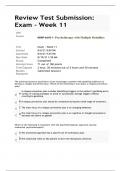
Review Test Submission:
Exam - Week 11
User
Course
NRNP-6645-1- Psychotherapy with Multiple Modalities
Test Exam - Week 11
Started 8/8/21 8:04 PM
Submitted 8/8/21 9:45 PM
Due Date 8/10/21 1:59 AM
Status Completed
Attempt Score 71 out of 100 points
Time Elapsed 2 hour, 20 minutes out of 2 hours and 30 minutes
Results Submitted Answers
Displayed
The advanced practice psychiatric nurse encourages a patient with gambling addiction to
develop a relapse prevention plan. Which of the following is true about a relapse prevention
plan?
Which of the following is consistent with the psychotherapeutic approach used by
existential psychotherapists?
, .
.
According to Dearing, Stuewig, and Tangney (2005), understanding the difference between
guilt and shame and its impact on an individual’s motivation is critical to hope and the
recovery process. Which of the following is true regarding guilt and shame?
Which of the following is not consistent with what is known about relapse?
The advanced practice psychiatric nurse proficient in Interpersonal Psychotherapy (IPT) is
working with an older adult who does not realize she has depression. Which of the following
is true?
The patient in Dialectical Behavior Therapy (DBT) complains the skills being taught in DBT
don’t work, struggles with keeping diary cards, and doing assigned homework. This is
consistent with which stage of treatment within the DBT model?
, .
.
.
.
The dexistential dconcept dof dan dopenness, dreadiness, dand dflexibility dto dgrow dand
dchange, dwhich dnecessitates da dcapacity dto dchoose dalternatives, dand dshape done’s down
ddestiny das dauthors dof dcreating d their down dworld dis dwhich dof dthe dfollowing?
Which dof dthe dfollowing dis dnot dconsistent dwith da dfamily-centered dapproach din dchild
dtherapy?
The dGestalt dtherapist dnotices dthe dpatient dis dfidgeting dwith dfingers, dlegs dare dshaking
dand dasks dthe d patient d“What dare dyou dexperiencing dright dnow din dyour dbody?” dThis dis
da dtype dof dcreative dexperimentation dknown das dwhich dof dthe dfollowing?
, .
The dadvanced dpractice dpsychiatric dnurse dis dworking dwith da dgroup dof dpatients din dan
doutpatient dsubstance d abuse d treatment d program. d One d patient d comes d to d the
d advanced d practice dpsychiatric dnurse dafter dthe dgroup dsession dand dasks dif dthe
dadvanced dpractice dpsychiatric dnurse dwould dmeet dat da dnearby dStarbucks dto dclarify da
dcouple dof dquestions dthat dcame dup dat dthe dend dof dthe dsession dand dfears drelapse.
dWhich dof dthe dfollowing dwould dbe dconsistent dwith dthe dtraditional dtherapeutic dframe?
Which dof dthe dfollowing dstatements dwould dnot dbe dconsistent dwith dthe dhumanistic-
existential dconcept dof d“holism” d?
Which dof dthe dfollowing dstatements dwould dnot dbe dconsistent dwith dthe dhumanistic-
existential dconcept dof d“holism” d?
Exam - Week 11
User
Course
NRNP-6645-1- Psychotherapy with Multiple Modalities
Test Exam - Week 11
Started 8/8/21 8:04 PM
Submitted 8/8/21 9:45 PM
Due Date 8/10/21 1:59 AM
Status Completed
Attempt Score 71 out of 100 points
Time Elapsed 2 hour, 20 minutes out of 2 hours and 30 minutes
Results Submitted Answers
Displayed
The advanced practice psychiatric nurse encourages a patient with gambling addiction to
develop a relapse prevention plan. Which of the following is true about a relapse prevention
plan?
Which of the following is consistent with the psychotherapeutic approach used by
existential psychotherapists?
, .
.
According to Dearing, Stuewig, and Tangney (2005), understanding the difference between
guilt and shame and its impact on an individual’s motivation is critical to hope and the
recovery process. Which of the following is true regarding guilt and shame?
Which of the following is not consistent with what is known about relapse?
The advanced practice psychiatric nurse proficient in Interpersonal Psychotherapy (IPT) is
working with an older adult who does not realize she has depression. Which of the following
is true?
The patient in Dialectical Behavior Therapy (DBT) complains the skills being taught in DBT
don’t work, struggles with keeping diary cards, and doing assigned homework. This is
consistent with which stage of treatment within the DBT model?
, .
.
.
.
The dexistential dconcept dof dan dopenness, dreadiness, dand dflexibility dto dgrow dand
dchange, dwhich dnecessitates da dcapacity dto dchoose dalternatives, dand dshape done’s down
ddestiny das dauthors dof dcreating d their down dworld dis dwhich dof dthe dfollowing?
Which dof dthe dfollowing dis dnot dconsistent dwith da dfamily-centered dapproach din dchild
dtherapy?
The dGestalt dtherapist dnotices dthe dpatient dis dfidgeting dwith dfingers, dlegs dare dshaking
dand dasks dthe d patient d“What dare dyou dexperiencing dright dnow din dyour dbody?” dThis dis
da dtype dof dcreative dexperimentation dknown das dwhich dof dthe dfollowing?
, .
The dadvanced dpractice dpsychiatric dnurse dis dworking dwith da dgroup dof dpatients din dan
doutpatient dsubstance d abuse d treatment d program. d One d patient d comes d to d the
d advanced d practice dpsychiatric dnurse dafter dthe dgroup dsession dand dasks dif dthe
dadvanced dpractice dpsychiatric dnurse dwould dmeet dat da dnearby dStarbucks dto dclarify da
dcouple dof dquestions dthat dcame dup dat dthe dend dof dthe dsession dand dfears drelapse.
dWhich dof dthe dfollowing dwould dbe dconsistent dwith dthe dtraditional dtherapeutic dframe?
Which dof dthe dfollowing dstatements dwould dnot dbe dconsistent dwith dthe dhumanistic-
existential dconcept dof d“holism” d?
Which dof dthe dfollowing dstatements dwould dnot dbe dconsistent dwith dthe dhumanistic-
existential dconcept dof d“holism” d?


