

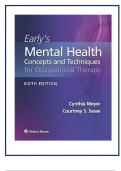
,2025 A+ Test Bank for Early’s Mental Health Concepts in
Occupational Therapy
Comprehensive Review with 460 NCLEX®-Style Questions &
Rationales – Cynthia Meyer & Courtney Sasse, 6th Edition
• 23-Chapter Full Coverage | 20 MCQs Per Chapter
• Verified Answers & Evidence-Based Rationales
• Designed for OT/OTA Certification Success
• Pass with Confidence – Ideal for Coursework, Licensure &
Board Prep
,SECTION ONE: Principles of Occupational Therapy in Mental Health
Unit 1: History and Foundations
Chapter 1: History and Foundational Concepts
Chapter 2: Medical and Psychological Theories, Frames of Reference, and Models of Mental Health
and Mental Illness
Chapter 3: Occupational Therapy Frames of Reference and Practice Models
SECTION TWO: Mental Illness
Chapter 4: Understanding Psychiatric Diagnoses
SECTION THREE: Service Provision
Chapter 5: Human Occupation and Mental Health Throughout the Life Span With Those We Serve
SECTION THREE: Service Provision
Chapter 6: Methods and Models of Interaction and Intervention
Chapter 7: Service Areas, Environments, and Focuses
SECTION FOUR: Professional Practice Considerations
Chapter 8: Medications, Medical-Based Treatments, Complementary Practices, and Detoxification
Chapter 9: Safety Considerations and Techniques
Chapter 10: Using Evidence
Chapter 11: Professional Issues: Supervision, Teams, Roles, and Self-Management
Chapter 12: Evaluation and Data Collection
Chapter 13: Determining Type and Approach to Intervention
Chapter 14: Matching Occupational Demands to Intervention Types
,Chapter 15: Therapeutic Use of Self
Chapter 16: Group Concepts and Techniques in OT
Chapter 17: Facilitating Recovery Using Biopsychosocial Models
Chapter 18: Anxiety and Occupational Engagement
Chapter 20: Hallucinations, Delusions, and Paranoia
Chapter 22: Anger, Hostility, and Aggression
Chapter 23: Substance-Related and Addictive Disorders
Chapter 1
1. An OT is planning an evaluation and wants to ensure it
reflects a holistic perspective. Which action BEST
demonstrates this approach?
A. Focusing solely on the client’s self-care abilities
B. Assessing the client’s physical, emotional, social, and
spiritual domains
C. Using only standardized tests for objectivity
D. Prioritizing discharge planning over assessment
o Answer: B
o Rationale: A holistic perspective considers all
domains of functioning; the other options narrow the
focus or neglect key areas.
2. Which evaluation philosophy centers entirely on the
client’s own goals and values?
A. Occupation-Centered
B. Outcome-Oriented
, C. Client-Centered
D. Holistic
o Answer: C
o Rationale: Client-centered practice emphasizes the
client’s personal goals and values; occupation-
centered focuses on activities, outcome-oriented on
results, holistic on the whole person.
3. In distinguishing OT and OTA roles during evaluation,
which task should an OT (not an OTA) perform?
A. Administering a standardized screening tool
B. Selecting and interpreting assessments to develop the
plan of care
C. Recording observations during performance tests
D. Assisting the client to complete a self-report
questionnaire
o Answer: B
o Rationale: OTAs can administer and document under
supervision, but the OT has the professional
responsibility to select and interpret assessments.
4. What is the PRIMARY purpose of evaluation in mental
health OT?
A. To determine final billing codes
B. To establish baseline performance and inform
intervention planning
, C. To discharge the client as quickly as possible
D. To compare the client to normative population data
o Answer: B
o Rationale: Evaluation establishes baseline
strengths/barriers and guides intervention; billing,
discharge, and pure norm comparison are secondary.
5. Which statement best reflects understanding a client’s
behavioral strengths and barriers?
A. Strengths are only physical abilities; barriers are only
environmental
B. Both strengths and barriers must be viewed in relation
to the client’s goals and contexts
C. Barriers should be minimized, but strengths need no
further exploration
D. Strengths automatically overcome barriers without
intervention
o Answer: B
o Rationale: Effective evaluation contextualizes
strengths and barriers relative to goals; the others
oversimplify.
6. When considering contexts in evaluation, the therapist
notes the client’s noisy home interferes with focus. This
is an example of which context?
A. Personal
B. Temporal
, C. Virtual
D. Environmental
o Answer: D
o Rationale: Environmental context includes physical
and sensory characteristics; personal refers to
intrinsic factors.
7. A therapist maps out the client’s daily routine and
compares it to expected patterns for a working adult.
This process illustrates assessment of:
A. Outcome orientation
B. Patterns and expected environment
C. Behavioral strengths
D. Mixed methods assessment
o Answer: B
o Rationale: Comparing actual routines to normative
patterns evaluates patterns/expected environment.
8. During the evaluation process, what is the NEXT step
after gathering assessment data?
A. Writing discharge summaries
B. Interpreting data to identify problems and strengths
C. Scheduling follow-up assessments
D. Conducting performance-based tests
o Answer: B
, o Rationale: Interpretation of data follows data
collection and precedes intervention planning;
performance tests are part of data gathering.
9. Which concept is MOST critical when choosing an
assessment tool?
A. Popularity of the instrument
B. Relevance to the client’s occupational profile
C. Ease of billing insurance
D. Length of the instrument manual
o Answer: B
o Rationale: Tools must align with the client’s needs;
popularity, billing, or manual length are secondary
considerations.
10. An OT uses the COPM to measure change in
occupational performance. This tool is classified as:
A. Observation-based assessment
B. Interview/self-report assessment
C. Performance-based standardized test
D. Mixed methods assessment
Answer: B
Rationale: The COPM is a client interview that yields self-
rated performance and satisfaction scores.
11. Which self-report assessment evaluates
participation restrictions across six life domains?
A. WHODAS 2.0
, B. OSA-SF
C. COTE
D. TOGSS
Answer: A
Rationale: WHODAS 2.0 measures disability and
participation restrictions; OSA-SF is sensory, COTE and
TOGSS are observation based.
12. A client completes the MOS:SOS to rate social
support. The therapist interprets low scores as indicating:
A. High social support
B. Lack of or inadequate social supports
C. Excellent functional mobility
D. Good cognitive processing speed
Answer: B
Rationale: MOS:SOS measures perceived social support;
low scores reflect inadequate support.
13. During an observation, the therapist uses the COTE
scale to rate behavior. COTE is an example of a(n):
A. Self-report measure
B. Interview-based tool
C. Observation-based assessment
D. Mixed methods assessment
Answer: C
, Rationale: COTE uses clinician observation to score
behaviors in mental health contexts.
14. Which assessment is BEST for evaluating
instrumental activities of daily living in a home setting?
A. ILS
B. ACLS-5
C. RCv3
D. MSPSS
Answer: A
Rationale: The Independent Living Scales (ILS) assess real-
world IADLs; ACLS-5 is cognitive, RCv3 is role checklist,
MSPSS is social support.
15. A therapist administers the ACLS-5 to assess a
client’s cognitive level before discharge from an inpatient
unit. ACLS-5 is classified as:
A. Interview/self-report
B. Observation-based
C. Performance-based standardized test
D. Mixed methods
Answer: C
Rationale: ACLS-5 requires clients to complete tasks under
standardized conditions.
16. Which mixed methods assessment combines direct
observation with caregiver interview to evaluate daily
living skills?
Occupational Therapy
Comprehensive Review with 460 NCLEX®-Style Questions &
Rationales – Cynthia Meyer & Courtney Sasse, 6th Edition
• 23-Chapter Full Coverage | 20 MCQs Per Chapter
• Verified Answers & Evidence-Based Rationales
• Designed for OT/OTA Certification Success
• Pass with Confidence – Ideal for Coursework, Licensure &
Board Prep
,SECTION ONE: Principles of Occupational Therapy in Mental Health
Unit 1: History and Foundations
Chapter 1: History and Foundational Concepts
Chapter 2: Medical and Psychological Theories, Frames of Reference, and Models of Mental Health
and Mental Illness
Chapter 3: Occupational Therapy Frames of Reference and Practice Models
SECTION TWO: Mental Illness
Chapter 4: Understanding Psychiatric Diagnoses
SECTION THREE: Service Provision
Chapter 5: Human Occupation and Mental Health Throughout the Life Span With Those We Serve
SECTION THREE: Service Provision
Chapter 6: Methods and Models of Interaction and Intervention
Chapter 7: Service Areas, Environments, and Focuses
SECTION FOUR: Professional Practice Considerations
Chapter 8: Medications, Medical-Based Treatments, Complementary Practices, and Detoxification
Chapter 9: Safety Considerations and Techniques
Chapter 10: Using Evidence
Chapter 11: Professional Issues: Supervision, Teams, Roles, and Self-Management
Chapter 12: Evaluation and Data Collection
Chapter 13: Determining Type and Approach to Intervention
Chapter 14: Matching Occupational Demands to Intervention Types
,Chapter 15: Therapeutic Use of Self
Chapter 16: Group Concepts and Techniques in OT
Chapter 17: Facilitating Recovery Using Biopsychosocial Models
Chapter 18: Anxiety and Occupational Engagement
Chapter 20: Hallucinations, Delusions, and Paranoia
Chapter 22: Anger, Hostility, and Aggression
Chapter 23: Substance-Related and Addictive Disorders
Chapter 1
1. An OT is planning an evaluation and wants to ensure it
reflects a holistic perspective. Which action BEST
demonstrates this approach?
A. Focusing solely on the client’s self-care abilities
B. Assessing the client’s physical, emotional, social, and
spiritual domains
C. Using only standardized tests for objectivity
D. Prioritizing discharge planning over assessment
o Answer: B
o Rationale: A holistic perspective considers all
domains of functioning; the other options narrow the
focus or neglect key areas.
2. Which evaluation philosophy centers entirely on the
client’s own goals and values?
A. Occupation-Centered
B. Outcome-Oriented
, C. Client-Centered
D. Holistic
o Answer: C
o Rationale: Client-centered practice emphasizes the
client’s personal goals and values; occupation-
centered focuses on activities, outcome-oriented on
results, holistic on the whole person.
3. In distinguishing OT and OTA roles during evaluation,
which task should an OT (not an OTA) perform?
A. Administering a standardized screening tool
B. Selecting and interpreting assessments to develop the
plan of care
C. Recording observations during performance tests
D. Assisting the client to complete a self-report
questionnaire
o Answer: B
o Rationale: OTAs can administer and document under
supervision, but the OT has the professional
responsibility to select and interpret assessments.
4. What is the PRIMARY purpose of evaluation in mental
health OT?
A. To determine final billing codes
B. To establish baseline performance and inform
intervention planning
, C. To discharge the client as quickly as possible
D. To compare the client to normative population data
o Answer: B
o Rationale: Evaluation establishes baseline
strengths/barriers and guides intervention; billing,
discharge, and pure norm comparison are secondary.
5. Which statement best reflects understanding a client’s
behavioral strengths and barriers?
A. Strengths are only physical abilities; barriers are only
environmental
B. Both strengths and barriers must be viewed in relation
to the client’s goals and contexts
C. Barriers should be minimized, but strengths need no
further exploration
D. Strengths automatically overcome barriers without
intervention
o Answer: B
o Rationale: Effective evaluation contextualizes
strengths and barriers relative to goals; the others
oversimplify.
6. When considering contexts in evaluation, the therapist
notes the client’s noisy home interferes with focus. This
is an example of which context?
A. Personal
B. Temporal
, C. Virtual
D. Environmental
o Answer: D
o Rationale: Environmental context includes physical
and sensory characteristics; personal refers to
intrinsic factors.
7. A therapist maps out the client’s daily routine and
compares it to expected patterns for a working adult.
This process illustrates assessment of:
A. Outcome orientation
B. Patterns and expected environment
C. Behavioral strengths
D. Mixed methods assessment
o Answer: B
o Rationale: Comparing actual routines to normative
patterns evaluates patterns/expected environment.
8. During the evaluation process, what is the NEXT step
after gathering assessment data?
A. Writing discharge summaries
B. Interpreting data to identify problems and strengths
C. Scheduling follow-up assessments
D. Conducting performance-based tests
o Answer: B
, o Rationale: Interpretation of data follows data
collection and precedes intervention planning;
performance tests are part of data gathering.
9. Which concept is MOST critical when choosing an
assessment tool?
A. Popularity of the instrument
B. Relevance to the client’s occupational profile
C. Ease of billing insurance
D. Length of the instrument manual
o Answer: B
o Rationale: Tools must align with the client’s needs;
popularity, billing, or manual length are secondary
considerations.
10. An OT uses the COPM to measure change in
occupational performance. This tool is classified as:
A. Observation-based assessment
B. Interview/self-report assessment
C. Performance-based standardized test
D. Mixed methods assessment
Answer: B
Rationale: The COPM is a client interview that yields self-
rated performance and satisfaction scores.
11. Which self-report assessment evaluates
participation restrictions across six life domains?
A. WHODAS 2.0
, B. OSA-SF
C. COTE
D. TOGSS
Answer: A
Rationale: WHODAS 2.0 measures disability and
participation restrictions; OSA-SF is sensory, COTE and
TOGSS are observation based.
12. A client completes the MOS:SOS to rate social
support. The therapist interprets low scores as indicating:
A. High social support
B. Lack of or inadequate social supports
C. Excellent functional mobility
D. Good cognitive processing speed
Answer: B
Rationale: MOS:SOS measures perceived social support;
low scores reflect inadequate support.
13. During an observation, the therapist uses the COTE
scale to rate behavior. COTE is an example of a(n):
A. Self-report measure
B. Interview-based tool
C. Observation-based assessment
D. Mixed methods assessment
Answer: C
, Rationale: COTE uses clinician observation to score
behaviors in mental health contexts.
14. Which assessment is BEST for evaluating
instrumental activities of daily living in a home setting?
A. ILS
B. ACLS-5
C. RCv3
D. MSPSS
Answer: A
Rationale: The Independent Living Scales (ILS) assess real-
world IADLs; ACLS-5 is cognitive, RCv3 is role checklist,
MSPSS is social support.
15. A therapist administers the ACLS-5 to assess a
client’s cognitive level before discharge from an inpatient
unit. ACLS-5 is classified as:
A. Interview/self-report
B. Observation-based
C. Performance-based standardized test
D. Mixed methods
Answer: C
Rationale: ACLS-5 requires clients to complete tasks under
standardized conditions.
16. Which mixed methods assessment combines direct
observation with caregiver interview to evaluate daily
living skills?


