BSNC 6020 Ethical Analysis Paper : Frameworks & Case Evaluation Guide
BSNC 6020 Ethical Analysis Paper Information and Rubric
BSNC 6020 Ethical Analysis Paper
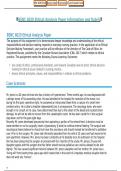
The purpose of this assignment is to demonstrate deeper knowledge and understanding of the ethical
responsibilities and decision-making required in everyday nursing practice. In the application of an Ethical
Decision-Making Framework, your practice will be reflective of the direction of The Code of Ethics for
Registered Nurses, published by the Canadian Nurses Association (CNA, 2017) which relates to ethical
practice. This assignment meets the following Course Learning Outcomes:
• Use codes of ethics, professional standards, and relevant Canadian laws to direct ethical decision-
making for ethical issues related to nursing practice.
• Assess ethical principles, values, and responsibilities in relation to ethical problems.
Case Scenario:
Mr. Jones is a 62-year-old man who has a history of hypertension. Three months ago, he was diagnosed with
a benign tumor of his ascending colon. He was admitted to the hospital for resection of the tumor, but
during his first post- operative night, he sustained an intracranial bleed from a rupture of a small inter-
cerebral artery. He is able to breathe independently but is unresponsive. The neurology team, who were
brought in to consult on his case, have determined that due to the extent of the bleed and resultant brain
damage, he will not be able to recover from this catastrophic event. He has been cared for in the surgical
step-down unit for the past eight days.
Recently Mr. Jones developed pneumonia from aspirating a portion of his enteral feed. A decision must be
made whether or not to surgically insert a jejunostomy (J-tube) to continue enteral feeding. The surgical and
neurological teams believe he should not have this procedure and should instead be transferred to palliative
care. Prior to the surgery, Mr. Jones had informally separated from his wife of 25 years and had moved to his
own apartment. However, Mrs. Jones has been constantly at his bedside since his admission to the hospital.
She has been pressuring the surgeon to proceed with the insertion of the J-tube. Mr. Jones’s 25-year-old
daughter agrees with the surgeon that her father should receive palliative care and be allowed to die with
dignity. This has caused significant tension between Mr. Jones’s daughter and her mother. Mr. Jones has a
“living will” from twenty-three years ago which states that in the event of a hopeless medical situation that he
does not want any “heroics”.
®™
, BSNC 6020 Ethical Analysis Paper : Frameworks & Case Evaluation Guide
Jan 2025
®™
BSNC 6020 Ethical Analysis Paper Information and Rubric
BSNC 6020 Ethical Analysis Paper
The purpose of this assignment is to demonstrate deeper knowledge and understanding of the ethical
responsibilities and decision-making required in everyday nursing practice. In the application of an Ethical
Decision-Making Framework, your practice will be reflective of the direction of The Code of Ethics for
Registered Nurses, published by the Canadian Nurses Association (CNA, 2017) which relates to ethical
practice. This assignment meets the following Course Learning Outcomes:
• Use codes of ethics, professional standards, and relevant Canadian laws to direct ethical decision-
making for ethical issues related to nursing practice.
• Assess ethical principles, values, and responsibilities in relation to ethical problems.
Case Scenario:
Mr. Jones is a 62-year-old man who has a history of hypertension. Three months ago, he was diagnosed with
a benign tumor of his ascending colon. He was admitted to the hospital for resection of the tumor, but
during his first post- operative night, he sustained an intracranial bleed from a rupture of a small inter-
cerebral artery. He is able to breathe independently but is unresponsive. The neurology team, who were
brought in to consult on his case, have determined that due to the extent of the bleed and resultant brain
damage, he will not be able to recover from this catastrophic event. He has been cared for in the surgical
step-down unit for the past eight days.
Recently Mr. Jones developed pneumonia from aspirating a portion of his enteral feed. A decision must be
made whether or not to surgically insert a jejunostomy (J-tube) to continue enteral feeding. The surgical and
neurological teams believe he should not have this procedure and should instead be transferred to palliative
care. Prior to the surgery, Mr. Jones had informally separated from his wife of 25 years and had moved to his
own apartment. However, Mrs. Jones has been constantly at his bedside since his admission to the hospital.
She has been pressuring the surgeon to proceed with the insertion of the J-tube. Mr. Jones’s 25-year-old
daughter agrees with the surgeon that her father should receive palliative care and be allowed to die with
dignity. This has caused significant tension between Mr. Jones’s daughter and her mother. Mr. Jones has a
“living will” from twenty-three years ago which states that in the event of a hopeless medical situation that he
does not want any “heroics”.
®™
, BSNC 6020 Ethical Analysis Paper : Frameworks & Case Evaluation Guide
Jan 2025
®™