Science Medicine Pathophysiology
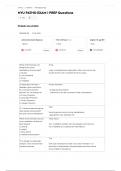
NYU PATHO EXAM I PREP Questions
Save
Students also studied
Flashcard sets Study guides
Altered Electorate Balances NYU HAP Exam 1 Chapter 37; pg 929-9
128 terms 77 terms 7 terms
annie1039 Preview ericatimms Preview Hannah200450
Which of the following is an Bruise
example of a clinical
manifestation known as sign? A sign is something that is observable to the nurse. A bruise can
a. Nausea be seen by the nurse on a patient and is thus a sign.
b. Loss of appetite
c. Bruise
d. Headache
An obese adult with type II Tertiary Prevention
diabetes is given prescription
for a low-calorie diet and - Already has the condition
exercise. This is an example of: - Intervention is to treat it to prevent further complications
a. Primary Prevention
b. Secondary Prevention
c. Tertiary Prevention
d. Disease Prevention
False
T/F Individuals experiencing the
same disease process exhibit
Many things contribute to clinical manifestations:
the same clinical manifestations.
- age, gender, race, healthcare, etc.
Which of the following would be Family history
a non-modifiable risk factor for
heart disease? Non- modifiable risk factor can't be changed. Family history is
a. smoking non-modifiable as our genetics are what they are.
b. obesity
c. family history
d. elevated blood pressure
True
T/F A change in a physiologic
variable is more important than One value itself doesn't provide much useful information. It is
the absolute values. important to understand an individuals baseline and then look at
results related to the baseline.
, False
T/F Prevalence is the number of
new cases of a disease in a Prevalence is the number of old cases + new cases.
given population at a given time.
Incidence is the number of only new cases
T/F Breast cancer screening False
programs are an example of
primary level of prevention. Secondary level of prevention = screening and test
True
T/F Apoptotic cell death can be
characterized as "cell suicide"
trigger cell to kill itself
Glucose must enter the body Facilitated Diffusion
cell in order to provide energy
for the client who was recently - uses a carrier protein aka insulin to enter the body cell.
diagnosed with diabetes. The
nurse knows that which of the
following processes allows
glucose to enter body cells?
a. osmosis
b. active transport
c. diffusion
d. Facilitated diffusion
The nurse is examining the Metaplasia
results of the bronchoscopy of a
chronic smoker. The report If a cell changes from one differentiated cell type to another,
showed stratified squamous that is termed metaplasia.
cells as opposed to columnar
ciliated cells. The nurse hyperplasia - an increase in # of the same type of cells
understands this is which type of Dysplasia - loss of form and cells become irregular
cellular adaptation? Anaplasia - the cells become totally undifferentiated and
cancerous.
a. hyperplasia
b. dysplasia
c. anaplasia
d. metaplasia
Which of the following cellular Intracellular accumulation
accumulations is indicative of
injury due to faulty metabolism? Can occur due to build up of normal body substance, a build up
of exogenous substances, or build up of abnormal endogenous
a. Hydropic swelling products due to faulty metabolism.
b. Lactate production
c. Metaplasia
d. Intracellular accumulations
See an expert-written answer!
NYU PATHO EXAM I PREP Questions
Save
Students also studied
Flashcard sets Study guides
Altered Electorate Balances NYU HAP Exam 1 Chapter 37; pg 929-9
128 terms 77 terms 7 terms
annie1039 Preview ericatimms Preview Hannah200450
Which of the following is an Bruise
example of a clinical
manifestation known as sign? A sign is something that is observable to the nurse. A bruise can
a. Nausea be seen by the nurse on a patient and is thus a sign.
b. Loss of appetite
c. Bruise
d. Headache
An obese adult with type II Tertiary Prevention
diabetes is given prescription
for a low-calorie diet and - Already has the condition
exercise. This is an example of: - Intervention is to treat it to prevent further complications
a. Primary Prevention
b. Secondary Prevention
c. Tertiary Prevention
d. Disease Prevention
False
T/F Individuals experiencing the
same disease process exhibit
Many things contribute to clinical manifestations:
the same clinical manifestations.
- age, gender, race, healthcare, etc.
Which of the following would be Family history
a non-modifiable risk factor for
heart disease? Non- modifiable risk factor can't be changed. Family history is
a. smoking non-modifiable as our genetics are what they are.
b. obesity
c. family history
d. elevated blood pressure
True
T/F A change in a physiologic
variable is more important than One value itself doesn't provide much useful information. It is
the absolute values. important to understand an individuals baseline and then look at
results related to the baseline.
, False
T/F Prevalence is the number of
new cases of a disease in a Prevalence is the number of old cases + new cases.
given population at a given time.
Incidence is the number of only new cases
T/F Breast cancer screening False
programs are an example of
primary level of prevention. Secondary level of prevention = screening and test
True
T/F Apoptotic cell death can be
characterized as "cell suicide"
trigger cell to kill itself
Glucose must enter the body Facilitated Diffusion
cell in order to provide energy
for the client who was recently - uses a carrier protein aka insulin to enter the body cell.
diagnosed with diabetes. The
nurse knows that which of the
following processes allows
glucose to enter body cells?
a. osmosis
b. active transport
c. diffusion
d. Facilitated diffusion
The nurse is examining the Metaplasia
results of the bronchoscopy of a
chronic smoker. The report If a cell changes from one differentiated cell type to another,
showed stratified squamous that is termed metaplasia.
cells as opposed to columnar
ciliated cells. The nurse hyperplasia - an increase in # of the same type of cells
understands this is which type of Dysplasia - loss of form and cells become irregular
cellular adaptation? Anaplasia - the cells become totally undifferentiated and
cancerous.
a. hyperplasia
b. dysplasia
c. anaplasia
d. metaplasia
Which of the following cellular Intracellular accumulation
accumulations is indicative of
injury due to faulty metabolism? Can occur due to build up of normal body substance, a build up
of exogenous substances, or build up of abnormal endogenous
a. Hydropic swelling products due to faulty metabolism.
b. Lactate production
c. Metaplasia
d. Intracellular accumulations
See an expert-written answer!