

Written by students who passed Immediately available after payment Read online or as PDF Wrong document? Swap it for free 4.6 TrustPilot
logo-home
Document preview thumbnail
Preview 4 out of 104 pages
Exam (elaborations)

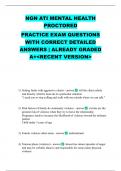
NGN ATI MENTAL HEALTH PROCTORED PRACTICE EXAM QUESTIONS WITH CORRECT DETAILED ANSWERS | ALREADY GRADED A+RECENT VERSION

Document preview thumbnail
Preview 4 out of 104 pages

NGN ATI MENTAL HEALTH PROCTORED PRACTICE EXAM QUESTIONS WITH CORRECT DETAILED ANSWERS | ALREADY GRADED A+RECENT VERSION 1) Setting limits with aggressive clients - answer tell the client calmly and directly what he must do in a particular situation "i need you to stop yelling and walk with me outside where we can talk." 2) Risk factors of family & community violence - answer victims are the greatest risk of violence when they try to leave the relationship Pregnancy tends to increase the likelihood of violence toward the intimate partner Child under 3 years of age 3) Family violence other name - answer maltreatment 4) Tension phase (violence) - answer abuser has minor episodes of anger and may be verbally abusive and responsible for some minor physical violence 5) Acute battering phase - answer the tension becomes too much to bear and serious abuse takes place Victim may try to cover up injuries or may get help 6) Honeymoon phase - answer abuser becomes loving, promises to change, and is sorry for behavior 7) Shaken baby syndrome findings - answer may cause intercranial hemorrhage assess for respiratory distress, bulging fontanelles, increase in head circumference 8) Referrals for older adult client after suicide attempt - answer a. Occupational therapy, b. Meal delivery services, e. Home health services 9) Informed consent for deaf client undergoing ect - answer a. Request a professional interpreter to translate 10) Action for aggressive client refusing lorazepam - answer b. Do not administer the lorazepam 11) Client's behavior in initial interview - answer a. Is beginning to trust the nurse 12) Nurse's action in group therapy with dominating client - answer d. Interrupt the client and direct the discussion to another group member 13) Nurse's first action when suspecting abuse - answer a. Initiate a referral to social services for suspected abuse 14) Referral to social services - answer initiate a referral to social services for suspected abuse. 15) Signs of abuse - answer check the client for other signs and symptoms of abuse. 16) Escalating abuse - answer assist the client to identify signs of escalating abuse. 17) Supportive family member - answer identify a family member who can provide support to the client. 18) Alcoholics anonymous understanding - answer a client indicates understanding of teaching by stating, 'i will learn ways to decrease my alcohol use.' 19) Peer support in recovery - answer a client indicates understanding of teaching by stating, 'i will use peer support to maintain my abstinence.' 20) Responsibility for addiction - answer a client indicates understanding of teaching by stating, 'i will learn to take responsibility for my addiction.' 21) Health care professional as sponsor - answer a client indicates understanding of teaching by stating, 'i will use a health care professional as my sponsor.' 22) Orienting client with dementia - answer place a large wall calendar in the client's room. 23) Healthy adolescent behavior - answer displays an egocentric approach in problem-solving (preschooler). 24) Literal explanations - answer requires literal explanations (toddler). 25) Mistrust in infants - answer demonstrates mistrust of others (infant). 26) Realistic self-concept - answer exhibits a realistic self-concept. 27) Alcoholic cardiomyopathy lab values - answer increased creatine phosphokinase (cpk) is expected (muscle enzyme released when muscle tissue is damaged, occurs with cardiomyopathy). 28) Low-density lipoproteins - answer increased low-density lipoproteins (ldl). 29) Fasting blood sugar - answer decreased fasting blood sugar (fbs). 30) Aspartate aminotransferase - answer decreased aspartate aminotransferase (ast). 31) Client's concern about discharge - answer an appropriate response is, 'you seem concerned about getting out of the hospital.' 32) False reassurance - answer an inappropriate response is, 'care at the hospital will help you to feel better about yourself.' 33) Client with schizophrenia - answer assess the client for evidence of a perceptual disturbance (assess the situation to determine if the client is hallucinating or misperceiving external stimuli). 34) Inappropriate action with hallucination - answer ask the client to identify the bomb in the room (inappropriate action because the nurse is responding as if the hallucination is real). 35) Disaster protocols - answer initiate disaster protocols per facility policies and procedures (without evidence of a disaster on a mental health unit). 36) Risperidone - answer a medication that can cause diabetes mellitus to develop; therefore, the nurse should plan to monitor the client's blood glucose level when taking this medication. 37) Anorexia nervosa - answer a condition where the nurse should expect clinical findings such as amenorrhea, tooth erosion, russell's sign, and parotid gland swelling. 38) Electroconvulsive therapy (ect) - answer a procedure that can increase the risk for developing parkinson's disease and may cause short-term memory loss. 39) Complicated grief - answer a risk indicated by statements such as feeling empty without the deceased and having difficulty getting up every morning. 40) Negative symptoms of schizophrenia - answer symptoms such as flat affect, which is the absence of emotion. 41) Positive symptoms of schizophrenia - answer symptoms such as hallucinations and flight of ideas, which indicate alterations in perception and thought disorder. 42) Bereavement support group - answer a setting where strategies such as dividing the group into pairs can help encourage participation from silent members. 43) Tooth erosion - answer a clinical finding associated with bulimia from self-induced vomiting. 44) Amenorrhea - answer a clinical finding caused by low weight in clients with anorexia nervosa. 45) Russell's sign - answer calluses on knuckles that can occur due to self-inducing vomiting. 46) Parotid gland swelling - answer a clinical finding in clients with bulimia, indicated by increased serum amylase levels. 47) Short-term memory loss - answer a potential effect following electroconvulsive therapy (ect). 48) Cardiac monitor - answer a device that will be in place during the electroconvulsive therapy (ect) procedure. 49) Guilt in bereavement - answer an expression of guilt, such as wishing to have been nicer before the death, which is expected during bereavement. 50) Anger in bereavement - answer an expression of anger, such as blaming the deceased for not listening to medical advice. 51) Preoccupation with the deceased - answer a statement indicating ongoing thoughts about the deceased during outings, which can be a sign of complicated grief. 52) Agitated behavior - answer a positive symptom of schizophrenia characterized by bizarre behavior. 53) Hallucinations - answer alterations in perception that are classified as positive symptoms of schizophrenia. 54) Group participation strategies - answer techniques such as reminding the group to participate or focusing on other members to encourage participation. 55) Discharge teaching - answer education provided to family members of clients with new diagnoses, such as depression. 56) Relapse in depression - answer early identification of changes such as decreased social involvement is important. 57) Posttraumatic stress disorder (ptsd) - answer distressing dream (persistently reexperience the event that triggers ptsd in the form of distressing dreams). 58) Delusions - answer false fixed beliefs that are difficult to eradicate. 59) Difficulty concentrating - answer persistent increased arousal. 60) Compulsions - answer compelled to repeatedly perform to reduce anxiety. 61) Exaggerated startle response - answer persistent increased arousal. 62) Bipolar disorder priority behavior - answer giving away possessions (risk for suicide). 63) Anger and aggression management - answer defuse the situation using therapeutic communication. 64) Dependent personality disorder - answer the client needs excessive external input to make everyday decisions. 65) Ocd behavior - answer the client demonstrates a dedication to his job that excludes time for leisure activities. 66) Rigid rule adherence - answer the client adheres to a rigid set of rules. 67) Avoidant personality disorder - answer the client has difficulty starting new relationships unless he feels accepted. 68) Haloperidol side effects - answer blurred vision. 69) Photosensitivity - answer a side effect of haloperidol that should be reported. 70) Shuffling gait - answer pseudoparkinsonism, occurring 5 hours to 30 days after beginning treatment. 71) Mild anxiety - answer restlessness, irritability, nail biting, and fidgeting. 72) Moderate anxiety - answer tension, palpitation, increased heart rate, and diaphoresis. 73) Severe anxiety - answer difficulty sleeping, light headedness, nausea, tremors, and a sense of impending doom. 74) Panic - answer hyperactivity, severe tremors, and uncoordinated impulsive behavior. 75) Borderline personality disorder care goal - answer the client will refrain from self-mutilation. 76) Purpose of attending a support group - answer provide assurance that others have a similar problem. 77) Active listening - answer offering self (demonstrate genuine interest in the client). 78) Active listening - answer use of silence (demonstrate willingness to wait for the client's response). 79) Active listening - answer attention to body language. 80) Active listening - answer reflection of feelings (encourage the client to acknowledge his feeling). 81) Lithium level - answer 1.5 meq/l. 82) Additional laboratory data priority - answer serum sodium 125 meq/l (low sodium level). 83) Situational crisis example - answer the client recently lost a grandparent in a motor vehicle crash. 84) Adventitious crisis example - answer the client's town was hit by a tornado. 85) Maturational crisis example - answer the client's youngest son leaves for college. 86) Informed consent - answer a 35-year-old who has major depressive disorder. 87) Informed consent - answer a 17-year-old who lives with friends (minor).

Content preview

NGN ATI MENTAL HEALTH
PROCTORED
PRACTICE EXAM QUESTIONS
WITH CORRECT DETAILED
ANSWERS | ALREADY GRADED
A+<RECENT VERSION>


1) Setting limits with aggressive clients - answer tell the client calmly
and directly what he must do in a particular situation
"i need you to stop yelling and walk with me outside where we can talk."


2) Risk factors of family & community violence - answer victims are the
greatest risk of violence when they try to leave the relationship
Pregnancy tends to increase the likelihood of violence toward the intimate
partner
Child under 3 years of age


3) Family violence other name - answer maltreatment


4) Tension phase (violence) - answer abuser has minor episodes of anger
and may be verbally abusive and responsible for some minor physical
violence

,5) Acute battering phase - answer the tension becomes too much to bear
and serious abuse takes place
Victim may try to cover up injuries or may get help


6) Honeymoon phase - answer abuser becomes loving, promises to
change, and is sorry for behavior


7) Shaken baby syndrome findings - answer may cause intercranial
hemorrhage assess for respiratory distress, bulging fontanelles, increase
in head circumference


8) Referrals for older adult client after suicide attempt - answer a.
Occupational therapy, b. Meal delivery services, e. Home health services


9) Informed consent for deaf client undergoing ect - answer a. Request a
professional interpreter to translate


10) Action for aggressive client refusing lorazepam - answer b. Do
not administer the lorazepam


11) Client's behavior in initial interview - answer a. Is beginning to
trust the nurse


12) Nurse's action in group therapy with dominating client - answer
d. Interrupt the client and direct the discussion to another group member


13) Nurse's first action when suspecting abuse - answer a. Initiate a
referral to social services for suspected abuse

,14) Referral to social services - answer initiate a referral to social
services for suspected abuse.


15) Signs of abuse - answer check the client for other signs and
symptoms of abuse.


16) Escalating abuse - answer assist the client to identify signs of
escalating abuse.


17) Supportive family member - answer identify a family member
who can provide support to the client.


18) Alcoholics anonymous understanding - answer a client
indicates understanding of teaching by stating, 'i will learn ways to
decrease my alcohol use.'


19) Peer support in recovery - answer a client indicates
understanding of teaching by stating, 'i will use peer support to maintain
my abstinence.'


20) Responsibility for addiction - answer a client indicates
understanding of teaching by stating, 'i will learn to take responsibility for
my addiction.'


21) Health care professional as sponsor - answer a client indicates
understanding of teaching by stating, 'i will use a health care professional
as my sponsor.'


22) Orienting client with dementia - answer place a large wall
calendar in the client's room.

, 23) Healthy adolescent behavior - answer displays an egocentric
approach in problem-solving (preschooler).


24) Literal explanations - answer requires literal explanations
(toddler).


25) Mistrust in infants - answer demonstrates mistrust of others
(infant).


26) Realistic self-concept - answer exhibits a realistic self-concept.


27) Alcoholic cardiomyopathy lab values - answer increased
creatine phosphokinase (cpk) is expected (muscle enzyme released when
muscle tissue is damaged, occurs with cardiomyopathy).


28) Low-density lipoproteins - answer increased low-density
lipoproteins (ldl).


29) Fasting blood sugar - answer decreased fasting blood sugar
(fbs).


30) Aspartate aminotransferase - answer decreased aspartate
aminotransferase (ast).


31) Client's concern about discharge - answer an appropriate
response is, 'you seem concerned about getting out of the hospital.'


Document information

Uploaded on
June 22, 2025
Number of pages
104
Written in
2024/2025
Type
Exam (elaborations)
Contains
Questions & answers
$13.99

Wrong document? Swap it for free Within 14 days of purchase and before downloading, you can choose a different document. You can simply spend the amount again.
Written by students who passed
Immediately available after payment
Read online or as PDF

Seller avatar
Reputation scores are based on the amount of documents a seller has sold for a fee and the reviews they have received for those documents. There are three levels: Bronze, Silver and Gold. The better the reputation, the more your can rely on the quality of the sellers work.
jervismuthami
4.5
(2)
Sold
12
Followers
0
Items
567
Last sold
2 months ago


Why students choose Stuvia

Created by fellow students, verified by reviews

Quality you can trust: written by students who passed their tests and reviewed by others who've used these notes.

Didn't get what you expected? Choose another document

No worries! You can instantly pick a different document that better fits what you're looking for.

Pay as you like, start learning right away

No subscription, no commitments. Pay the way you're used to via credit card and download your PDF document instantly.

Student with book image

“Bought, downloaded, and aced it. It really can be that simple.”

Alisha Student

Working on your references?

Create accurate citations in APA, MLA and Harvard with our free citation generator.

Working on your references?

Frequently asked questions
