Written by students who passed Immediately available after payment Read online or as PDF Wrong document? Swap it for free 4.6 TrustPilot
logo-home
Exam (elaborations)

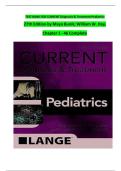
TEST BANK FOR CURRENT Diagnosis & Treatment Pediatrics 27th Edition by Maya Bunik; William W. Hay, Chapter 1 - 46 Complete DR ERIC///Current Diagnosis and Treatment Pediatrics, 27th Edition Test Bank

Rating
-
Sold
-
Pages
497
Grade
A+
Uploaded on
22-06-2025
Written in
2024/2025

TEST BANK FOR CURRENT Diagnosis & Treatment Pediatrics 27th Edition by Maya Bunik; William W. Hay, Chapter 1 - 46 Complete DR ERIC DR ERIC Current Diagnosis and Treatment Pediatrics, 27th Edition Test Bank Table of Contents: Chapter 1. The Newborn Infant Chapter 2. Child Development and Behavior Chapter 3. Adolescence Chapter 4. Adolescent Substance Abuse Chapter 5. Eating Disorders Chapter 6. Child and Adolescent Psychiatric Disorders Chapter 7. Child Abuse and Neglect Chapter 8. Ambulatory / Office Pediatrics Chapter 9. Immunization Chapter 10. Travel Medicine Chapter 11. Normal Childhood Nutrition and Its Disorders Chapter 12. Emergencies and Injuries Chapter 13. Poisoning Chapter 14. Critical Care Chapter 15. Skin Chapter 16. Eye Chapter 17. Oral Medicine and Dentistry Chapter 18. Ear, Nose, and Throat Chapter 19. Respiratory Tract and Mediastinum Chapter 20. Sleep Medicine Chapter 21. Cardiovascular Diseases Chapter 22. Gastrointestinal Tract Chapter 23. Liver and Pancreas Chapter 24. Kidney and Urinary Tract Chapter 25. Neurologic and Muscular Disorders Chapter 26. Orthopedics Chapter 27. Sports Medicine Chapter 28. Rehabilitation Medicine Chapter 29. Rheumatic Diseases Chapter 30. Hematologic Disorders Chapter 31. Neoplastic Disease Chapter 32. Pain Management and Palliative Care Chapter 33. Immunodeficiency Chapter 34. Endocrine Disorders Chapter 35. Diabetes Mellitus Chapter 36. Inborn Errors of Metabolism Chapter 37. Genetics and Dysmorphology Chapter 38. Allergic Disorders Chapter 39. Antimicrobial Therapy Chapter 40. Infections: Viral and Rickettsial Chapter 41. Human Immunodeficiency Virus Infection Chapter 42. Infections: Bacterial and Spirochetal Chapter 43. Infections: Parasitic and Mycotic Chapter 44. Sexually Transmitted Infections Chapter 45. Fluid, Electrolyte, and Acid-Base Disorders and Therapy Chapter 46. Pediatric Laboratory Medicine and Reference Ranges DR ERIC DR ERIC Chapter 1: The Newborn Infant Current Diagnosis and Treatment Pediatrics, 27th Edition Test Bank Multiple Choice 1. Which milestone is developmentally appropriate for a 2-month-old infant when the nurse pulls the infant to a sitting position? a. Head lag is present when the infants trunk is lifted. b. The infant is able to support the head when the trunk is lifted. c. The infant is briefly able to hold the head erect. d. The infant is fully able to support and hold the head in a straight line. ANSWER: C A 2-month-old infant is able to hold the head erect only briefly and continues to have some head lag. It is not until 4 months of age that the infant can keep his or her head in a straight line when pulled to a sitting position. 2. Approximately what should a newborn weigh at 1 year of age if the newborns birth weight was 7 pounds 6 ounces? a. 14 3/4 pounds b. 22 1/8 pounds c. 29 1/2 pounds d. Unable to estimate weight at 1 year ANSWER: B An infant triples the birth weight by 1 year of age. An infant doubles the birth weight by 6 months of age. An infant quadruples the birth weight by 2 years of age. Weight at 6 months, 1 year, and 2 years of age can be estimated from the birth weight. DR ERIC DR ERIC 3. Which statement made by a parent would be consistent with a developmental delay? a. I have noticed that my 9-month-old infant responds consistently to the sound of his name. b. I have noticed that my 12-month-old child does not get herselfto a sitting position or pull to stand. c. I am so happy when my 1 1/2-month-old infant smiles at me. d. My 5-month-old infant is not rolling over in both directions yet. ANSWER: B Critical developmental milestones for gross motor development in a 12 month old include standing briefly without support, getting to a sitting position, and pulling to stand. If a 12- month- old child does not perform these activities, it may be indicative of a developmental delay. An infant who responds to his name at 9 months of age is demonstrating abilities to both hear and interpret sound. A social smile is present by 2 months of age. Rolling over in both directions is not a critical milestone for gross motor development until the child reaches 6 months of age. 4. At a healthy 2-month-old infants well-child clinic visit, the nurse should give which immunizations? a. DTaP, IPV, HepB, Hib, PCV, rotavirus b. MMR, DTaP, PVC, and IPV c. Hib, DTaP, rotavirus, and OPV d. Hib and MMR, IPV, and rotavirus ANSWER: A DTaP, IPV, HepB, Hib, PCV, and rotavirus are the appropriate sequence of immunizations for a healthy 2-month-old infant. MMR is given at or after 12 months of age. Oral polio vaccine (OPV) is no longer administered in the U.S. 5. The nurse advises the mother of a 3-month-old infant, exclusively breast-fed, to: a. start giving the infant a vitamin D supplement. DR ERIC DR ERIC b. start using an infant feeder and add rice cereal to the formula. c. start feeding the infant rice cereal with a spoon at the evening feeding. d. continue breast-feeding without any supplements. ANSWER: A Breast milk does not provide an adequate amount of dietary vitamin D. Infants who are exclusively breast-fed need vitamin D supplements to prevent rickets. An infant feeder is an inappropriate method of providing the infant with caloric intake. Solid foods and rice cereal are not recommended for a 3-month-old infant. Solid feedings do not typically begin before 4 to 6 months of age. Because breast milk is not an adequate source of fluoride, infants need to be given a fluoride supplement. 6. At months of age, an infant should first be expected to locate an object hidden from view. a. 4 b. 6 c. 9 d. 20 ANSWER: C By 9 months of age an infant will actively search for an object that is out of sight. Four-month￾old infants are not cognitively capable of searching out objects hidden from their view. Infants at this developmental level do not pursue hidden objects. Six-month-old infants have not developed the ability to perceive objects as permanent and do not search out objects hidden from their view. Twenty-month-old infants actively pursue objects not in their view and are capable of recalling the location of an object not in their view. They first look for hidden objects around the age of 9 months. 7. The parents of a newborn infant state, We will probably not have our baby immunized because we are concerned about the risk of our child being injured. Which is the best response for the nurse to make? DR ERIC DR ERIC a. It is your decision. b. Have you talked with your parents about this? They can probably help you think about this decision. c. The risks of not immunizing your baby are greater than the risks from the immunizations. d. You are making a mistake. ANSWER: C Although immunizations have been documented to have a negative effect in a small number of cases, an unimmunized infant is at greater risk for development of complications from childhood diseases than from the vaccines. It is the parents decision not to immunize the child; however, the nurse has a responsibility to inform parents about the risks to infants who are not immunized. Grandparents can be supportive but are not the primary decision makers for the infant. Telling parents that they are making a mistake is an inappropriate response. 8. The mother of a 9-month-old infant is concerned because the infant cries when she leaves him. Which is the best response for the nurse to make to the mother? a. You could consider leaving the infant more often so he can adjust. b. You might consider taking him to the doctor because he may be ill. c. Have you noticed whether the baby is teething? d. This can be a healthy sign of attachment. ANSWER: D Healthy attachment is manifested by stranger anxiety in late infancy. An infant who manifests stranger anxiety can be supported by the mother leaving the infant for only short periods of time. Assessing developmental needs is appropriate before taking an infant to a physician. Pain from teething expressed by the infants cries would not occur only when the mother left the room. 9. Which statement concerning physiological factors of infancy is true? a. The infant has a slower metabolic rate than an adult. DR ERIC DR ERIC b. An infant is not able to digest protein and lactase. c. Infants have a slower circulatory response than adults. d. The kidneys of an infant are less efficient in concentrating urine than an adults kidneys. ANSWER: D The infants kidneys are not as effective at concentrating urine compared with an adults kidneys because of immaturity of the renal system and a slower glomerular filtration rates. The infants metabolic rate is faster, not slower, than an adults. Although the newborn infants gastrointestinal system is immature, it is capable of digesting protein and lactase, but the ability to digest and absorb fat does not reach adult levels until approximately 6 to 9 months of age. 10. Which is a priority in counseling parents of a 6-month-old infant? a. Increased appetite from secondary growth spurt b. Allowing the infant to self-feed c. Securing a developmentally safe environment for the infant d. Strategies to teach infantsto sit up ANSWER: C Safety is a primary concern as an infant becomes increasingly mobile. The infants appetite and growth velocity decrease in the second half of infancy. Fine motor development, which is refined in the second half of infancy, is necessary before the infant can self-feed. Unless the infant has a neuromuscular deficit, strategies for teaching a normally developing infant to sit up are not necessary. 11. A mother of a 2-month-old infant tells the nurse, My child doesnt sleep as much as his older brother did at the same age. What is the best response for the nurse? a. Have you tried to feed the baby more often? b. Infant sleep patterns vary widely, with some infants sleeping only 2 to 3 hours at a time. DR ERIC DR ERIC c. It is helpfulto keep a record of your babys eating, waking, sleeping, and elimination patterns and to come back in a week to discuss them. d. This infant is difficult. It is important for you to identify what is bothering the baby. ANSWER: B Newborn infants may sleep as much as 17 to 20 hours per day. Sleep patterns vary widely, with some infants sleeping only 2 to 3 hours at a time. Infants typically do not need more caloric intake to improve sleep behaviors. Keeping intake, output, waking, and sleeping data is not typically helpful in discussing differences among infants behaviors. Identifying an infant as difficult without identifying helpful actions is not a therapeutic response for a parent concerned about sleep. 12. The mother of a 10-month-old infant tells the nurse that her infant really likes cows milk. Which is the best response to this mother? a. Milk is good for him. b. It is best to wait until he is a year old before giving him cows milk. c. Limit cows milk to his bedtime bottle. d. Mix his cereal with cows milk and give him formula in a bottle. ANSWER: B It is best to wait until the infant is at least a year old before giving him cows milk because of the risk of allergies and intestinal problems. Cows milk protein intolerance isthe most common food allergy during infancy. Although milk is a good source of calcium and protein for children after the first year of life, it is not the best source of nutrients for children younger than 1 year old. Bedtime bottles of formula or milk are contraindicated because oftheir high sugar content, which leads to dental decay in primary teeth. Cereal can be mixed with formula. 13. The mother of a 10-month-old infant asks the nurse about beginning to wean her child from the bottle. Which statement by the mother suggests that the child is not ready to be weaned? DR ERIC DR ERIC a. My son is frequently throwing his bottle down.

Show more Read less
Institution
Telistic Ap
Course
Telistic Ap

Content preview

DR ERIC


TEST BANK FOR CURRENT Diagnosis & Treatment Pediatrics

27th Edition by Maya Bunik; William W. Hay,

Chapter 1 - 46 Complete


DR ERIC

, DR ERIC


Current Diagnosis and Treatment Pediatrics, 27th Edition Test Bank
Table of Contents:
Chapter 1. The Newborn Infant
Chapter 2. Child Development and Behavior
Chapter 3. Adolescence
Chapter 4. Adolescent Substance Abuse
Chapter 5. Eating Disorders
Chapter 6. Child and Adolescent Psychiatric Disorders
Chapter 7. Child Abuse and Neglect
Chapter 8. Ambulatory / Office Pediatrics
Chapter 9. Immunization
Chapter 10. Travel Medicine
Chapter 11. Normal Childhood Nutrition and Its Disorders
Chapter 12. Emergencies and Injuries
Chapter 13. Poisoning
Chapter 14. Critical Care
Chapter 15. Skin
Chapter 16. Eye
Chapter 17. Oral Medicine and Dentistry
Chapter 18. Ear, Nose, and Throat
Chapter 19. Respiratory Tract and Mediastinum
Chapter 20. Sleep Medicine
Chapter 21. Cardiovascular Diseases
Chapter 22. Gastrointestinal Tract
Chapter 23. Liver and Pancreas
Chapter 24. Kidney and Urinary Tract
Chapter 25. Neurologic and Muscular Disorders
Chapter 26. Orthopedics
Chapter 27. Sports Medicine
Chapter 28. Rehabilitation Medicine
Chapter 29. Rheumatic Diseases
Chapter 30. Hematologic Disorders
Chapter 31. Neoplastic Disease
Chapter 32. Pain Management and Palliative Care
Chapter 33. Immunodeficiency
Chapter 34. Endocrine Disorders
Chapter 35. Diabetes Mellitus
Chapter 36. Inborn Errors of Metabolism
Chapter 37. Genetics and Dysmorphology
Chapter 38. Allergic Disorders
Chapter 39. Antimicrobial Therapy
Chapter 40. Infections: Viral and Rickettsial
Chapter 41. Human Immunodeficiency Virus Infection
Chapter 42. Infections: Bacterial and Spirochetal
Chapter 43. Infections: Parasitic and Mycotic
Chapter 44. Sexually Transmitted Infections
Chapter 45. Fluid, Electrolyte, and Acid-Base Disorders and Therapy
Chapter 46. Pediatric Laboratory Medicine and Reference Ranges


DR ERIC

, DR ERIC


Chapter 1: The Newborn Infant
Current Diagnosis and Treatment Pediatrics, 27th Edition Test Bank

Multiple Choice

1. Which milestone is developmentally appropriate for a 2-month-old infant when the nurse
pulls the infant to a sitting position?

a. Head lag is present when the infants trunk is lifted.
b. The infant is able to support the head when the trunk is lifted.
c. The infant is briefly able to hold the head erect.
d. The infant is fully able to support and hold the head in a straight line.


ANSWER: C

A 2-month-old infant is able to hold the head erect only briefly and continues to have some
head lag. It is not until 4 months of age that the infant can keep his or her head in a straight
line when pulled to a sitting position.

2. Approximately what should a newborn weigh at 1 year of age if the newborns birth
weight was 7 pounds 6 ounces?

a. 14 3/4 pounds
b. 22 1/8 pounds
c. 29 1/2 pounds
d. Unable to estimate weight at 1 year


ANSWER: B

An infant triples the birth weight by 1 year of age. An infant doubles the birth weight by 6
months of age. An infant quadruples the birth weight by 2 years of age. Weight at 6 months, 1
year, and 2 years of age can be estimated from the birth weight.


DR ERIC

, DR ERIC


3. Which statement made by a parent would be consistent with a developmental delay?

a. I have noticed that my 9-month-old infant responds consistently to the sound
of his name.
b. I have noticed that my 12-month-old child does not get herself to a
sitting position or pull to stand.
c. I am so happy when my 1 1/2-month-old infant smiles at me.
d. My 5-month-old infant is not rolling over in both directions yet.


ANSWER: B

Critical developmental milestones for gross motor development in a 12 month old include
standing briefly without support, getting to a sitting position, and pulling to stand. If a 12-
month- old child does not perform these activities, it may be indicative of a developmental
delay. An infant who responds to his name at 9 months of age is demonstrating abilities to
both hear and interpret sound. A social smile is present by 2 months of age. Rolling over in
both directions is not a critical milestone for gross motor development until the child reaches 6
months of age.

4. At a healthy 2-month-old infants well-child clinic visit, the nurse should give which
immunizations?

a. DTaP, IPV, HepB, Hib, PCV, rotavirus
b. MMR, DTaP, PVC, and IPV
c. Hib, DTaP, rotavirus, and OPV
d. Hib and MMR, IPV, and rotavirus


ANSWER: A

DTaP, IPV, HepB, Hib, PCV, and rotavirus are the appropriate sequence of immunizations for a
healthy 2-month-old infant. MMR is given at or after 12 months of age. Oral polio vaccine
(OPV) is no longer administered in the U.S.

5. The nurse advises the mother of a 3-month-old infant, exclusively breast-fed, to:

a. start giving the infant a vitamin D supplement.
DR ERIC
Written for

Institution
Telistic Ap
Course
Telistic Ap

Document information

Uploaded on
June 22, 2025
Number of pages
497
Written in
2024/2025
Type
Exam (elaborations)
Contains
Questions & answers

Subjects

$12.99
Get access to the full document:

Wrong document? Swap it for free Within 14 days of purchase and before downloading, you can choose a different document. You can simply spend the amount again.
Written by students who passed
Immediately available after payment
Read online or as PDF

Get to know the seller

Seller avatar
Reputation scores are based on the amount of documents a seller has sold for a fee and the reviews they have received for those documents. There are three levels: Bronze, Silver and Gold. The better the reputation, the more your can rely on the quality of the sellers work.
DRERIC University Of Washington
View profile
Follow You need to be logged in order to follow users or courses
Sold
25
Member since
2 year
Number of followers
1
Documents
1179
Last sold
1 week ago
NURSING BUSINESS AND ENGINEERING

Assignments, Case Studies, Research, Essay writing service, Questions and Answers, Discussions etc. for students who want to see results twice as fast. I have done papers of various topics and complexities. I am punctual and always submit work on-deadline. I write engaging and informative content on all subjects. Send me your research papers, case studies, psychology papers, etc, and I’ll do them to the best of my abilities. Writing is my passion when it comes to academic work. I’ve got a good sense of structure and enjoy finding interesting ways to deliver information in any given paper. I love impressing clients with my work, and I am very punctual about deadlines. Send me your assignment and I’ll take it to the next level. I strive for my content to be of the highest quality. Your wishes come first— send me your requirements and I’ll make a piece of work with fresh ideas, consistent structure, and following the academic formatting rules. For every student you refer to me with an order that is completed and paid transparently, I will do one assignment for you, free of charge!!!!!!!!!!!! WELCOME TO MY STORE .I APPRECIATE YOU BEING HERE TO FIND THE QUALITY TEST BANKS AND EXAMS YOU NEED FOR THAT I SAY THANK YOU. EVERYTHING HERE IS QUALITY , WELL RESEARCHED AND VERIFIED WITH THE PROPER PRCING . BE ASSURED TO 100% PASS YOUR EXAMS . REMEBER YOU CAN RATE MY DOCUMENTS .THANK YOU AGAIN FOR BEING HERE

Read more Read less
3.3

8 reviews

5
3
4
1
3
1
2
1
1
2

Recently viewed by you

Why students choose Stuvia

Created by fellow students, verified by reviews

Quality you can trust: written by students who passed their tests and reviewed by others who've used these notes.

Didn't get what you expected? Choose another document

No worries! You can instantly pick a different document that better fits what you're looking for.

Pay as you like, start learning right away

No subscription, no commitments. Pay the way you're used to via credit card and download your PDF document instantly.

Student with book image

“Bought, downloaded, and aced it. It really can be that simple.”

Alisha Student

Working on your references?

Create accurate citations in APA, MLA and Harvard with our free citation generator.

Working on your references?

Frequently asked questions