CHLH 200
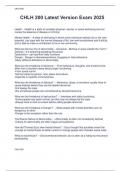
CHLH 200 Latest Version Exam 2025
Health - -Health is a state of complete physical, mental, or social well-being and not
merely the absence of disease or infirmity
Mental Health - -A state of well-being in which every individual realizes his or her own
potential, can cope with the normal stresses of life, can work productively and fruitfully,
and is able to make a contribution to his or her community.
What are the four D's of abnormality - -Deviance - Behave in ways outside the "norm."
Distress - It is bothering/upsetting the person
Dysfunction - can't perform daily functions
Danger - Danger to themselves/others. Engaging in risky behaviors.
-Many different definitions of abnormality
What are the limitations of deviance - --From behaviors, thoughts, and emotions that
differ from a society's ideas about proper functioning.
-From social norms
-Normal varies by person, time, place and culture.
-Depends on specific circumstances
What are the limitations of distress? - --Behaviors, ideas, or emotions usually have to
cause distress before they can be labeled abnormal
-Not always the case
-But sometimes people are not bothered by deviant behaviors.
What are the limitations of dysfunction? - --Interferes with daily functioning
-Some people may seem normal, but that may not always be the case
-Always have to look at context before calling people abnormal
What are the limitations of Danger? - --Most people with mental disorders are not
dangerous to other.
-Danger is the exception rather than the rule
The Elusive Nature of Abnormality - --Abnormality is often not consistently defined
-Criteria for abnormality are often vague and subjective
How did Thomas Szaz view mental illness? - -Szaz thought that societies invent the
concept of mental illness to better control or change people who threaten social order.
What is eccentricity? - -Unconventional behavior, but is seen as a hobby by the person
participating
CHLH 200
, CHLH 200
What is meant by the "elusive nature of abnormality?" - --It is difficult to distinguish
abnormal from eccentricity
What is treatment? - -The combating of a disease or illness
How was abnormality viewed during the Stone Age? - -Abnormal behavior = victory of
evil spirits
Treamtment = force the demons from the body through trephination and exorcism.
How was abnormality viewed by the Greeks and Romans? - -They were philosophers
and physicians
Hippocrates = "father of modern medicine"
Abnormal behavior = disease
Treatment = correct internal physical cause
How was abnormality viewed in Europe during the Middle Ages? - --500-1350 A.D.
-Abnormality was seen as a conflict between good and evil
-Treatment = rid the body of the devil
-At the close of the middle ages, demonology and its methods began to lose favor
-Medical perspective reemerged
How was abnormality viewed during the Renaissance period? - --1400 - 1700 A.D.
-Rise of asylums - institutions whose primary purpose was to care for the mentally ill
-Run by people who thought mental disorders were medical illnesses
-Intention was good care, but because of overcrowding they became virtual prisons.
The Nineteenth Century - Reform and Moral Treatment - --The treatment of people with
mental disorders began to improve
-Moral treatment = Sympathy and kindness; Freedom; sunlight rooms; Support; Advice
-At the end of the 19th century you saw a decline of moral treatment, because state
hospitals offered long term hospitilization
What is the somatagenic perspective? - --Abnormal functioning has physical causes
What is psychogenic perspective? - --Abnormal functioning has psychological causes
Current trends in how psychological problems are treated - --Outpatient care
-Medications
-De-institutionalization
-Prevention
-Positive psychology
-Multiculturalism
-Managed care programs
-Technology and cyber therapy
CHLH 200
CHLH 200 Latest Version Exam 2025
Health - -Health is a state of complete physical, mental, or social well-being and not
merely the absence of disease or infirmity
Mental Health - -A state of well-being in which every individual realizes his or her own
potential, can cope with the normal stresses of life, can work productively and fruitfully,
and is able to make a contribution to his or her community.
What are the four D's of abnormality - -Deviance - Behave in ways outside the "norm."
Distress - It is bothering/upsetting the person
Dysfunction - can't perform daily functions
Danger - Danger to themselves/others. Engaging in risky behaviors.
-Many different definitions of abnormality
What are the limitations of deviance - --From behaviors, thoughts, and emotions that
differ from a society's ideas about proper functioning.
-From social norms
-Normal varies by person, time, place and culture.
-Depends on specific circumstances
What are the limitations of distress? - --Behaviors, ideas, or emotions usually have to
cause distress before they can be labeled abnormal
-Not always the case
-But sometimes people are not bothered by deviant behaviors.
What are the limitations of dysfunction? - --Interferes with daily functioning
-Some people may seem normal, but that may not always be the case
-Always have to look at context before calling people abnormal
What are the limitations of Danger? - --Most people with mental disorders are not
dangerous to other.
-Danger is the exception rather than the rule
The Elusive Nature of Abnormality - --Abnormality is often not consistently defined
-Criteria for abnormality are often vague and subjective
How did Thomas Szaz view mental illness? - -Szaz thought that societies invent the
concept of mental illness to better control or change people who threaten social order.
What is eccentricity? - -Unconventional behavior, but is seen as a hobby by the person
participating
CHLH 200
, CHLH 200
What is meant by the "elusive nature of abnormality?" - --It is difficult to distinguish
abnormal from eccentricity
What is treatment? - -The combating of a disease or illness
How was abnormality viewed during the Stone Age? - -Abnormal behavior = victory of
evil spirits
Treamtment = force the demons from the body through trephination and exorcism.
How was abnormality viewed by the Greeks and Romans? - -They were philosophers
and physicians
Hippocrates = "father of modern medicine"
Abnormal behavior = disease
Treatment = correct internal physical cause
How was abnormality viewed in Europe during the Middle Ages? - --500-1350 A.D.
-Abnormality was seen as a conflict between good and evil
-Treatment = rid the body of the devil
-At the close of the middle ages, demonology and its methods began to lose favor
-Medical perspective reemerged
How was abnormality viewed during the Renaissance period? - --1400 - 1700 A.D.
-Rise of asylums - institutions whose primary purpose was to care for the mentally ill
-Run by people who thought mental disorders were medical illnesses
-Intention was good care, but because of overcrowding they became virtual prisons.
The Nineteenth Century - Reform and Moral Treatment - --The treatment of people with
mental disorders began to improve
-Moral treatment = Sympathy and kindness; Freedom; sunlight rooms; Support; Advice
-At the end of the 19th century you saw a decline of moral treatment, because state
hospitals offered long term hospitilization
What is the somatagenic perspective? - --Abnormal functioning has physical causes
What is psychogenic perspective? - --Abnormal functioning has psychological causes
Current trends in how psychological problems are treated - --Outpatient care
-Medications
-De-institutionalization
-Prevention
-Positive psychology
-Multiculturalism
-Managed care programs
-Technology and cyber therapy
CHLH 200