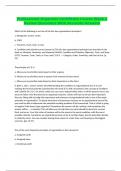
Professional Organizer Certificate Course Week 2
Review Questions With Accurate Answers
Which of the following is not one of the five key organizational principles?
a. Reorganize, review, revise
b. COPE
c. Treasures, trash, tools, or toys
d. Condition and calamity correct answer (a) The five key organizational principles are described in the
book as: Minimize, Maximize, and Maintain (MMM); Condition and Calamity; Objective, Tools, and Steps
(OTS); Treasure, Trash, Tools, or Toys; and C.O.P.E. — Category, Order, Proximity, and Ease of Use. [p.
54]
The principle of C & C:
a. Allows you to prioritize tasks based on their urgency
b. Allows you to prioritize areas or spaces from messiest to least messy
c. Allows you to prioritize tasks based on their importance to the client
d. Both a. and c. correct answer (d) Understanding the condition an organizational area is in and
realizing the level of potential calamity that will result if it is left unresolved is the concept of Condition
and Calamity Or C & C, for short), which you can use to help prioritize tasks. It will be easy for you to see
areas of clients' lives that need to be organized; however, clients will have to tell you how important
they are. Being able to judge the importance and relevance of organizational tasks is one of the major
principles of organization. To decide what level of importance to place on an organizational area of life,
you must be able to determine the potential resulting problems if left unresolved. That is: What is going
to happen if this doesn't get organized? Sometimes the answer will be: nothing. And sometimes the
answer will be — a calamity! This will allow you to help them see what should be done first, second,
third, and so on. Your first order of business will be the areas in the worst condition, with the worst
possible calamity. Sometimes an organizational area can be in terrible shape, but the potential calamity
is relatively minor. You can consider leaving these areas for a later time, and focusing on the biggest
concerns. [pp. 55-57]
One of the most important principles of organization is the concept of:
a. Assigned worth
b. Assigned value
c. Emotional worth
Review Questions With Accurate Answers
Which of the following is not one of the five key organizational principles?
a. Reorganize, review, revise
b. COPE
c. Treasures, trash, tools, or toys
d. Condition and calamity correct answer (a) The five key organizational principles are described in the
book as: Minimize, Maximize, and Maintain (MMM); Condition and Calamity; Objective, Tools, and Steps
(OTS); Treasure, Trash, Tools, or Toys; and C.O.P.E. — Category, Order, Proximity, and Ease of Use. [p.
54]
The principle of C & C:
a. Allows you to prioritize tasks based on their urgency
b. Allows you to prioritize areas or spaces from messiest to least messy
c. Allows you to prioritize tasks based on their importance to the client
d. Both a. and c. correct answer (d) Understanding the condition an organizational area is in and
realizing the level of potential calamity that will result if it is left unresolved is the concept of Condition
and Calamity Or C & C, for short), which you can use to help prioritize tasks. It will be easy for you to see
areas of clients' lives that need to be organized; however, clients will have to tell you how important
they are. Being able to judge the importance and relevance of organizational tasks is one of the major
principles of organization. To decide what level of importance to place on an organizational area of life,
you must be able to determine the potential resulting problems if left unresolved. That is: What is going
to happen if this doesn't get organized? Sometimes the answer will be: nothing. And sometimes the
answer will be — a calamity! This will allow you to help them see what should be done first, second,
third, and so on. Your first order of business will be the areas in the worst condition, with the worst
possible calamity. Sometimes an organizational area can be in terrible shape, but the potential calamity
is relatively minor. You can consider leaving these areas for a later time, and focusing on the biggest
concerns. [pp. 55-57]
One of the most important principles of organization is the concept of:
a. Assigned worth
b. Assigned value
c. Emotional worth