

Hoorcollege 3:
CPU rotation: order of actions that you can perform that will lead to a certain result. The rotation of
a CPU is the “elementary cycles”, how it performs.
The CPU will go through this list of micro-instructions. Step for step the process of how information
travels.
We separate the ‘instruction counter’ into two components -> 1. The program counter: holding an
address and incrementing that all the time 2. Instruction pointer: handles the next address, the next
address can come from program counter or branch prediction.
A task is a list of operations. Cycle: is a rotation of instructions for 1 operation. Operation: (ordered)
list of instructions to transform a datum. Tick: single task ( one micro-instruction). Rotations is
measured in ticks (clock sequence) -> timing diagram. Micro-instruction: one execution of one
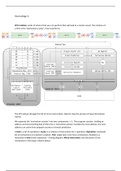
component in the larger scheme above.
,On the high-level you have a task. The task contains certain operations. The operation are matched
with certain instructions that are in the instructions set of the CPU. The CPU doesn’t understand the
list of operations, what it does understand is moving data from the memory to a certain register and
(e.g. subtracting or adding (arithmetic operations)) on what is standing in the register (for example in
the assembler number a or b) . This will end up in a result, and this result will be stored in the
accumulation register. The accumulator is a register in which intermediate arithmetic and
logic results are stored. The content of the accumulation register can be put back again into the
memory. This bit says the place where the content is stored in the memory. So we fetched two data
items from the memory than we do the subtraction and then we have a result which need to land
somewhere in the memory again.
The last step, is to move the content into of what we already put into the memory from the results,
we put them I consecutive (opeenvolgende) places into the memory.
Each of these instructions is composed (samengesteld) into micro-instructions. Step by Step:
program counter is increment by 1, then move the content from the program counter into the
instruction pointer which is basically a address for example the first line; mov 0x0000 1A00 is the
address, putting this into the address buffer, than we wait for the memory to return it’s information,
we get the return from the data bus moving that into the instruction register, decoding what is in
the instruction register, than executing the instruction, than moving the result into the HL register
(High-low register) , than moving the result back into the memory again.
, How do you get information from the memory? – Memory Lookup:
The memory access sequence (volgorde), no matter if you want to retrieve data of instructions, we
count as T (ticks), so one clock tick.
1 tick that moves the address from the instruction pointer or HL into the address register. That puts
the address on the address bus, it first check if the information is stored in the cache, if so it will
retrieve the information directly without checking the memory, if not it will continue the journey in
the figure below, it will forward the address to the memory that will access the memory controller
where it does it’s decoding, than you have the latency meaning that this is the time it takes for the
memory to pick one item from the memory cell and retrieve it, this retrieved content either
instruction or content is put on the data bus but before it sends on the control bus that it found the
piece of information; the address you were looking for, so this displays one memory access cycle.
This piece of information then ends up in one of the data registers, in the stack pointer we need in
order to control the stack or it can also return the piece of information to the instruction register to
perform instructions now.
CPU rotation: order of actions that you can perform that will lead to a certain result. The rotation of
a CPU is the “elementary cycles”, how it performs.
The CPU will go through this list of micro-instructions. Step for step the process of how information
travels.
We separate the ‘instruction counter’ into two components -> 1. The program counter: holding an
address and incrementing that all the time 2. Instruction pointer: handles the next address, the next
address can come from program counter or branch prediction.
A task is a list of operations. Cycle: is a rotation of instructions for 1 operation. Operation: (ordered)
list of instructions to transform a datum. Tick: single task ( one micro-instruction). Rotations is
measured in ticks (clock sequence) -> timing diagram. Micro-instruction: one execution of one
component in the larger scheme above.
,On the high-level you have a task. The task contains certain operations. The operation are matched
with certain instructions that are in the instructions set of the CPU. The CPU doesn’t understand the
list of operations, what it does understand is moving data from the memory to a certain register and
(e.g. subtracting or adding (arithmetic operations)) on what is standing in the register (for example in
the assembler number a or b) . This will end up in a result, and this result will be stored in the
accumulation register. The accumulator is a register in which intermediate arithmetic and
logic results are stored. The content of the accumulation register can be put back again into the
memory. This bit says the place where the content is stored in the memory. So we fetched two data
items from the memory than we do the subtraction and then we have a result which need to land
somewhere in the memory again.
The last step, is to move the content into of what we already put into the memory from the results,
we put them I consecutive (opeenvolgende) places into the memory.
Each of these instructions is composed (samengesteld) into micro-instructions. Step by Step:
program counter is increment by 1, then move the content from the program counter into the
instruction pointer which is basically a address for example the first line; mov 0x0000 1A00 is the
address, putting this into the address buffer, than we wait for the memory to return it’s information,
we get the return from the data bus moving that into the instruction register, decoding what is in
the instruction register, than executing the instruction, than moving the result into the HL register
(High-low register) , than moving the result back into the memory again.
, How do you get information from the memory? – Memory Lookup:
The memory access sequence (volgorde), no matter if you want to retrieve data of instructions, we
count as T (ticks), so one clock tick.
1 tick that moves the address from the instruction pointer or HL into the address register. That puts
the address on the address bus, it first check if the information is stored in the cache, if so it will
retrieve the information directly without checking the memory, if not it will continue the journey in
the figure below, it will forward the address to the memory that will access the memory controller
where it does it’s decoding, than you have the latency meaning that this is the time it takes for the
memory to pick one item from the memory cell and retrieve it, this retrieved content either
instruction or content is put on the data bus but before it sends on the control bus that it found the
piece of information; the address you were looking for, so this displays one memory access cycle.
This piece of information then ends up in one of the data registers, in the stack pointer we need in
order to control the stack or it can also return the piece of information to the instruction register to
perform instructions now.


