

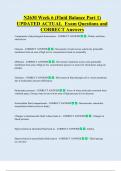
N2630 Week 6 (Fluid Balance Part 1)
UPDATED ACTUAL Exam Questions and
CORRECT Answers
Components of physiological homeostasis - CORRECT ANSWER - Fluids, acid-base,
electrolytes
Osmosis - CORRECT ANSWER - Movement of water across selectively permeable
membrane from an area of high to low concentration based on osmolality
Diffusion - CORRECT ANSWER - Movement of particles across semi-permeable
membrane from area of high to low concentration (passive or active for electrolytes using ion
pumps)
Filtration - CORRECT ANSWER - Movement of fluid through cell or vessel membrane
due to hydrostatic pressure differences
Hydrostatic pressure - CORRECT ANSWER - Force of water molecules outwards from
confined space, forcing water to move from area of high pressure to low pressure
Extracellular fluid compartments - CORRECT ANSWER - Intravascular, interstitial,
transcellular (fluid cavities in body)
Changes in intramuscular fluid volume leads to - CORRECT ANSWER - Changes in
blood pressure
Hypervolemia in interstitial fluid leads to - CORRECT ANSWER - Edema
Hypervolemia in transcellular fluid leads to - CORRECT ANSWER - Third spacing
(ex.Ascites)
, Role of hypothalamus in fluid regulation - CORRECT ANSWER - Stimulates/inhibits
desire to drink
Renin-Angiotensin-Aldosterone System (RAAS)—fluid regulation - CORRECT
ANSWER - decrease in perfusion to kidneys leads to renin release—> renin converts
angiotensin—>angiotensin I to angiotensin II in lungs—> angiotensin II leads to
vasoconstriction, stimulates thirst, stimulates aldosterone to retain water and N
What inhibits the RAAS system and when - CORRECT ANSWER - In state of fluid
volume overload Atrial Natriuretic Peptide (ANP) inhibits this system when in state of overload
Role of ADH in fluid regulation - CORRECT ANSWER - Stimulates water retention by
kidneys
What leads to the release of ADH? - CORRECT ANSWER - Changes in blood osmolality
stimulate ADH release from pituitary
Routes of fluid intake - CORRECT ANSWER - Oral, tube feed, IV
Routes of fluid outake - CORRECT ANSWER - GIRLS—-GI losses, Intravascular fluid
loss, Renal (urine), Lungs (expiration), Skin (sweating)
Hypovolemia - CORRECT ANSWER - Fluid volume deficit due to fluid shifting out of
Intravascular space
Hypervolemia - CORRECT ANSWER - Fluid volume overload due to fluid retention in
Intravascular space
Causes of hypovolemia - CORRECT ANSWER - Insufficient intake, excessive loss, or
fluids shifts—third spacing
UPDATED ACTUAL Exam Questions and
CORRECT Answers
Components of physiological homeostasis - CORRECT ANSWER - Fluids, acid-base,
electrolytes
Osmosis - CORRECT ANSWER - Movement of water across selectively permeable
membrane from an area of high to low concentration based on osmolality
Diffusion - CORRECT ANSWER - Movement of particles across semi-permeable
membrane from area of high to low concentration (passive or active for electrolytes using ion
pumps)
Filtration - CORRECT ANSWER - Movement of fluid through cell or vessel membrane
due to hydrostatic pressure differences
Hydrostatic pressure - CORRECT ANSWER - Force of water molecules outwards from
confined space, forcing water to move from area of high pressure to low pressure
Extracellular fluid compartments - CORRECT ANSWER - Intravascular, interstitial,
transcellular (fluid cavities in body)
Changes in intramuscular fluid volume leads to - CORRECT ANSWER - Changes in
blood pressure
Hypervolemia in interstitial fluid leads to - CORRECT ANSWER - Edema
Hypervolemia in transcellular fluid leads to - CORRECT ANSWER - Third spacing
(ex.Ascites)
, Role of hypothalamus in fluid regulation - CORRECT ANSWER - Stimulates/inhibits
desire to drink
Renin-Angiotensin-Aldosterone System (RAAS)—fluid regulation - CORRECT
ANSWER - decrease in perfusion to kidneys leads to renin release—> renin converts
angiotensin—>angiotensin I to angiotensin II in lungs—> angiotensin II leads to
vasoconstriction, stimulates thirst, stimulates aldosterone to retain water and N
What inhibits the RAAS system and when - CORRECT ANSWER - In state of fluid
volume overload Atrial Natriuretic Peptide (ANP) inhibits this system when in state of overload
Role of ADH in fluid regulation - CORRECT ANSWER - Stimulates water retention by
kidneys
What leads to the release of ADH? - CORRECT ANSWER - Changes in blood osmolality
stimulate ADH release from pituitary
Routes of fluid intake - CORRECT ANSWER - Oral, tube feed, IV
Routes of fluid outake - CORRECT ANSWER - GIRLS—-GI losses, Intravascular fluid
loss, Renal (urine), Lungs (expiration), Skin (sweating)
Hypovolemia - CORRECT ANSWER - Fluid volume deficit due to fluid shifting out of
Intravascular space
Hypervolemia - CORRECT ANSWER - Fluid volume overload due to fluid retention in
Intravascular space
Causes of hypovolemia - CORRECT ANSWER - Insufficient intake, excessive loss, or
fluids shifts—third spacing


