

Comparison of Approaches
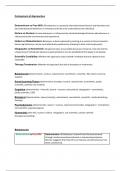
Determinism vs Free Will: All behaviour is caused by internal/external factors and therefore can
be predicted vs all behaviour is voluntary and free to be controlled by the individual.
Nature vs Nurture: Human behaviour is influenced by inherited biological factors vs behaviour is
influenced by the environment and experience.
Holism vs Reductionism: Behaviour is best explained by looking at a variety of interconnected
factors vs behaviour can be most effectively explained by breaking it down into simple parts.
Idiographic vs Nomothetic: No general laws are possible because of chance, free will and the
uniqueness of individuals vs laws or generalisations can be established that apply to all people.
Scientific Credibility: Whether the approach uses scientific methods that are objective and
replicable.
Therapy Treatments: Whether the approach has led to therapies or treatments.
Behaviourist (deterministic, nurture, reductionist, nomothetic, scientific, SD, token economy
system)
Social Learning Theory (deterministic (mostly), nurture, reductionist, nomothetic, partly
scientific, positive role models)
Cognitive (deterministic + free will, nature + nurture, reductionist, idiographic + nomothetic,
partly scientific, CBT)
Biological (deterministic, nature (mostly), reductionist, nomothetic, scientific, medication/drug
therapy)
Psychodynamic (deterministic, nature + nurture, reductionist (mostly), idiographic + nomothetic,
not scientific, psychoanalysis)
Humanistic (free will, nurture, holism, idiographic, not scientific, person centred
therapy/counselling)
Behaviourist
Determinism vs Free Will Deterministic: All behaviour is learnt from the environment
through reinforcement/punishment or learned associations.
Skinner suggests that free will is an illusion and all behaviour has
been conditioned.
, Nature vs Nurture Nurture: Suggests we are blank slates, and all behaviour comes
from our environment (nurture) through reinforcement and
association.
Holism vs Reductionism Reductionist: Complex behaviour is broken up into units of
stimulus and response to aid lab testing.
Idiographic vs Nomothetic Nomothetic: Creates universal laws as it suggests all human
behaviour is due to stimulus-response associations.
Scientific Credibility Scientific: Objective measures have been used to create
concepts (Skinner’s rats and Pavlov’s dogs) which have a high
degree of replicability.
Therapy Treatments Classical conditioning -> Systematic De-sensitisation – counter
conditioning those with phobias to reassociate the phobic
stimulus with a new learned response (to be calm).
Operant conditioning -> Token Economy System – rewards
positive behaviour.
Social Learning Theory
Determinism vs Free Will Mostly deterministic: Reciprocal Determinism – behaviour is
largely a product of our experience as we observe others
(vicarious learning).
However, mediational processes suggest we have an element of
free will.
Nature vs Nurture Nurture: Suggests we are blank slates, and all behaviour comes
from our environment (nurture) through social contexts –
imitation and observation.
Holism vs Reductionism Reductionist: Complex behaviour is broken up into a handful of
key processes (imitation, modelling etc.).
Idiographic vs Nomothetic Nomothetic: Attempts to establish general rules for human
behaviour e.g., vicarious reinforcement.
Scientific Credibility Partly scientific: Objective measures have been used to create
controlled observation, but elements such as mediational
processes require inferences to be drawn.
Therapy Treatments Use of positive role models
Cognitive
Determinism vs Free Will Both: Our past experiences influence our thoughts (schemas) and
thought processes which determine our behaviour – we have a
degree of control, but it is limited by what we know.
Nature vs Nurture Both: Many of our information processing abilities and schemas
are innate (nature) but they are constantly refined through our
experience (nurture).
Holism vs Reductionism Reductionist: Machine Reductionism – presents people as
information processing systems and ignores the role of emotion in
behaviour.
Determinism vs Free Will: All behaviour is caused by internal/external factors and therefore can
be predicted vs all behaviour is voluntary and free to be controlled by the individual.
Nature vs Nurture: Human behaviour is influenced by inherited biological factors vs behaviour is
influenced by the environment and experience.
Holism vs Reductionism: Behaviour is best explained by looking at a variety of interconnected
factors vs behaviour can be most effectively explained by breaking it down into simple parts.
Idiographic vs Nomothetic: No general laws are possible because of chance, free will and the
uniqueness of individuals vs laws or generalisations can be established that apply to all people.
Scientific Credibility: Whether the approach uses scientific methods that are objective and
replicable.
Therapy Treatments: Whether the approach has led to therapies or treatments.
Behaviourist (deterministic, nurture, reductionist, nomothetic, scientific, SD, token economy
system)
Social Learning Theory (deterministic (mostly), nurture, reductionist, nomothetic, partly
scientific, positive role models)
Cognitive (deterministic + free will, nature + nurture, reductionist, idiographic + nomothetic,
partly scientific, CBT)
Biological (deterministic, nature (mostly), reductionist, nomothetic, scientific, medication/drug
therapy)
Psychodynamic (deterministic, nature + nurture, reductionist (mostly), idiographic + nomothetic,
not scientific, psychoanalysis)
Humanistic (free will, nurture, holism, idiographic, not scientific, person centred
therapy/counselling)
Behaviourist
Determinism vs Free Will Deterministic: All behaviour is learnt from the environment
through reinforcement/punishment or learned associations.
Skinner suggests that free will is an illusion and all behaviour has
been conditioned.
, Nature vs Nurture Nurture: Suggests we are blank slates, and all behaviour comes
from our environment (nurture) through reinforcement and
association.
Holism vs Reductionism Reductionist: Complex behaviour is broken up into units of
stimulus and response to aid lab testing.
Idiographic vs Nomothetic Nomothetic: Creates universal laws as it suggests all human
behaviour is due to stimulus-response associations.
Scientific Credibility Scientific: Objective measures have been used to create
concepts (Skinner’s rats and Pavlov’s dogs) which have a high
degree of replicability.
Therapy Treatments Classical conditioning -> Systematic De-sensitisation – counter
conditioning those with phobias to reassociate the phobic
stimulus with a new learned response (to be calm).
Operant conditioning -> Token Economy System – rewards
positive behaviour.
Social Learning Theory
Determinism vs Free Will Mostly deterministic: Reciprocal Determinism – behaviour is
largely a product of our experience as we observe others
(vicarious learning).
However, mediational processes suggest we have an element of
free will.
Nature vs Nurture Nurture: Suggests we are blank slates, and all behaviour comes
from our environment (nurture) through social contexts –
imitation and observation.
Holism vs Reductionism Reductionist: Complex behaviour is broken up into a handful of
key processes (imitation, modelling etc.).
Idiographic vs Nomothetic Nomothetic: Attempts to establish general rules for human
behaviour e.g., vicarious reinforcement.
Scientific Credibility Partly scientific: Objective measures have been used to create
controlled observation, but elements such as mediational
processes require inferences to be drawn.
Therapy Treatments Use of positive role models
Cognitive
Determinism vs Free Will Both: Our past experiences influence our thoughts (schemas) and
thought processes which determine our behaviour – we have a
degree of control, but it is limited by what we know.
Nature vs Nurture Both: Many of our information processing abilities and schemas
are innate (nature) but they are constantly refined through our
experience (nurture).
Holism vs Reductionism Reductionist: Machine Reductionism – presents people as
information processing systems and ignores the role of emotion in
behaviour.


