

TCI Written Test Review (2025) ACTUAL EXAM COMPREHENSIVE
TCI Written Test Review
QUESTIONS AND VERIFIED ACCURATE SOLUTION (DETAILED &
Study online at https://quizlet.com/_fe3nx1
ELABORATED) |GET IT 100% ACCURATE!! 2025 TEST!!
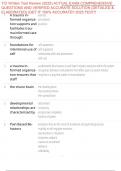
1. A trauma in- -policies
formed organiza- -procedures
tion supports and -practices
facilitates trau-
ma informed care
through:
2. foundations for -self-awareness
intentional use of -self-regulation
self -relationship skills and attunement
-self-care
3. a trauma in- -understands what trauma is and how it impacts everyone within the system
formed organiza- -recognizes behaviors and patterns that reflect past or present trauma
tion ensures that -respond in a way that avoids re-traumatization
staff
4. the triune brain -the thinking brain
-the emotional brain
-the survival brain
5. developmental -attachment
relationships are -reciprocity
characterized by -progressive complexity
-balance of power
6. Pain Based Be- -behaviors that are the result of emotional and psychological pain
haviors -inability to self-regulate emotions
-overreaction to situations
-impulsive outburst
-trauma re-enactment
-defiance
-inflexibility
1/8
, TCI Written Test Review
Study online at https://quizlet.com/_fe3nx1
-running away through anger or fear
-self-injury
-withdrawal
7. The TCI system -prevent crisis from occurring
assists organiza- -de-escalate potential crisis
tions to -manage acute physical behavior
-reduce potential and actual injury to children and staff
-teach children emotional regulation skills and coping strategies
-develop a learning organization
8. a crisis occurs A child's fight, flight or freeze response is activated and they are unable to regulate
when their emotions and behaviors
9. Therapeutic Mi- The combination of people, emotions, attitudes, and objects that create a sense of
lieu safety, respect, belonging, care, and accountability.
10. Goals of Crisis In- -support: providing immediate emotional and environmental support to reduce
tervention stress and risk and increase the child's sense of safety
-teach: help children learn and practice ways to regulate their emotions and
behaviors
11. Spaces within the Ideological, Physical, Cultural, Social, Emotional
therapeutic mi-
lieu
12. stress model of Baseline
crisis Triggering event,
Escalation phase,
Outburst crisis,
Recovery.
2/8
TCI Written Test Review
QUESTIONS AND VERIFIED ACCURATE SOLUTION (DETAILED &
Study online at https://quizlet.com/_fe3nx1
ELABORATED) |GET IT 100% ACCURATE!! 2025 TEST!!
1. A trauma in- -policies
formed organiza- -procedures
tion supports and -practices
facilitates trau-
ma informed care
through:
2. foundations for -self-awareness
intentional use of -self-regulation
self -relationship skills and attunement
-self-care
3. a trauma in- -understands what trauma is and how it impacts everyone within the system
formed organiza- -recognizes behaviors and patterns that reflect past or present trauma
tion ensures that -respond in a way that avoids re-traumatization
staff
4. the triune brain -the thinking brain
-the emotional brain
-the survival brain
5. developmental -attachment
relationships are -reciprocity
characterized by -progressive complexity
-balance of power
6. Pain Based Be- -behaviors that are the result of emotional and psychological pain
haviors -inability to self-regulate emotions
-overreaction to situations
-impulsive outburst
-trauma re-enactment
-defiance
-inflexibility
1/8
, TCI Written Test Review
Study online at https://quizlet.com/_fe3nx1
-running away through anger or fear
-self-injury
-withdrawal
7. The TCI system -prevent crisis from occurring
assists organiza- -de-escalate potential crisis
tions to -manage acute physical behavior
-reduce potential and actual injury to children and staff
-teach children emotional regulation skills and coping strategies
-develop a learning organization
8. a crisis occurs A child's fight, flight or freeze response is activated and they are unable to regulate
when their emotions and behaviors
9. Therapeutic Mi- The combination of people, emotions, attitudes, and objects that create a sense of
lieu safety, respect, belonging, care, and accountability.
10. Goals of Crisis In- -support: providing immediate emotional and environmental support to reduce
tervention stress and risk and increase the child's sense of safety
-teach: help children learn and practice ways to regulate their emotions and
behaviors
11. Spaces within the Ideological, Physical, Cultural, Social, Emotional
therapeutic mi-
lieu
12. stress model of Baseline
crisis Triggering event,
Escalation phase,
Outburst crisis,
Recovery.
2/8


