
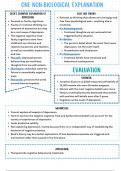
One Non-Biological Explanation
Beck’s cognitive explanation of Ellis’ abc theory:
depression: Rational as thinking that allows us to be happy and
Focused on faulty cognitions. free from psychological pain - anything else is
Faulty or irrational thinking is a irrational.
symptom of depression but may A - Activating event:
be a root cause of depression. Irrational thoughts are not automatic but
The negative cognitive triad - triggered by the situation.
faulty cognitions stem from B - Beliefs:
childhood via criticism and The person’s belief about the event that cause
rejection by parents and teachers depression, not the event itself.
as well as unrealistic expectations Musterbation and utopianism
and loss. C - Consequences:
The self - depressed person Irrational beliefs have emotional and
believes they are worthless, behavioural consequences.
thoughts from low self-esteem.
The future - individual views the
future in unavoidably negative Evaluation
ways.
strength:
The world - perceives the world
Jonathon Evans et al 2005 measured self-beliefs of
around them as hopeless.
12,003 women who were 18 weeks pregnant.
Women with the most negative beliefs were more
likely to eventually become depressed that women
with positive self-beliefs even after 3 years.
Cognition as the onset of depression.
weaknesses:
Cannot explain all aspects of depression.
Hard to see how the negative cognitive triad and dysfunctional beliefs can account for the
variety of experiences of depression.
Lacks predictive validity.
Not explaining depression, mainly because there is no independent way of establishing the
existence of negative schemas.
Beck’s theory may be a better explanation of how depressive episodes are triggered and
maintained rather than caused in the first place.
application:
Therapies like cognitive behavioural treatment.
Beck’s cognitive explanation of Ellis’ abc theory:
depression: Rational as thinking that allows us to be happy and
Focused on faulty cognitions. free from psychological pain - anything else is
Faulty or irrational thinking is a irrational.
symptom of depression but may A - Activating event:
be a root cause of depression. Irrational thoughts are not automatic but
The negative cognitive triad - triggered by the situation.
faulty cognitions stem from B - Beliefs:
childhood via criticism and The person’s belief about the event that cause
rejection by parents and teachers depression, not the event itself.
as well as unrealistic expectations Musterbation and utopianism
and loss. C - Consequences:
The self - depressed person Irrational beliefs have emotional and
believes they are worthless, behavioural consequences.
thoughts from low self-esteem.
The future - individual views the
future in unavoidably negative Evaluation
ways.
strength:
The world - perceives the world
Jonathon Evans et al 2005 measured self-beliefs of
around them as hopeless.
12,003 women who were 18 weeks pregnant.
Women with the most negative beliefs were more
likely to eventually become depressed that women
with positive self-beliefs even after 3 years.
Cognition as the onset of depression.
weaknesses:
Cannot explain all aspects of depression.
Hard to see how the negative cognitive triad and dysfunctional beliefs can account for the
variety of experiences of depression.
Lacks predictive validity.
Not explaining depression, mainly because there is no independent way of establishing the
existence of negative schemas.
Beck’s theory may be a better explanation of how depressive episodes are triggered and
maintained rather than caused in the first place.
application:
Therapies like cognitive behavioural treatment.


