
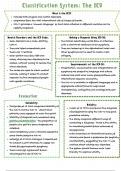
Classification System: The ICD
What is the ICD?
Includes both physical and mental disorders.
Originated from the 1893 International List of Causes Of Death.
ICD-11 provides a ‘common language’ so that data collected in different countries can be
usefully compared.
Mental Disorders and the ICD Code: Making a Diagnosis Using ICD-10:
Each disorder has a code, starting The clinician selects key words from an interview
with F. with a client that relates to their symptoms.
They are listed consecutively and They are looked up in the alphabetical index and
there are 11 sections. other symptoms can be used to create a sub-
Each section has a few left over category.
codes, allowing new disorders to be
added, without having to recode the
Improvements of the ICD-10:
other disorders. Presentation, communication and interpretation of
The codes are used to index medical symptoms are shaped by language and culture.
records, making it easier to conduct Culture bias could occur which poses problems with
research to find examples of people international research community.
with specific conditions. The ICD-10 is available in different languages and in
appropriate cultural forms to help reveal
inconsistencies, ambiguities and overlaps between
disorders.
Evaluation
Reliability:
Validity:
Ponizovsky et al 2006 compared reliability of
Mason et al 1997 have shown the diagnosis
the ICD-9 and the ICD-10 - about 3000
of schizophrenia using the ICD-10 has good
patients were assessed at each time point.
predictive validity.
Stability of diagnosis was measured using
The study compared different ways of
positive predictive value - the proportion of
conducting a diagnosis - there is the ability
people who get the same diagnosis are
to accurately predict future outcomes of
retested.
schizophrenia.
Good consistency when 2 clinicians assess the
WHO conducted an international survey of
same clients using the ICD-10.
clinicians and found a preference for simplicity
Galeazzi et al 2004 arranged 2 researchers
and flexibility, suggesting the ICD-11 was
to conduct a joint interview to assess 100
cautious about adding new disorders.
clients for psychosomatic symptoms.
The system should become more ‘user-
There was high agreement shown -
friendly’ to improve validity.
encourages the use of ICD-10.
What is the ICD?
Includes both physical and mental disorders.
Originated from the 1893 International List of Causes Of Death.
ICD-11 provides a ‘common language’ so that data collected in different countries can be
usefully compared.
Mental Disorders and the ICD Code: Making a Diagnosis Using ICD-10:
Each disorder has a code, starting The clinician selects key words from an interview
with F. with a client that relates to their symptoms.
They are listed consecutively and They are looked up in the alphabetical index and
there are 11 sections. other symptoms can be used to create a sub-
Each section has a few left over category.
codes, allowing new disorders to be
added, without having to recode the
Improvements of the ICD-10:
other disorders. Presentation, communication and interpretation of
The codes are used to index medical symptoms are shaped by language and culture.
records, making it easier to conduct Culture bias could occur which poses problems with
research to find examples of people international research community.
with specific conditions. The ICD-10 is available in different languages and in
appropriate cultural forms to help reveal
inconsistencies, ambiguities and overlaps between
disorders.
Evaluation
Reliability:
Validity:
Ponizovsky et al 2006 compared reliability of
Mason et al 1997 have shown the diagnosis
the ICD-9 and the ICD-10 - about 3000
of schizophrenia using the ICD-10 has good
patients were assessed at each time point.
predictive validity.
Stability of diagnosis was measured using
The study compared different ways of
positive predictive value - the proportion of
conducting a diagnosis - there is the ability
people who get the same diagnosis are
to accurately predict future outcomes of
retested.
schizophrenia.
Good consistency when 2 clinicians assess the
WHO conducted an international survey of
same clients using the ICD-10.
clinicians and found a preference for simplicity
Galeazzi et al 2004 arranged 2 researchers
and flexibility, suggesting the ICD-11 was
to conduct a joint interview to assess 100
cautious about adding new disorders.
clients for psychosomatic symptoms.
The system should become more ‘user-
There was high agreement shown -
friendly’ to improve validity.
encourages the use of ICD-10.


